Premise or Premises: What’s the Difference and Which One Should You Use?
Premise or Premises: What’s the Difference and Which One Should You Use?
Introduction
English contains many words that change meaning when they shift from singular to plural. One pair that often confuses writers, students, and professionals is premise and premises. Although they look almost identical, they are not always interchangeable. Choosing the wrong form can change the meaning of your sentence and make your writing less precise.
If you have ever wondered whether you should use premise or premises, this comprehensive guide will explain the difference, meanings, examples, common mistakes, and proper usage in both everyday and professional writing.
Quick Answer
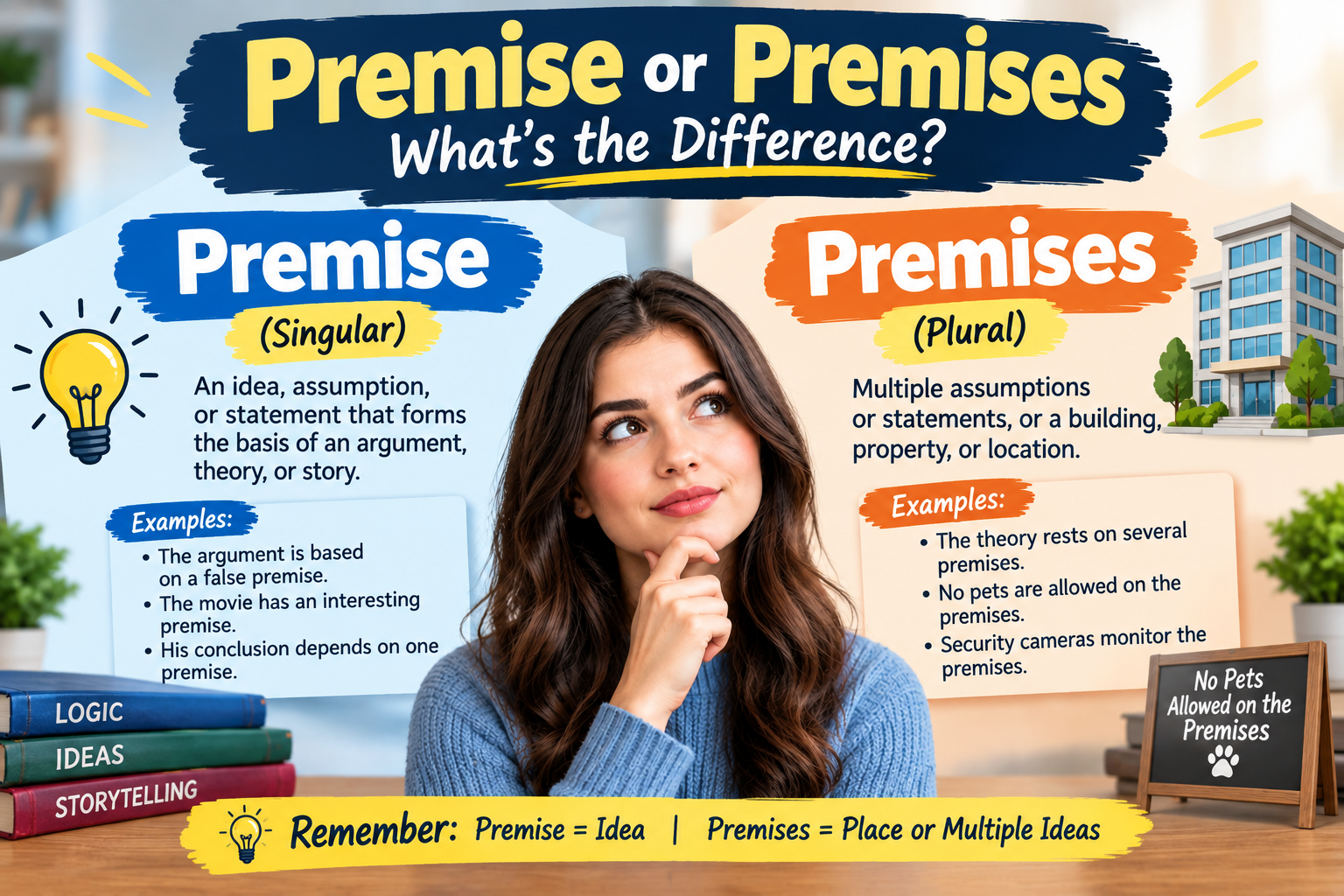
The difference is simple:
- Premise = Singular
- Premises = Plural
However, the meanings can vary depending on context.
Examples
✅ The argument is based on a false premise.
✅ Employees are not allowed to smoke on the company premises.
In the first example, premise refers to an idea or assumption.
In the second example, premises refers to a building or property.
Understanding this distinction is the key to using these words correctly.
What Does “Premise” Mean?
A premise is an idea, statement, assumption, or proposition that forms the basis of an argument, theory, or conclusion.
It is commonly used in:
- Logic
- Philosophy
- Academic writing
- Debates
- Business discussions
- Storytelling
Examples
- His conclusion was based on a faulty premise.
- The entire argument depends on a single premise.
- The movie has an interesting premise.
- The research starts with the premise that climate conditions are changing.
In each example, a premise is the foundational idea upon which something else is built.
What Does “Premises” Mean?
The word premises can simply be the plural of premise, meaning multiple assumptions or statements.
Examples
- The argument contains several important premises.
- Both premises must be true for the conclusion to be valid.
In logic and reasoning, premises means multiple foundational statements.
However, there is another very common meaning.
Premises as Property or Buildings
In business, legal, and everyday contexts, premises often refers to a building, land, or property.
Examples
- No pets are allowed on the premises.
- Security cameras monitor the entire premises.
- Visitors must leave the premises by 6 p.m.
- The company owns several commercial premises.
This meaning is extremely common in contracts, signs, and workplace policies.
Premise in Storytelling
One of the most popular modern uses of premise is in books, movies, television shows, and video games.
A story premise is the central idea around which the plot is built.
Examples
- The film’s premise is unique and engaging.
- The novel has a fascinating premise.
- The show’s premise involves time travel.
Example Story Premise
“A young scientist discovers a machine that allows communication with future generations.”
This sentence describes the basic concept of the story.
Premise in Logic and Reasoning
In logic, a premise is a statement used to support a conclusion.
Example
Premise 1: All humans are mortal.
Premise 2: Sarah is human.
Conclusion: Sarah is mortal.
Here, the conclusion is based on two premises.
Without valid premises, the conclusion may be unreliable.
Why Is “Premises” Used for Buildings?
Many people wonder why a singular building is often called premises.
The reason comes from legal and historical usage.
Originally, the term referred to all the land, structures, and property associated with a location. Over time, the plural form became standard even when referring to a single property.
Examples
- The premises are protected by security guards.
- Smoking is prohibited on these premises.
- Unauthorized persons must leave the premises immediately.
Even when referring to one building, English typically uses premises rather than premise.
Premise vs Premises: Side-by-Side Comparison
| Word | Meaning | Example |
|---|---|---|
| Premise | A single assumption, idea, or statement | The argument relies on one premise. |
| Premises | Multiple assumptions or statements | The theory rests on several premises. |
| Premises | A building, property, or land | Visitors must leave the premises. |
This table highlights why context is important.
Common Mistakes
Mistake 1: Using Premise for Property
❌ Smoking is prohibited on the premise.
✅ Smoking is prohibited on the premises.
When referring to a building or property, use premises.
Mistake 2: Using Premises for a Single Assumption
❌ The argument is based on one premises.
✅ The argument is based on one premise.
A single assumption requires the singular form.
Mistake 3: Confusing Story Premise with Property
❌ The movie premises was interesting.
✅ The movie premise was interesting.
A story uses a premise, not premises.
Examples in Everyday Sentences
Using Premise
- The author’s premise is thought-provoking.
- Her argument rests on a questionable premise.
- The business plan is based on a strong premise.
- The film succeeds because of its original premise.
Using Premises
- The lawyer challenged the premises of the argument.
- Several premises support the conclusion.
- Security officers patrol the premises daily.
- Customers must remain off restricted premises.
Premise vs Assumption
Many people use these words interchangeably, but they are not identical.
Assumption
Something accepted without proof.
Premise
A statement intentionally used to support an argument.
Example
Assumption:
- I assume it will rain today.
Premise:
- The forecast predicts rain; therefore, we should cancel the event.
A premise is generally more structured and logical.
Professional and Business Usage
In business writing, you will often encounter both meanings.
Strategic Planning
- The company’s growth strategy is based on a simple premise.
Workplace Policies
- Employees must remain on the premises during emergencies.
Because both forms appear frequently in professional communication, understanding the distinction is essential.
Memory Trick
A simple way to remember the difference:
Premise = Idea
Think:
One idea = one premise
Premises = Place or Multiple Ideas
Think:
Property has many parts, so use premises
This easy trick can help you choose the correct word every time.
Frequently Asked Questions
Is premise singular or plural?
Premise is singular.
What is the plural of premise?
Premises.
Is a building called a premise or premises?
The correct term is usually premises.
What is a story premise?
A story premise is the central idea or concept around which a story is built.
Can premises mean assumptions?
Yes. In logic and reasoning, premises are multiple assumptions or statements supporting a conclusion.
Conclusion
The difference between premise and premises is straightforward once you understand the context. Premise is the singular form and refers to an idea, assumption, or foundational statement. Premises is either the plural form of premise or a term used to describe a building, property, or location.
Whether you are writing an academic paper, creating a business report, discussing a movie, or reading a legal document, using the correct word improves clarity and professionalism. Remember: a single idea is a premise, multiple ideas are premises, and a property is almost always referred to as the premises.