Any Time or Anytime: Which Is Correct?
Any Time or Anytime: Which Is Correct?
Have you ever wondered whether to write “any time” or “anytime”? Both expressions are commonly used in English, and they look almost identical. However, they are not always interchangeable. Understanding the difference can help you write more clearly and avoid common grammar mistakes.
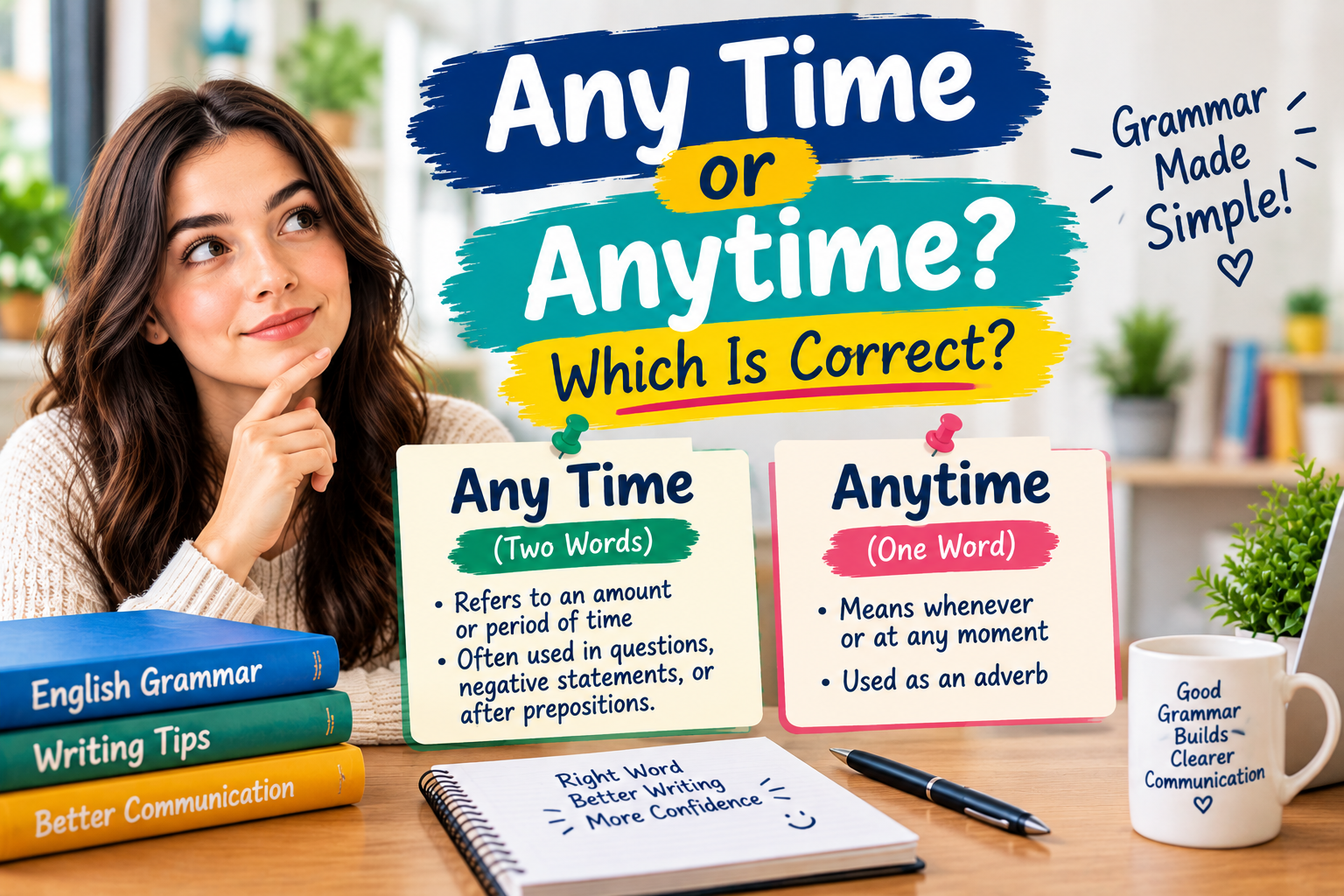
The good news is that both “any time” and “anytime” are correct, but they are used in different situations. “Any time” is generally used when referring to an unspecified amount of time, while “anytime” is an adverb meaning whenever or at any moment.
In this guide, you will learn the difference between any time and anytime, discover how to use each expression correctly, and explore practical examples to improve your English writing.
Any Time or Anytime: The Correct Answer
Both “any time” and “anytime” are correct in standard American English. The appropriate choice depends on the meaning and grammatical structure of your sentence.
“Any time,” written as two words, is a noun phrase that refers to an unspecified amount or period of time.
“Anytime,” written as one word, is an adverb that means whenever or at any time.
For example:
- You can call me anytime.
- Do you have any time to help me today?
- I can meet you anytime next week.
- Do you have any time available this afternoon?
In the first and third examples, “anytime” means whenever. In the second and fourth examples, “any time” refers to an amount of time.
Quick answer: Use “anytime” to mean “whenever,” and use “any time” when referring to an amount or period of time, especially after prepositions such as “at” or “in.”
What Does Any Time Mean?
“Any time” is a two-word expression that usually functions as a noun phrase. It refers to an unspecified amount of time or an available period.
It is particularly common in questions, negative statements, and sentences involving the availability of time.
For example:
- Do you have any time to talk?
- I don’t have any time to waste.
- We didn’t spend any time at the museum.
- Is there any time available for an appointment?
In these sentences, “any time” refers to time as a resource or quantity.
It can also appear after a preposition, as in the phrase “at any time.”
For example:
“You may contact customer support at any time.”
Here, “any time” follows the preposition “at,” making the two-word form the standard choice.
What Does Anytime Mean?
“Anytime” is a one-word adverb that means whenever, at any moment, or on any occasion.
It is commonly used to describe when an action can happen without specifying an exact time.
For example:
- You can visit us anytime.
- Call me anytime you need help.
- She can arrive anytime tomorrow.
- You are welcome to stop by anytime.
In each sentence, “anytime” communicates flexibility about when something can happen.
The word is especially common in everyday American English, informal messages, emails, and conversations.
For example, if a friend says, “Thank you for helping me,” you might respond, “Anytime!”
In this context, “anytime” means something similar to “You’re welcome” or “I’m always happy to help.”
Any Time vs. Anytime: Key Differences
The difference between the two expressions becomes easier to understand when you compare their grammatical functions.
| Feature | Any Time | Anytime |
|---|---|---|
| Spelling | Two words | One word |
| Part of speech | Noun phrase | Adverb |
| Main meaning | An unspecified amount or period of time | Whenever or at any moment |
| Common usage | Questions, quantities, and prepositional phrases | Flexible or unspecified timing |
| Example | Do you have any time? | Call me anytime. |
Both expressions can communicate a similar general idea, but their grammatical roles are different.
For professional writing, pay attention to whether the sentence refers to an amount of time or describes when an action may occur.
Examples of Any Time and Anytime in Sentences
Here are ten practical examples showing how both expressions are used correctly.
Examples of Any Time
- Do you have any time to help me with this project?
- I don’t have any time to finish the assignment today.
- We didn’t spend any time shopping during our trip.
- You can contact the office at any time.
- Is there any time available for a meeting tomorrow?
Each sentence uses “any time” to refer to an amount of time or as part of the established phrase “at any time.”
Examples of Anytime
- You can call me anytime.
- She can visit anytime she wants.
- Feel free to ask questions anytime.
- We can leave anytime after lunch.
- You are welcome to come over anytime.
In these sentences, “anytime” means whenever or at any moment.
Is It Anytime or Any Time Soon?
Both forms can appear in expressions involving the word “soon,” but the meaning and sentence structure matter.
For example:
“Will you have any time soon?”
This is correct because “any time” refers to an available amount or period of time.
However:
“I hope to see you anytime soon.”
This is also used in English, although “anytime soon” is especially common in informal usage. In standard edited writing, “any time soon” is often preferred when the meaning is “at some point in the near future.”
For example:
“I don’t expect the package to arrive any time soon.”
In this sentence, “any time soon” is the conventional expression.
A useful rule is to write “any time soon” when talking about whether something is likely to happen in the near future.
Is It At Any Time or At Anytime?
The standard expression is “at any time,” written as two words.
The preposition “at” is followed by the noun phrase “any time.”
For example:
- You may cancel your subscription at any time.
- The store can change its policies at any time.
- Customers can contact us at any time.
Although “anytime” can mean “at any time,” the phrase “at anytime” is generally avoided in standard edited English.
This is one of the easiest ways to remember the difference: when using “at” immediately before the expression, write “at any time.”
Common Mistakes to Avoid
Even fluent English speakers sometimes confuse these expressions. Here are a few mistakes to watch for.
Incorrect: Do you have anytime to talk?
Correct: Do you have any time to talk?
The sentence asks about an amount of available time, so the two-word form is appropriate.
Incorrect: You can contact us at anytime.
Correct: You can contact us at any time.
The conventional prepositional phrase uses two words.
Incorrect: I don’t have anytime to waste.
Correct: I don’t have any time to waste.
Here, “any time” refers to an amount of time.
Remember that “anytime” is an adverb, while “any time” functions as a noun phrase.
Frequently Asked Questions
1. Is anytime one word or two words?
“Anytime” is one word when used as an adverb meaning whenever. “Any time” is two words when referring to an amount or period of time.
2. Is anytime grammatically correct?
Yes. “Anytime” is grammatically correct when used as an adverb. For example, “You can call me anytime.”
3. Is any time soon one word or two?
“Any time soon” is generally written as three words in standard edited English. For example, “I don’t think he will return any time soon.”
4. Is it at any time or at anytime?
“At any time” is the standard form. The expression uses two words after the preposition “at.”
5. Can I use anytime in formal writing?
Yes. “Anytime” is acceptable in professional and formal writing when it functions as an adverb. However, use “any time” when the grammatical structure requires a noun phrase.
6. Is anytime the same as whenever?
In many sentences, yes. “Anytime” can mean “whenever,” as in “You can visit anytime.” However, the two words “any time” may be required in other grammatical contexts.
Final Thoughts
When choosing between “any time” and “anytime,” remember that both expressions are correct, but they serve different grammatical purposes.
Use “any time” when referring to an amount of time, as in “Do you have any time?” or “at any time.”
Use “anytime” when you mean whenever or at any moment, as in “You can call me anytime.”
Simple rule to remember: “Any time” refers to time as a noun phrase, while “anytime” is an adverb meaning whenever.