Anyway or Anyways: Which Is Correct?
Anyway or Anyways: Which Is Correct?
Have you ever wondered whether to write “anyway” or “anyways”? Both words are commonly heard in everyday conversations, emails, and online discussions. However, there are important differences in how they are used, especially in formal and professional writing.
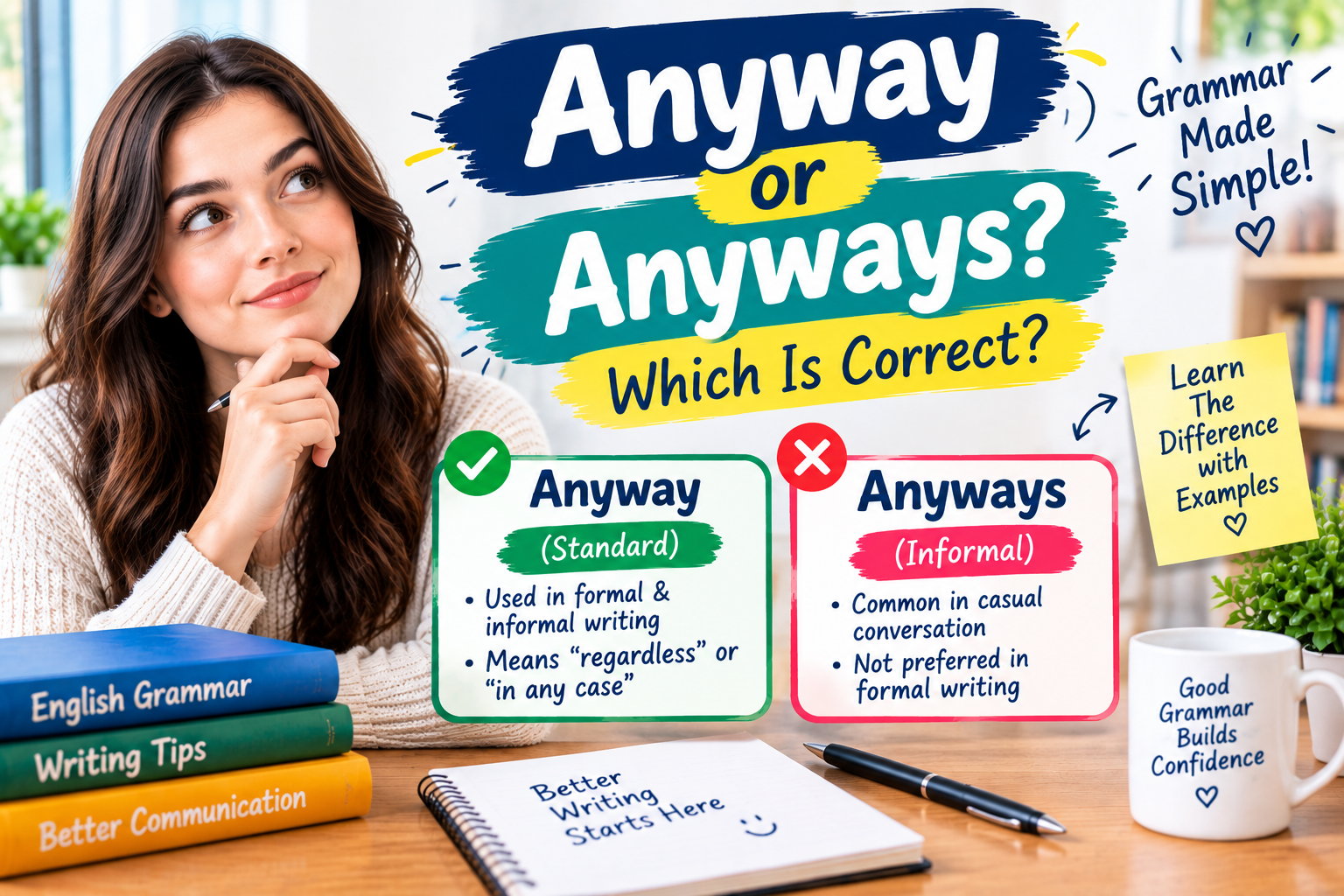
The correct standard form is “anyway.” It is widely accepted in American English and can be used in both formal and informal writing. “Anyways” is also used in casual conversations, particularly in informal American English, but it is generally considered nonstandard and is best avoided in professional writing.
In this guide, you will learn the difference between anyway and anyways, understand their meanings, explore practical sentence examples, and discover which word is appropriate for different situations.
Anyway or Anyways: The Correct Answer
“Anyway” is the standard English adverb. It means regardless, in any case, or despite what has been said or happened.
“Anyways” is an informal variation of “anyway.” Although it is commonly used in casual speech, it is not generally preferred in formal or edited writing.
For example:
- Anyway, let’s get started.
- I was tired, but I went to work anyway.
- Anyway, what were we talking about?
- She didn’t agree with me, but I finished the project anyway.
In each example, “anyway” is the conventional choice.
Quick answer: Use “anyway” in professional emails, academic assignments, blog posts, and formal writing. Use “anyways” only when an informal or conversational tone is appropriate.
What Does Anyway Mean?
“Anyway” is an adverb that is commonly used to introduce a new topic, return to an earlier subject, or indicate that something happens regardless of a particular situation.
It has several common meanings depending on the context.
1. Anyway Means Regardless
In this usage, “anyway” indicates that an action happens despite a problem, obstacle, or circumstance.
Examples:
- It was raining, but we went outside anyway.
- He was exhausted, but he finished his homework anyway.
- I didn’t feel hungry, but I ate dinner anyway.
In these sentences, “anyway” means that the action happened despite the circumstances.
2. Anyway Is Used to Change the Subject
“Anyway” can also introduce a new topic or help move a conversation forward.
Examples:
- Anyway, how was your weekend?
- Anyway, let’s talk about the next project.
- Anyway, I wanted to ask you something.
This usage is common in everyday conversations, emails, and storytelling.
3. Anyway Means In Any Case
The word can also emphasize that a statement remains true regardless of other details.
Examples:
- I wasn’t going to buy it anyway.
- We have enough food for everyone anyway.
- She wasn’t interested in the offer anyway.
In each example, “anyway” reinforces the main point.
What Does Anyways Mean?
“Anyways” is an informal variant of “anyway.” It is frequently heard in casual conversations, text messages, social media posts, and informal dialogue.
For example:
- Anyways, let’s go home.
- I didn’t like the movie anyways.
- Anyways, what happened next?
These sentences are understandable in informal contexts, and many English speakers use “anyways” naturally in conversation.
However, in standard written English, “anyway” is generally preferred.
If you are writing a professional article, business email, academic assignment, or formal report, choosing “anyway” is the safer option.
It is also worth noting that “anyways” is not necessarily a plural form of “anyway.” It is simply an informal variation that developed through common usage.
Anyway vs. Anyways: Key Differences
The main difference between these expressions is their level of formality and acceptance in standard written English.
| Feature | Anyway | Anyways |
|---|---|---|
| Standard English | Yes | Informal, generally nonstandard |
| Part of speech | Adverb | Informal adverbial variant |
| Formal writing | Recommended | Generally avoid |
| Casual conversation | Common | Common in some varieties of English |
| Professional emails | Appropriate | Not recommended |
Both words may communicate the same intended meaning in casual conversation. However, “anyway” is the established standard form and is suitable for a wider range of writing situations.
Examples of Anyway and Anyways in Sentences
The following examples show how these words are used in everyday English.
Examples Using Anyway
- Anyway, let’s begin the meeting.
- I was feeling sick, but I went to school anyway.
- She didn’t want to go anyway.
- Anyway, I have something important to tell you.
- The store was closed, so we went home anyway.
These examples demonstrate the standard use of “anyway” to change a topic, express contrast, or emphasize a point.
Examples Using Anyways
- Anyways, I’ll call you tomorrow.
- I didn’t need the extra money anyways.
- Anyways, what do you want for dinner?
- He wasn’t going to attend anyways.
- Anyways, let’s finish what we started.
These examples reflect informal speech and conversational writing. For professional or edited content, replace “anyways” with “anyway.”
Is Anyway More Correct Than Anyways?
In standard written English, yes. “Anyway” is the conventional form and is accepted in both formal and informal contexts.
“Anyways” is widely understood and appears in everyday speech, but many style guides and editors recommend avoiding it in formal writing.
For example, in a business email, you might write:
“Anyway, I will send you the updated document tomorrow.”
This sounds natural and professional.
Writing “Anyways, I will send you the updated document tomorrow” may sound more conversational, but it is less suitable for formal communication.
The important distinction is that “anyways” is not necessarily incomprehensible or unusable. It is simply less appropriate when standard, polished English is expected.
Common Mistakes to Avoid
Even fluent English speakers sometimes confuse these expressions.
Here are three common mistakes and their corrections.
Incorrect for formal writing: Anyways, I would like to discuss the proposal.
Recommended: Anyway, I would like to discuss the proposal.
The standard form is preferable in business communication.
Less formal: I didn’t want to go anyways.
Standard: I didn’t want to go anyway.
Both are commonly understood, but “anyway” is the conventional choice.
Less formal: Anyways, let’s move on to the next topic.
Standard: Anyway, let’s move on to the next topic.
When writing for a professional audience, consistently using “anyway” helps maintain a polished and conventional tone.
Frequently Asked Questions
1. Is it anyway or anyways?
“Anyway” is the standard form and is recommended in formal and professional writing. “Anyways” is an informal variation used in casual speech.
2. Is anyways grammatically incorrect?
“Anyways” is widely used in informal English, but it is generally considered nonstandard in edited writing. “Anyway” is preferred in formal communication.
3. Can I use anyways in a sentence?
Yes, in informal conversations, text messages, and casual dialogue. However, use “anyway” in academic writing, professional emails, and formal articles.
4. What does anyway mean?
“Anyway” means regardless, in any case, or despite a particular situation. It can also be used to change a subject or return to a previous topic.
5. Is anyway one word?
Yes. “Anyway” is always written as one word. It should not be written as “any way” when used as an adverb meaning regardless.
6. Is anyway formal or informal?
“Anyway” is appropriate in both formal and informal English. Its suitability depends on the sentence and context.
Final Thoughts
When deciding between “anyway” and “anyways,” remember that “anyway” is the standard form of the word.
It can mean regardless, in any case, or be used to introduce a new topic. It works naturally in professional writing, everyday conversations, emails, and academic assignments.
Although “anyways” is commonly heard in casual speech, it is generally best avoided in formal writing.
Simple rule to remember: Use “anyway” for standard English and professional writing. Reserve “anyways” for informal conversations when a casual tone is appropriate.