Parties or Partys: Which Is Correct? Grammar, Meaning & Examples
Parties or Partys: Which Is Correct? Grammar, Meaning & Examples
Introduction
When writing in English, even simple words can sometimes cause confusion. One common spelling question is parties or partys. Both forms may look reasonable at first glance, but only one is grammatically correct in standard English.
Whether you are writing a birthday invitation, a business email, a school assignment, or a professional article, knowing the correct plural form of party can help you avoid spelling mistakes and communicate more clearly.
In this guide, we will explain the difference between parties and partys, explore the spelling rules behind the word, and provide useful examples to help you understand when and how to use it correctly.
Parties or Partys: Which Is Correct?
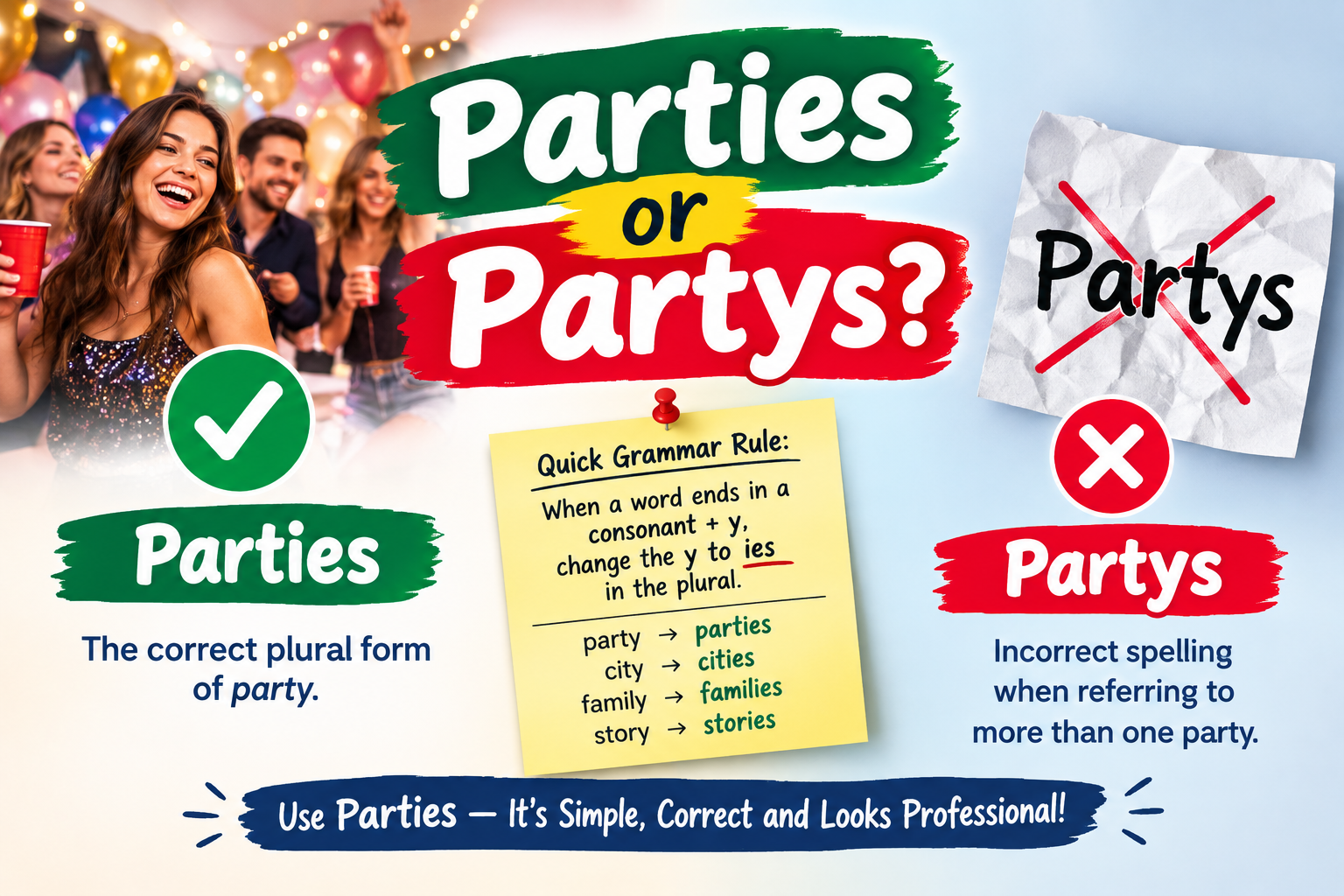
The correct plural form of party is parties.
The word partys is an incorrect spelling when you want to refer to more than one party.
For example:
- Correct: We attended three birthday parties last month.
- Incorrect: We attended three birthday partys last month.
The reason is a standard English spelling rule. When a noun ends in a consonant followed by the letter y, the y usually changes to ies when forming the plural.
This rule applies to many everyday English words, including baby, city, family, and story.
Understanding this simple pattern makes it easier to remember why parties is correct and partys is not.
What Does Parties Mean?
The word parties is the plural form of party. Its meaning depends on the context in which it is used.
Here are some common meanings of the word.
1. Social Gatherings
A party can be a social event where people meet to celebrate, enjoy food, listen to music, or spend time together.
Examples:
- We organized two parties for the holiday season.
- My friends invited me to several birthday parties.
- The summer parties were full of music and entertainment.
2. Political Organizations
In politics, a party is an organized group of people who share political ideas or work toward common political goals.
Examples:
- Several political parties participated in the election.
- The country has multiple registered political parties.
- Different parties presented their policy proposals.
3. People or Groups Involved in an Agreement
In legal and business English, the word party can refer to a person or organization involved in a contract, agreement, or legal case.
Examples:
- Both parties signed the business agreement.
- The parties agreed to resolve the dispute.
- All parties must follow the terms of the contract.
These examples show that parties has several meanings, depending on the situation.
Why Is Partys Incorrect?
The spelling partys is incorrect because it does not follow the standard pluralization rule for nouns ending in a consonant plus y.
In English, when a noun ends in a consonant followed by y, you generally remove the y and add ies.
For example:
- Party → Parties
- City → Cities
- Baby → Babies
- Family → Families
- Story → Stories
- Country → Countries
However, when a word ends in a vowel followed by y, you usually add only s.
Examples:
- Boy → Boys
- Toy → Toys
- Day → Days
- Key → Keys
This difference is important because it helps you recognize the correct plural spelling of many English nouns.
Parties vs Partys: Key Differences
| Feature | Parties | Partys |
|---|---|---|
| Spelling | Correct | Incorrect |
| Grammar | Standard plural of party | Not a standard plural |
| Meaning | More than one party | No accepted plural meaning |
| Usage | Formal and informal writing | Avoid in standard English |
| Example | We attended two parties. | We attended two partys. |
The main difference is simple: parties is the correct spelling, while partys is a common spelling mistake.
Parties in Sentences: Practical Examples
Learning through examples is one of the easiest ways to remember correct spelling.
Here are ten sentences using the word parties correctly:
- We attended several birthday parties during the summer.
- My sister loves organizing surprise parties for her friends.
- The political parties announced their plans before the election.
- Both parties reached an agreement after a long discussion.
- The company hosted two annual parties for its employees.
- Many families organize holiday parties in December.
- The parties involved in the contract agreed on the final terms.
- Our school arranged special parties for graduating students.
- Several parties expressed interest in the business partnership.
- The neighborhood parties brought everyone together.
Notice that parties works in different situations, including celebrations, politics, business, and legal discussions.
Common Mistakes When Using Parties
Even experienced English learners sometimes make spelling and grammar mistakes. Here are a few common errors to avoid.
Mistake 1: Writing Partys Instead of Parties
Incorrect: The school organized three partys.
Correct: The school organized three parties.
Mistake 2: Confusing Parties With Party’s
The apostrophe changes the meaning of the word.
- Parties: The plural form of party.
- Party’s: A possessive form or a contraction in certain contexts.
Example:
- The parties were enjoyable.
- The party’s decorations were beautiful.
In the second sentence, party’s means the decorations belong to the party.
Mistake 3: Using Parties With a Singular Verb
When parties refers to multiple events or groups, it generally takes a plural verb.
Incorrect: The parties is scheduled for Friday.
Correct: The parties are scheduled for Friday.
Remember that correct spelling and subject-verb agreement are both important for clear English writing.
Is Partys Ever Correct?
In standard English, partys is not the correct plural spelling of party. You should use parties in school assignments, professional documents, blog posts, emails, and everyday writing.
However, you might occasionally see partys in usernames, brand names, informal online posts, or deliberate creative spellings. Such uses are exceptions and do not change the standard grammar rule.
If you are unsure which spelling to choose, use parties whenever you mean more than one party.
Easy Tips to Remember Parties or Partys
You can remember the correct spelling with a few simple techniques.
- Remember the consonant-plus-y rule: If a noun ends in a consonant followed by y, change y to ies to form the plural.
- Practice with similar words: Remember city/cities, family/families, and baby/babies.
- Read your writing aloud: Reviewing your sentences can help you identify mistakes.
- Use a spell-checking tool: Grammar and spelling tools can help catch common errors.
- Create your own examples: Writing a few sentences with the word parties can reinforce the correct spelling.
With regular practice, remembering the difference becomes much easier.
Frequently Asked Questions (FAQs)
1. Is parties or partys correct?
Parties is correct. It is the standard plural form of party. Partys is an incorrect spelling when referring to multiple parties.
2. What is the plural of party?
The plural of party is parties. The final y changes to ies because the word ends in a consonant followed by y.
3. Why do we write parties instead of partys?
English spelling rules generally require nouns ending in a consonant plus y to change the y to ies when forming the plural.
4. What is the difference between parties and party’s?
Parties refers to more than one party. Party’s is a possessive form, as in “the party’s location,” or can represent a contraction in certain contexts.
5. Can I use partys in informal writing?
You may encounter partys in informal online content or creative names, but it is not standard English. Use parties for correct spelling.
6. Is parties singular or plural?
Parties is plural. The singular form is party.
Conclusion
When choosing between parties or partys, the correct answer is always parties in standard English when referring to more than one party.
The spelling follows a simple grammar rule: nouns ending in a consonant followed by y generally change the y to ies in the plural form.
Whether you are writing about birthday celebrations, political organizations, business agreements, or social events, using parties will make your writing more accurate and professional.
Remember this simple rule, practice with similar words, and you will find it much easier to avoid this common English spelling mistake.