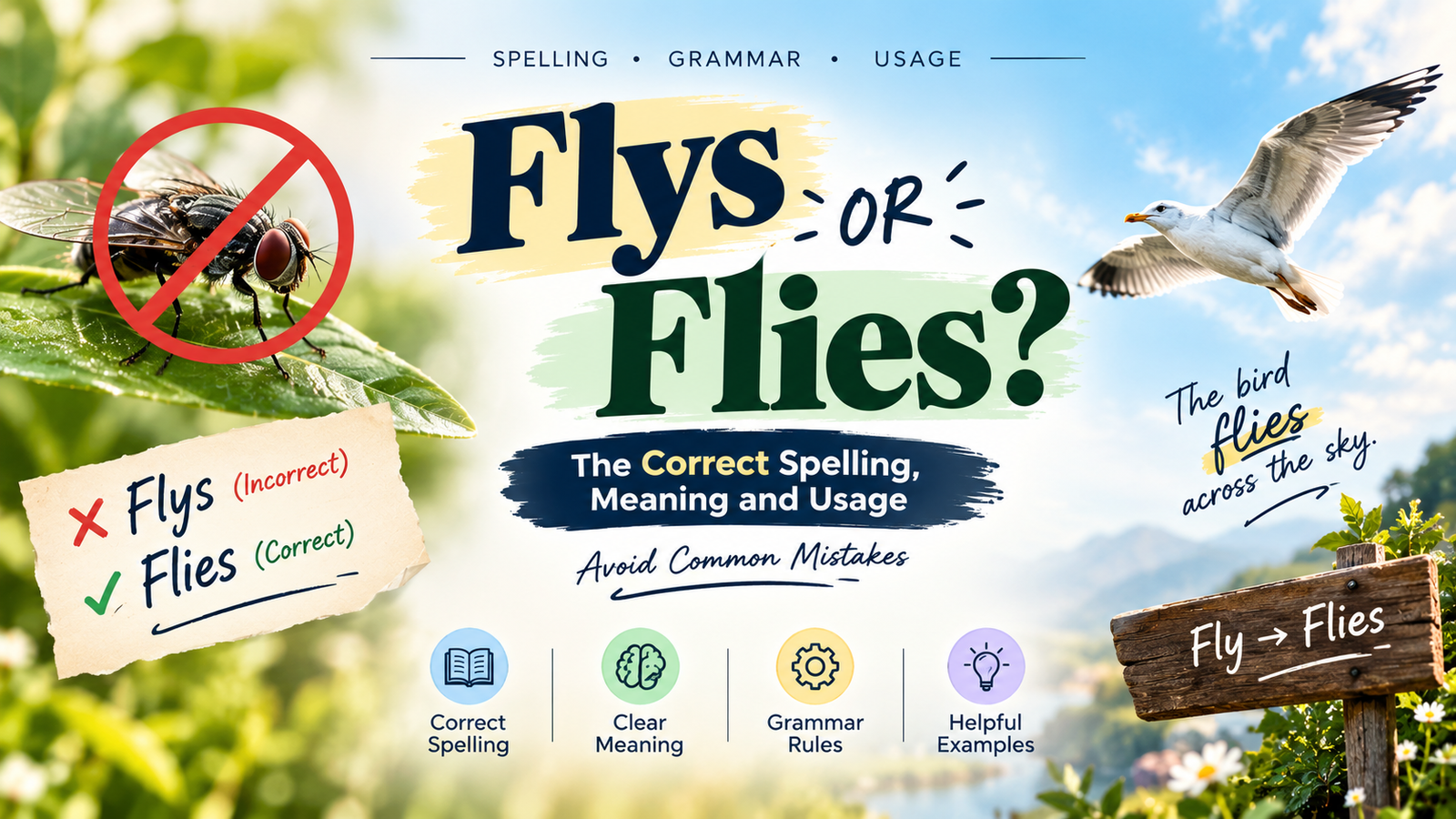
Flys or Flies? The Correct Spelling, Meaning, and Usage
Flys or Flies? The Correct Spelling, Meaning, and Usage
Flys or flies? If you have ever been unsure which spelling is correct, you are not alone. These words look almost identical, but they are used differently in English. In standard English, “flies” is the correct spelling in most situations. It can be the plural of the noun “fly” or the third-person singular form of the verb “fly.” The spelling “flys” is generally incorrect when you are using “fly” in its normal English forms. Flys or Flies? The Correct Spelling, Meaning, and Usage
Understanding the difference between flys and flies can help you avoid common spelling mistakes and make your writing more accurate. In this article, we will explain the correct spelling, grammar rules, meanings, examples, and common mistakes. Flys or Flies? The Correct Spelling, Meaning, and Usage
Flys or Flies: Which Is Correct?
The standard English spelling is “flies.”
The word flies has two common grammatical uses. First, it is the plural form of the noun fly, referring to more than one flying insect. Second, it is the third-person singular present-tense form of the verb fly.
For example:
- There are several flies in the kitchen.
- A bird flies across the sky.
- She flies to London every summer.
- The airplane flies over the mountains.
In standard English, “flys” is not the normal spelling for either of these meanings.
Why Is It “Flies” Instead of “Flys”?
The spelling rule explains the difference.
When a word ends in a consonant followed by y, the y often changes to i before adding certain endings.
For example:
- Fly → Flies
- Try → Tries
- Cry → Cries
- Carry → Carries
- Study → Studies
The same spelling pattern applies to fly.
When “fly” becomes a third-person singular verb, the correct form is:
Fly → Flies
Therefore, writing “flys” is normally incorrect.
This is an important spelling rule because many English learners assume that they can simply add “s” to every word to create a third-person singular verb or plural form. Words ending in consonant + y often follow a different pattern.
What Does “Flies” Mean?
The meaning of flies depends on how it is used in a sentence.
Flies as a Plural Noun
When “flies” is a noun, it means more than one fly.
A fly is a small flying insect. The plural form is flies.
Examples include:
- The flies were attracted to the food.
- Several flies entered through the open window.
- The farmer tried to keep the flies away from the animals.
In these examples, “flies” refers to multiple insects.
Flies as a Verb
“Flies” can also be a verb. It is the third-person singular form of fly.
Examples:
- The eagle flies high above the valley.
- My sister flies home tomorrow.
- The plane flies over the ocean.
- Time flies when you are having fun.
In these sentences, “flies” describes an action or movement.
Fly vs. Flies
Understanding when to use fly and flies is essential.
Use fly with:
- I
- You
- We
- They
- Plural subjects
Examples:
- I fly to New York next week.
- They fly every month.
- Birds fly south during the winter.
Use flies with a singular third-person subject such as:
- He
- She
- It
- A bird
- The airplane
Examples:
- He flies to work every Monday.
- She flies internationally for her job.
- The bird flies across the lake.
This grammatical distinction is one of the easiest ways to determine whether you need “fly” or “flies.”
Common Mistake: Flys
One of the most frequent spelling mistakes involving this word is “flys.”
For example, someone might write:
Incorrect: The bird flys over the house.
The correct sentence is:
Correct: The bird flies over the house.
Another example:
Incorrect: Several flys are inside the room.
The correct version is:
Correct: Several flies are inside the room.
The reason is that English spelling rules change the final y to i in this form.
When Should You Use “Fly”?
Although “flies” is correct in many situations, “fly” is also an important and correct word.
Use fly when the subject is “I,” “you,” “we,” or “they.”
For example:
- I fly tomorrow.
- You fly frequently.
- We fly to Paris next month.
- They fly first class.
“Fly” is also used after modal verbs and auxiliary verbs.
Examples:
- I can fly a plane.
- She will fly tomorrow.
- They might fly overseas.
- We should fly early.
Notice that even when the subject is “she,” the word remains fly after “will,” “can,” “might,” or similar helping verbs.
Flies in Everyday Expressions
The word flies appears in several common English expressions.
One of the best-known examples is:
“Time flies.”
This expression means that time seems to pass very quickly.
For example:
Time flies when you are having fun.
Another common use is:
“The way the bird flies.”
Here, “flies” describes the movement of the bird.
The word can also be used figuratively:
Rumors fly quickly on social media.
In this example, “fly” is being used metaphorically to describe how rapidly rumors spread.
Flys or Flies in Professional Writing
Choosing the correct spelling is especially important in professional and academic writing. A spelling mistake such as “flys” can make otherwise polished content look less professional.
Whether you are writing:
- A school assignment
- A blog post
- A business article
- A website
- An email
- A product description
- Social media content
- An academic paper
you should normally use “flies” rather than “flys” when the grammatical meaning requires it.
Correct spelling improves readability and helps readers understand your intended meaning without distraction.
How to Remember the Correct Spelling
A simple trick can help you remember the difference.
Think of other words ending in consonant + y:
Try → Tries
Cry → Cries
Study → Studies
Fly → Flies
The pattern becomes easier to recognize once you see several examples together.
Remember:
Fly + s ≠ Flys
Instead:
Fly → Flies
The y changes to ie.
Frequently Asked Questions
Is “flys” a correct word?
In standard English, flys is generally considered an incorrect spelling when intended as the plural of “fly” or the third-person singular form of the verb “fly.”
Is “flies” the correct plural of fly?
Yes. The plural noun form of fly is flies.
For example:
There were many flies around the food.
Is “flies” a verb?
Yes. Flies is the third-person singular present form of the verb fly.
For example:
The airplane flies over the city.
Why does fly become flies?
Because English spelling rules generally change a final consonant + y to i before adding the relevant ending. Thus, fly becomes flies.
Is it “the bird flys” or “the bird flies”?
The correct sentence is:
The bird flies across the sky.
“Bird” is a singular third-person subject, so the verb should be flies.
Final Answer: Flys or Flies?
When choosing between “flys” and “flies,” the correct standard-English form is “flies.” It is used as the plural of the noun “fly” and as the third-person singular form of the verb “fly.”
Remember the simple pattern:
Fly → Flies
If you are describing multiple insects, use flies. If you are describing what a singular person, animal, or object does, flies may also be the correct verb form. The spelling “flys” should generally be avoided in standard English.
By remembering the y → ies spelling pattern, you can easily avoid this common mistake and use flies correctly in everyday, academic, and professional writing.