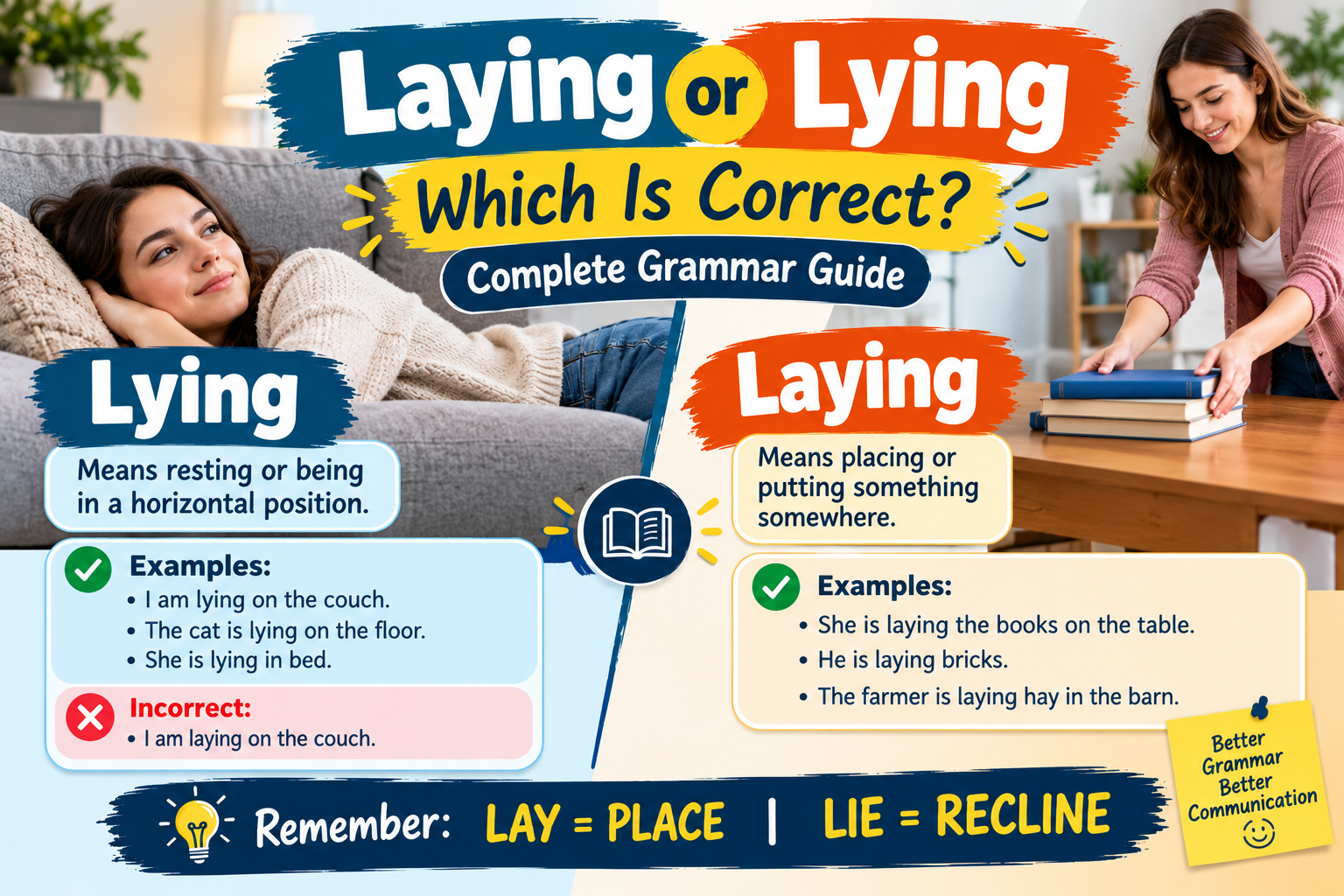
Laying or Lying: Which Is Correct?
Laying or Lying: Which Is Correct?
One of the most common grammar mistakes in English involves the words laying and lying. Even native English speakers frequently confuse these two words because they sound similar and are closely related in meaning. However, they are used in different situations and follow different grammar rules.
If you’ve ever wondered whether you should write laying on the couch or lying on the couch, this comprehensive guide will explain everything you need to know. By the end of this article, you’ll understand the difference between laying and lying, learn how to use them correctly, and avoid one of the most common mistakes in English grammar.
Quick Answer: Laying or Lying?
The difference is simple:
- Lying means resting or being in a horizontal position.
- Laying means placing or putting something down.
Examples
✅ Correct:
- I am lying on the bed.
- The dog is lying on the floor.
- She is laying the books on the table.
- The farmer is laying straw in the barn.
❌ Incorrect:
- I am laying on the bed. (Usually incorrect unless you are placing something down.)
In most situations when people talk about resting on a couch, bed, or floor, the correct word is lying.
Understanding the Verb “Lie”
The verb lie means to recline, rest, or be in a horizontal position.
It does not require a direct object.
Present Forms
| Tense | Form |
|---|---|
| Base Form | Lie |
| Present Participle | Lying |
| Past Tense | Lay |
| Past Participle | Lain |
Examples
- I like to lie on the beach.
- The cat is lying on the sofa.
- Yesterday, I lay in bed all morning.
- The blanket has lain there for days.
Notice that no object is being acted upon.
The subject simply rests or reclines.
Understanding the Verb “Lay”
The verb lay means to put or place something somewhere.
Unlike lie, it requires a direct object.
Present Forms
| Tense | Form |
|---|---|
| Base Form | Lay |
| Present Participle | Laying |
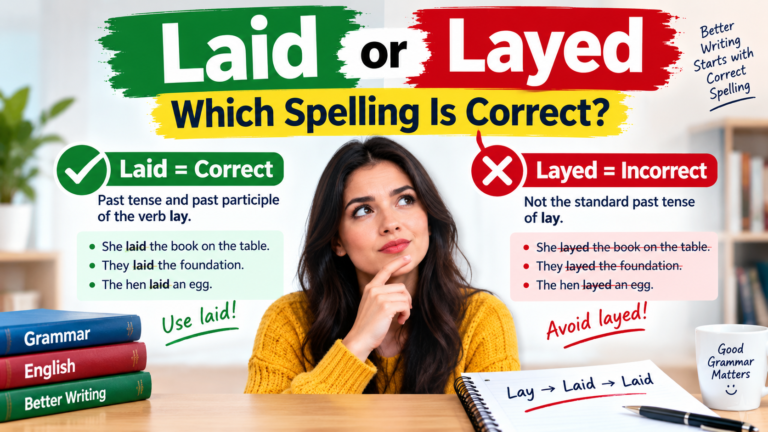
| Past Tense | Laid |
| Past Participle | Laid |
Examples
- Please lay the book on the table.
- She is laying the plates for dinner.
- He laid the keys on the counter.
- The worker has laid new flooring.
Notice that something is being placed somewhere.
Why People Get Confused
The confusion exists because the past tense of lie is lay.
Look at these forms:
Lie
- Present: lie
- Present participle: lying
- Past: lay
- Past participle: lain
Lay
- Present: lay
- Present participle: laying
- Past: laid
- Past participle: laid
Because the word lay appears in both verb systems, many writers accidentally mix them up.
Lying vs Laying: The Simple Rule
Ask yourself one question:
Is there an object being placed somewhere?
If yes, use laying.
If no, use lying.
Examples
Lying
- The baby is lying in the crib.
- The dog is lying near the fireplace.
- I am lying on the couch.
No object is being placed.
Laying
- She is laying the baby in the crib.
- The worker is laying bricks.
- He is laying the documents on the desk.
Something is being placed.
Common Everyday Examples
Correct Uses of Lying
- I am lying in bed.
- The cat is lying on the rug.
- She is lying by the pool.
- The phone is lying on the table.
- The child is lying on the grass.
Correct Uses of Laying
- I am laying the blanket on the bed.
- She is laying flowers on the grave.
- He is laying the cards on the table.
- The chef is laying ingredients on a tray.
- The farmer is laying hay in the barn.
Laying or Lying on the Couch?
This is one of the most searched grammar questions online.
Correct
✅ I am lying on the couch.
Incorrect
❌ I am laying on the couch.
Why?
Because you are not placing anything. You are simply resting.
Therefore, lying is correct.
Laying or Lying in Bed?
Another common question.
Correct
✅ She is lying in bed.
Incorrect
❌ She is laying in bed.
Again, she is resting, not placing something somewhere.
The correct word is lying.
What About Chickens Laying Eggs?
This is one situation where laying is correct.
Examples
- The hen is laying eggs.
- Several chickens are laying eggs today.
Why?
Because eggs are the direct object.
The chicken is producing and laying the eggs.
Common Grammar Mistakes
Incorrect
- I was laying on the beach all afternoon.
Correct
- I was lying on the beach all afternoon.
Incorrect
- The dog is laying on the floor.
Correct
- The dog is lying on the floor.
Incorrect
- She is lying the books on the desk.
Correct
- She is laying the books on the desk.
Memory Trick to Remember the Difference
A simple trick can help:
LAY = PLACE
If you can replace the word with place, use laying.
Example:
- She is laying the plates on the table.
- She is placing the plates on the table.
This works perfectly.
LIE = RECLINE
If someone or something is resting, reclining, or positioned horizontally, use lying.
Example:
- The dog is lying on the carpet.
- The dog is resting on the carpet.
This also works perfectly.
Frequently Asked Questions
Is it laying down or lying down?
Usually:
✅ Lying down
Example:
- I am lying down for a nap.
Is it laying in bed or lying in bed?
✅ Lying in bed
Is it laying on the sofa or lying on the sofa?
✅ Lying on the sofa
Why do so many people say “laying down”?
Many native speakers use it informally in everyday conversation. However, formal grammar rules still consider lying down the correct choice when someone is resting.
Conclusion
The difference between laying and lying becomes easy once you understand the role of the object.
- Lying means resting or reclining.
- Laying means placing something somewhere.
Remember this simple rule:
If there is an object, use laying. If there is no object, use lying.
Quick Summary
✅ Lying on the couch
✅ Lying in bed
✅ Lying on the floor
✅ Laying books on the table
✅ Laying bricks
✅ Laying eggs
❌ Laying on the couch
❌ Laying in bed
❌ Laying on the floor
Mastering the difference between laying and lying will instantly improve your grammar, writing, and everyday communication. Whether you’re writing an email, an essay, a blog post, or simply speaking English, using these words correctly will make your language sound more natural and professional.