Life or Lives: What Is the Difference and When Should You Use Each?
Life or Lives: What Is the Difference and When Should You Use Each?
The words “life” and “lives” are closely related, but they are not interchangeable. If you are learning English or trying to improve your writing, knowing when to use life and when to use lives can help you avoid common grammar mistakes.
The basic rule is simple:
- Life is the singular form.
- Lives is the plural form.
For example:
She has a happy life.
But:
They have happy lives.
Although the rule looks easy, the word life can become confusing because its plural form is not created by simply adding an “s.” Instead, life changes to lives.
In this guide, we will explain the difference between life and lives, how to use each word correctly, common mistakes, pronunciation, possessive forms, and plenty of examples.
Life or Lives: The Quick Answer
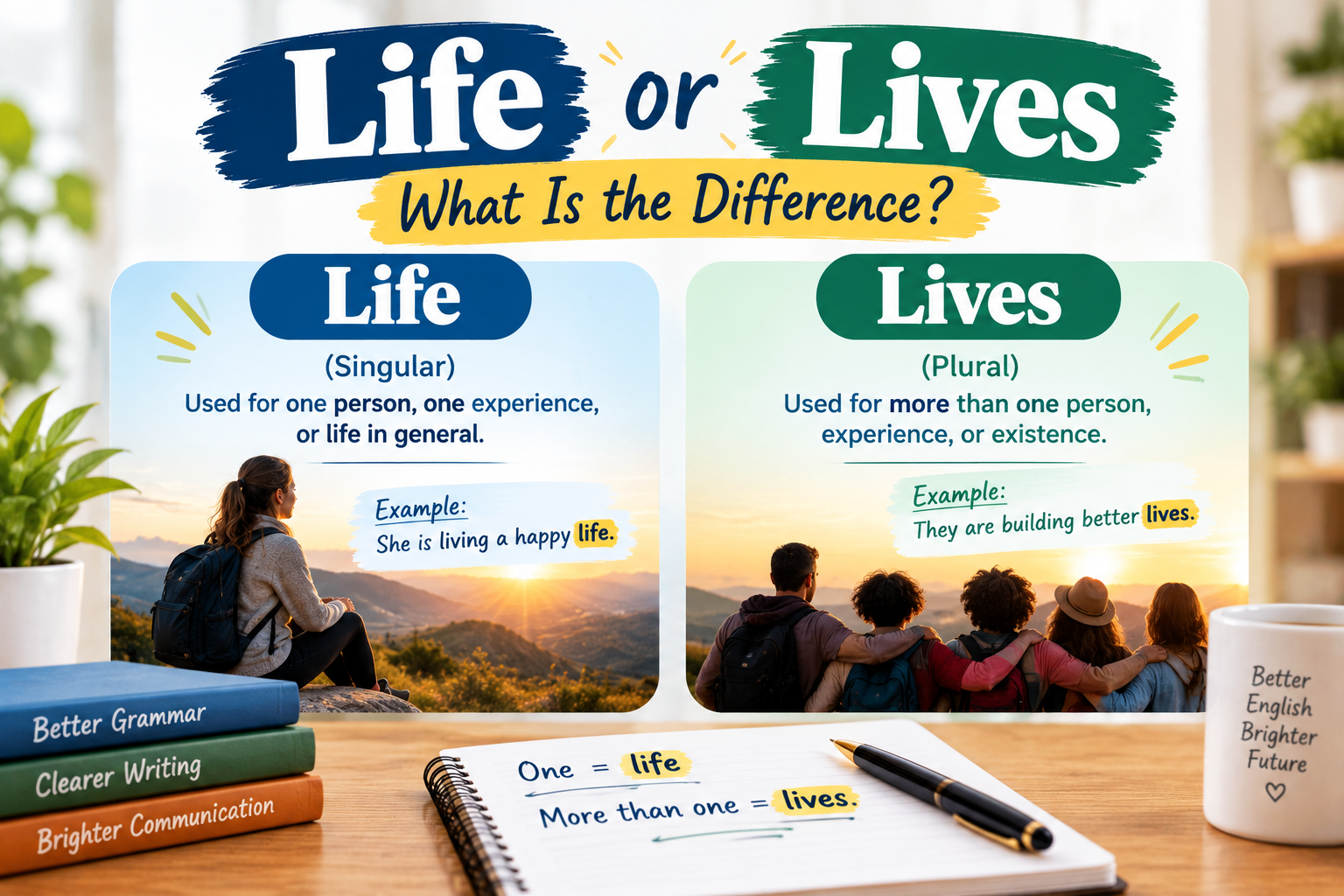
Use life when you are talking about one person’s existence, one individual experience, or one living existence.
Use lives when you are talking about more than one life.
Singular
My life has changed dramatically.
Plural
Their lives have changed dramatically.
This is the most important distinction to remember.
What Does “Life” Mean?
Life is a singular noun. It can refer to the condition of being alive, the existence of a person or animal, or the experiences that someone has.
For example:
Life is full of surprises.
She has a busy life.
He wants to change his life.
My life became easier after I moved.
In each example, life refers to one general existence or one person’s experience.
The word can also be used in a broader sense:
Life on Earth is incredibly diverse.
Here, “life” refers to living organisms generally rather than to several individual lives.
What Does “Lives” Mean?
Lives is the plural form of life.
It is used when referring to two or more individual lives.
For example:
The accident changed many lives.
Their lives are completely different.
Millions of lives could be affected.
The organization works to save lives.
In these sentences, more than one person’s or living being’s existence is being discussed.
Why Is the Plural of Life “Lives”?
One of the reasons English learners find this word confusing is that the plural is irregular.
Many nouns form their plural simply by adding -s:
- book → books
- car → cars
- house → houses
- student → students
But life changes differently:
life → lives
The spelling changes from f to v, followed by -es.
This pattern also appears in other English words:
- wife → wives
- knife → knives
- leaf → leaves
- wolf → wolves
- shelf → shelves
There are exceptions to this broader spelling pattern, but life → lives is one of the most common examples.
Examples of Life
Here are several examples showing how to use life correctly:
I enjoy my life.
She wants a better life.
Life can be unpredictable.
He has had an interesting life.
Everyone deserves a fulfilling life.
My daily life is very busy.
The book tells the story of a young man’s life.
The word remains singular because the sentence refers to one existence, one experience, or life in a general sense.
Examples of Lives
Use lives when referring to multiple individual lives.
The rescue team saved several lives.
The decision affected thousands of lives.
Their lives changed after the move.
The new technology could improve people’s lives.
These animals depend on their environment for their lives.
Here, “lives” refers to multiple individual existences or experiences.
Life vs. Lives in Common Sentences
Comparing similar sentences is one of the easiest ways to understand the difference.
One person
Her life changed after graduation.
Multiple people
Their lives changed after graduation.
One individual
He is happy with his life.
Multiple individuals
They are happy with their lives.
One existence
The doctor saved his life.
Multiple existences
The doctors saved their lives.
The meaning changes according to whether you are referring to one or multiple lives.
Life or Lives After “My,” “Your,” “His,” and “Their”
Possessive words can make the difference especially easy to see.
My life
I want to improve my life.
Because “my” refers to one person, life is normally singular.
Our lives
We want to improve our lives.
Because “we” refers to multiple people, lives is plural.
His life
His life changed after college.
One person means one life.
Their lives
Their lives changed after college.
Multiple people means multiple lives.
Life or Lives With “People”
The word people is plural, so it commonly appears with lives when referring to the individual experiences or existences of those people.
For example:
Social media has changed people’s lives.
The charity helps improve people’s lives.
The disaster affected thousands of people’s lives.
However, life can also be used with “people” when talking about life generally:
People often struggle with life changes.
So the correct word depends on what you are trying to express.
“Save a Life” vs. “Save Lives”
Both expressions are correct.
Use save a life for one person:
The paramedic helped save a life.
Use save lives for multiple people:
Emergency workers helped save many lives.
This distinction is particularly common in news reports, medical writing, public safety messages, and humanitarian discussions.
“Change Your Life” vs. “Change Your Lives”
The same rule applies here.
When speaking to one person:
This experience could change your life.
When speaking to multiple people:
This experience could change your lives.
The possessive pronoun determines whether the noun should be singular or plural.
Life’s vs. Lives: Another Common Confusion
There is another important distinction between life’s and lives.
Life’s
Life’s can be the possessive form of life or a contraction of “life is” or “life has,” depending on context.
Example of possession:
Life’s challenges can make us stronger.
Here, “life’s” means the challenges of life.
Example as a contraction:
Life’s getting better.
Here, “life’s” means life is.
Lives
Lives is the plural of life.
Many people lost their lives.
These words may look similar, but their meanings and grammatical functions are different.
Life or Lives: Common Mistakes
Incorrect:
They changed their life after moving abroad.
Better:
They changed their lives after moving abroad.
Because “they” refers to multiple people, “lives” is normally appropriate.
Another example:
Incorrect:
Many life were affected.
Correct:
Many lives were affected.
“Many” requires a plural countable noun, so lives is needed.
Incorrect:
She has lived many different lives.
This sentence is actually correct if the writer means that one person has experienced several distinct phases or identities in life.
This demonstrates that context matters. Grammar is not always determined simply by the subject.
Can “Lives” Be Used for Animals?
Yes. Lives can refer to the lives of people, animals, or other living beings.
For example:
The shelter has saved hundreds of animals’ lives.
Pollution threatens marine animals’ lives.
The project protects the lives of endangered species.
The singular form is also possible:
The dog’s life was saved.
Frequently Asked Questions
Is it “life” or “lives”?
Use life for one life and lives for more than one life.
Example:
She has a wonderful life.
They have wonderful lives.
What is the plural of life?
The plural of life is lives.
Why does life become lives?
The word has an irregular plural form in which the f changes to v, followed by -es:
life → lives
Is “people’s lives” correct?
Yes. People’s lives is correct when referring to the lives of multiple people.
For example:
The program has improved many people’s lives.
Is “my life” or “my lives” correct?
When referring to your own existence, my life is normally correct.
For example:
I want to make the most of my life.
“My lives” would generally only be used in unusual contexts where you are intentionally referring to multiple separate lives.
What is the difference between “lives” and “life’s”?
Lives is the plural of life.
Life’s can be possessive or a contraction, depending on the sentence.
Example:
Their lives changed.
Life’s challenges can be difficult.
Final Answer: Life or Lives?
The difference between life and lives is primarily a matter of singular and plural usage.
Use life when referring to one existence, one person’s experience, or life in a general sense.
Use lives when referring to multiple individual existences or experiences.
The easiest rule is:
One = life
More than one = lives
For example:
He wants to improve his life.
They want to improve their lives.
Remember that life → lives is an irregular plural form, just like wife → wives and knife → knives.
Once you understand this basic rule and pay attention to the subject and context of your sentence, choosing between life and lives becomes much easier.
SEO Details
SEO Title: Life or Lives: What’s the Difference? Grammar & Examples
Meta Description: Learn the difference between life and lives with simple grammar rules, examples, plural forms, possessives, common mistakes, and easy usage tips.
Focus Keyword: life or lives
Secondary Keywords:
- life vs lives
- life or lives grammar
- difference between life and lives
- plural of life
- lives meaning
- life meaning
- life and lives examples
- life’s vs lives
- people’s lives
- when to use life or lives
Suggested URL Slug:
/life-or-lives/
Featured Image Alt Text:
Life or lives grammar comparison with examples
Featured Image Title:
Life or Lives – What Is the Difference?
Hashtags:
#LifeOrLives #LifeVsLives #EnglishGrammar #GrammarTips #LearnEnglish #EnglishWriting #EnglishLanguage #GrammarRules #WritingTips #EnglishTips