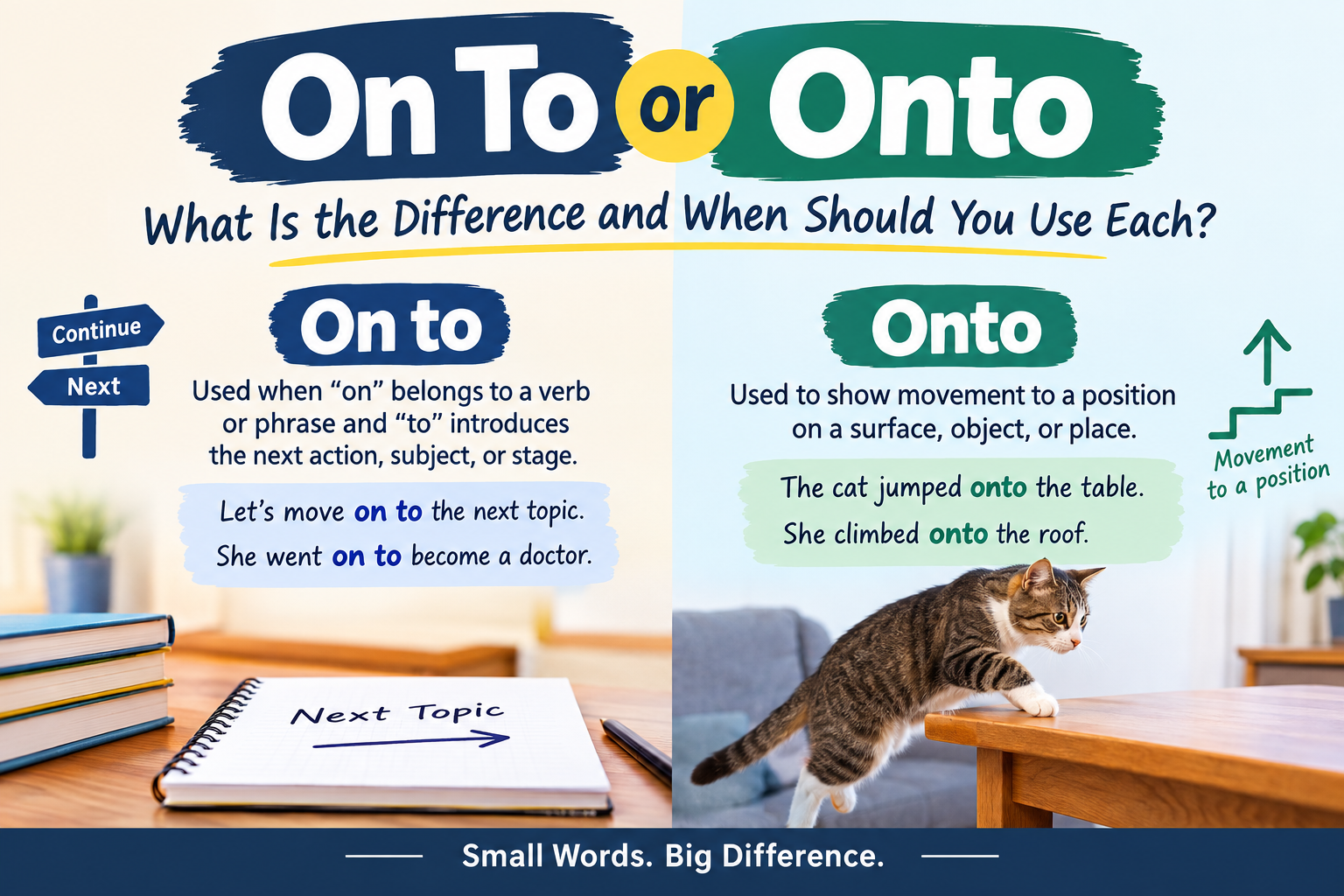
On To or Onto: What Is the Difference and When Should You Use Each?
On To or Onto: What Is the Difference and When Should You Use Each?
On to or onto — which one is correct? This is a common English grammar question because “on to” and “onto” look almost identical but can have different meanings and grammatical functions. On To or Onto: What Is the Difference and When Should You Use Each?
In some sentences, onto is the correct choice because it indicates movement toward or to a position on a surface. In other sentences, on to is correct because on belongs to the verb or phrase that comes before it, while to introduces the next destination, action, or idea.
Understanding the difference between on to and onto can make your writing clearer and help you avoid a common English grammar mistake. On To or Onto: What Is the Difference and When Should You Use Each?
On To or Onto: The Basic Difference
The simplest way to understand on to vs. onto is to look at what the words are doing in the sentence.
Onto is usually a preposition that means movement to a position on a surface or place.
For example:
- The cat jumped onto the table.
- She stepped onto the stage.
- The child climbed onto the bed.
In each example, someone or something moves to a position on another surface or location.
On to, written as two separate words, is used when on is connected to the preceding verb, expression, or idea, and to introduces something that follows.
For example:
- Let’s move on to the next topic.
- She went on to become a successful writer.
- After finishing the first task, we moved on to the second.
The difference may seem small, but the meaning and grammatical structure can change.
What Does Onto Mean?
Onto is generally used to describe movement toward a position on something.
The word combines the ideas of on and to into a single preposition.
Consider this sentence:
The dog jumped onto the sofa.
The dog moves from another location and ends up on the sofa. Therefore, onto is appropriate.
More examples include:
- The bird flew onto the roof.
- He climbed onto the bus.
- She placed the books onto the desk.
- The child jumped onto the trampoline.
- The actor walked onto the stage.
A useful test is to ask whether the sentence describes movement to a position on something. If it does, onto is often the appropriate choice. On To or Onto: What Is the Difference and When Should You Use Each?
What Does On To Mean?
On to consists of two separate words. It is commonly used when on is part of a verb phrase and to begins a new phrase.
For example:
We moved on to the next lesson.
Here, move on is the expression. The word to introduces the next destination or subject: the next lesson.
Another example is:
She went on to become a doctor.
The phrase went on means that she continued, while to become introduces what happened next.
Other examples include:
- Let’s move on to the next question.
- He went on to win several awards.
- After discussing the budget, the meeting moved on to the schedule.
- She continued on to the next stage of the competition.
- The speaker went on to explain the problem in greater detail.
In these sentences, changing on to to onto would either be incorrect or change the meaning.
On To vs. Onto Examples
Comparing examples side by side can make the distinction easier to understand.
Example 1
The cat jumped onto the chair.
The cat physically moved to a position on the chair. Therefore, onto is correct.
Example 2
The teacher moved on to the next lesson.
Here, move on means continue, and to introduces the next lesson. Therefore, on to is correct.
Example 3
The child climbed onto the roof.
The child moved to a position on the roof. Onto is correct.
Example 4
After finishing college, she went on to study law.
The phrase went on means continued, while to study law explains what happened next. On to is correct.
How to Know Whether to Use On To or Onto
A simple grammar test can help you decide.
Ask: Does “on” describe a position or movement?
If the sentence describes movement to a position on a surface, onto is usually appropriate.
For example:
- He jumped onto the platform.
- She climbed onto the horse.
- The ball rolled onto the road.
Ask: Is “on” part of a verb phrase?
If on belongs to a phrase such as move on, go on, or carry on, use on to when to introduces what comes next.
Examples:
- We moved on to another subject.
- She went on to become a professor.
- He carried on to the next part of the project.
This distinction is one of the easiest ways to remember the difference.
Is Onto Always One Word?
In modern English, onto is commonly written as one word when it functions as a preposition indicating movement toward a position on something.
For example:
The cat jumped onto the table.
However, English usage can sometimes vary depending on meaning and style. In particular, when on functions independently and to introduces an infinitive or another phrase, the words should remain separate.
For example:
She went on to explain the situation.
Writing “She went onto explain” would be incorrect.
Therefore, it is important to consider the grammatical function rather than simply memorizing that one version is always correct.
Common Mistakes With On To and Onto
One common mistake is using onto whenever the words sound natural together.
For example:
Incorrect: She went onto explain the problem.
Correct: She went on to explain the problem.
Why? Because went on means continued, while to explain introduces the next action.
Another common mistake is separating the word when it should be onto.
For example:
Less appropriate: The child jumped on to the bed.
Standard: The child jumped onto the bed.
The second version clearly expresses movement to a position on the bed.
On To or Onto in Formal Writing
For professional, academic, and online writing, choosing the correct form is important because small grammar mistakes can affect readability and credibility.
When describing physical movement, onto is usually the clearest choice:
- The athlete stepped onto the field.
- The package fell onto the floor.
- The worker climbed onto the platform.
When describing continuation or progression, use on to:
- The discussion moved on to another issue.
- The researcher went on to conduct additional studies.
- The company went on to launch a new product.
Understanding this distinction can make articles, essays, reports, and other forms of writing more precise.
A Simple Trick to Remember the Difference
Here is an easy way to remember on to vs. onto:
ONTO = movement to a position on something.
Think:
jump → onto the table
climb → onto the roof
step → onto the stage
But:
ON TO = continue or move forward to something else.
Think:
move on → to the next topic
go on → to explain
move on → to another task
If you can separate on from the rest of the phrase and it still works as part of a verb expression, on to may be the better choice.
Quick Comparison: On To vs. Onto
| Form | Main Use | Example |
|---|---|---|
| Onto | Movement to a position on something | The cat jumped onto the table. |
| On to | Continuing to another subject, action, or stage | We moved on to the next topic. |
| Onto | Physical movement | She stepped onto the platform. |
| On to | Continuing or progressing | He went on to become a teacher. |
Final Thoughts: On To or Onto?
The difference between on to and onto becomes much easier once you understand their grammatical roles.
Use onto when you are describing movement toward a position on a surface, object, or place. For example, “The dog jumped onto the couch.”
Use on to when on belongs to the preceding verb or phrase and to introduces the next action, subject, destination, or stage. For example, “She went on to become a successful author.” On To or Onto: What Is the Difference and When Should You Use Each?
The key is not simply how the words sound. Instead, look at the meaning and structure of the sentence.
Whether you are writing a school assignment, professional article, website content, or everyday message, understanding on to vs. onto will help you produce clearer and more grammatically accurate English.