A Unique or An Unique? Which Is Correct? Grammar Rule & Examples
A Unique or An Unique? Which Is Correct? Grammar Rule & Examples
“A unique” or “an unique” — which one is correct? This is a common English grammar question because the word unique begins with the letter u, and many learners assume that words beginning with a vowel should always use “an.” However, English articles are determined by sound, not simply by the first letter of a word.
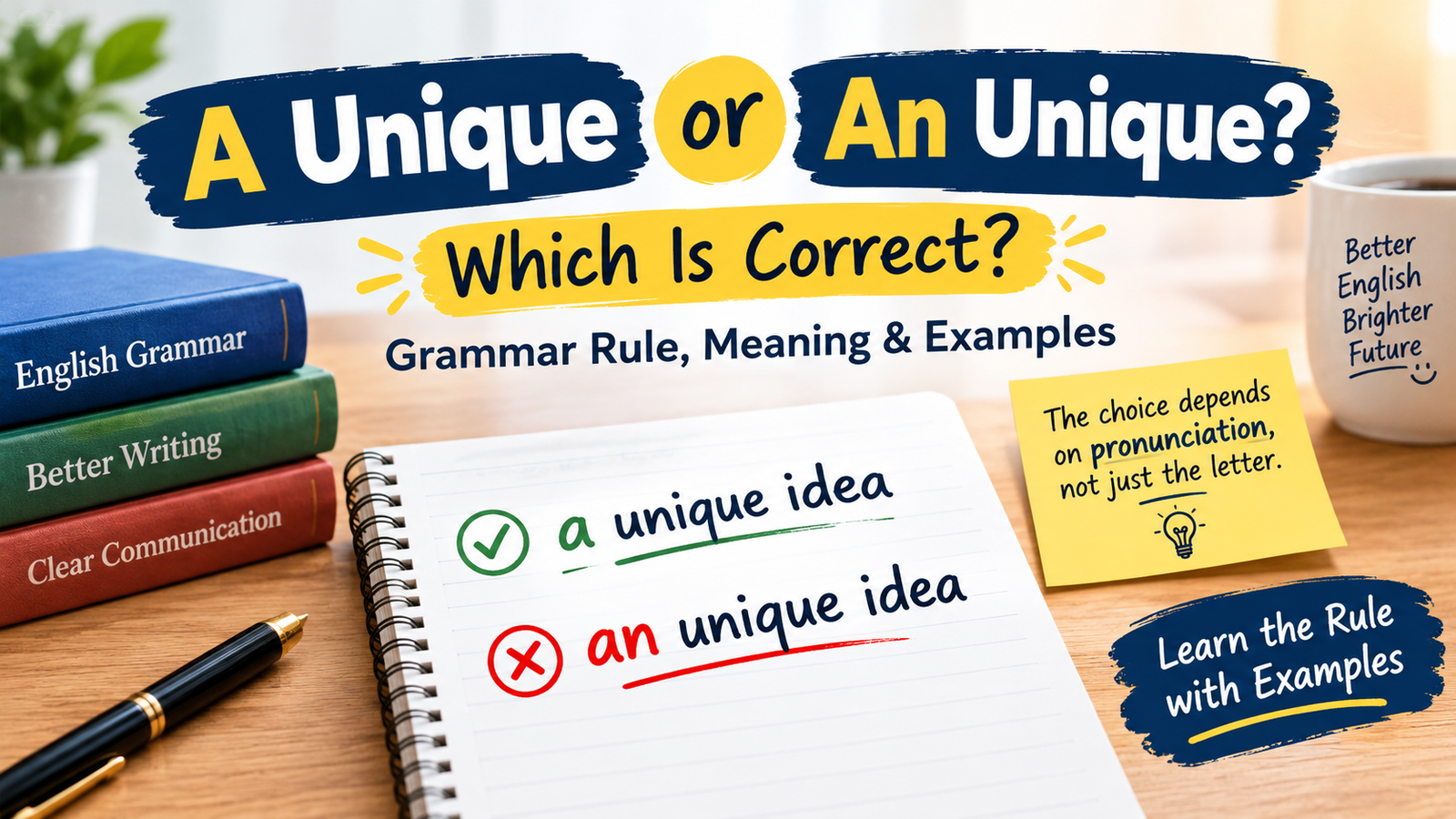
The correct expression is “a unique,” not “an unique.”
For example:
- She has a unique style. ✅
- She has an unique style. ❌
The reason is that unique begins with the sound /juː/, which is similar to the sound at the beginning of “you.” This is a consonant sound, so we use “a” rather than “an.”
In this article, we will explain the difference between a unique and an unique, the grammar rule behind it, pronunciation, common mistakes, and many practical examples A Unique or An Unique? Which Is Correct? Grammar Rule & Examples
A Unique or An Unique: The Correct Answer
The correct form is:
A unique ✅
The phrase “an unique” is grammatically incorrect in standard English.
The word unique is pronounced approximately as “yoo-NEEK.” Because the first sound is /j/, a consonant sound, the indefinite article “a” should be used.
Correct examples:
- This is a unique opportunity.
- She has a unique personality.
- He developed a unique approach to solving the problem.
- We discovered a unique solution.
- It was a unique experience.
Incorrect examples:
- This is an unique opportunity. ❌
- She has an unique personality. ❌
- He developed an unique approach. ❌
The important point is that the choice between “a” and “an” depends on pronunciation, not spelling.
Why Do We Say “A Unique”?
To understand why “a unique” is correct, you need to understand how indefinite articles work in English.
English uses two indefinite articles:
- a
- an
Generally, “a” is used before words beginning with a consonant sound, while “an” is used before words beginning with a vowel sound.
For example:
- a book
- a car
- a house
- a university
- an apple
- an orange
- an idea
- an hour
Notice that the rule is based on sound, not necessarily the written letter.
The word unique starts with a “yoo” sound:
unique → yoo-neek
Because “yoo” begins with a consonant sound, we use “a.”
Therefore:
a unique idea ✅
not:
an unique idea ❌
The Pronunciation Rule Behind “A Unique”
The pronunciation of unique is usually represented as:
/juːˈniːk/
The first sound is similar to the beginning of the word “you.”
Compare these:
- you → /juː/
- unique → /juːˈniːk/
- university → /ˌjuːnɪˈvɜːrsəti/
- uniform → /ˈjuːnɪfɔːrm/
- user → /ˈjuːzər/
All of these words begin with a “yoo” sound.
That is why we say:
- a unique idea
- a university
- a uniform
- a user
rather than:
- an unique idea ❌
- an university ❌
- an uniform ❌
- an user ❌
The spelling begins with a vowel letter, but the pronunciation begins with a consonant sound.
“A” and “An” Depend on Sound, Not Letter
One of the most important grammar rules to remember is:
Use “a” before a consonant sound.
Examples:
- a dog
- a teacher
- a university
- a European country
- a unique opportunity
Use “an” before a vowel sound.
Examples:
- an apple
- an engineer
- an idea
- an umbrella
- an hour
This explains why some words beginning with vowel letters take “a,” while some words beginning with consonant letters take “an.”
Words beginning with vowel letters but using “a”
- a university
- a uniform
- a useful tool
- a unique opportunity
- a European
- a user
Words beginning with consonant letters but using “an”
- an hour
- an honest person
- an honor
- an heir
- an MBA
In hour, the “h” is silent, so the word begins with a vowel sound.
This demonstrates why simply looking at the first letter is not enough.
What Does “Unique” Mean?
The adjective unique generally means one of a kind, unlike anything else, or different in a special way.
For example:
She has a unique talent.
This means her talent is unusual or different from others.
Another example:
The building has a unique design.
This means the design is distinctive or unlike ordinary designs.
The word can describe people, objects, experiences, ideas, opportunities, styles, qualities, situations, and many other things.
Examples of “A Unique” in Sentences
Here are several natural examples:
1. A Unique Opportunity
This scholarship provides a unique opportunity for young students.
2. A Unique Experience
Traveling through the region was a unique experience.
3. A Unique Design
The company created a unique design for its new product.
4. A Unique Idea
She presented a unique idea during the meeting.
5. A Unique Perspective
His background gives him a unique perspective on the issue.
6. A Unique Solution
The engineers developed a unique solution to the problem.
7. A Unique Personality
She has a unique personality that makes her memorable.
8. A Unique Approach
The teacher uses a unique approach to help students learn.
9. A Unique Style
The artist has a unique style.
10. A Unique Story
Every family has a unique story to tell.
All of these examples use “a unique” because unique begins with a consonant sound.
Is “An Unique” Ever Correct?
In standard modern English, “an unique” is generally considered incorrect.
Although you may occasionally see “an unique” in older texts, nonstandard writing, or writing by people applying the article rule based only on spelling, the standard form is:
a unique
For professional writing, academic writing, journalism, websites, business communication, and everyday standard English, use “a unique.”
For example:
Correct:
The company offers a unique service.
Incorrect:
The company offers an unique service.
A Unique vs. An Unique: Quick Comparison
| Phrase | Correct? | Reason |
|---|---|---|
| a unique idea | ✅ | “Unique” begins with a “yoo” consonant sound |
| an unique idea | ❌ | The first sound is not a vowel sound |
| a unique opportunity | ✅ | Begins with /juː/ |
| an unique opportunity | ❌ | Article does not match pronunciation |
| a unique person | ✅ | “Unique” starts with a consonant sound |
| an unique person | ❌ | Incorrect article |
The easiest rule is:
Listen to the first sound, not the first letter.
Why “A University” Is Correct Too
The same principle applies to university.
Many people incorrectly write:
an university ❌
The correct expression is:
a university ✅
This is because university is pronounced approximately:
yoo-ni-VER-si-ty
The first sound is “yoo,” which is a consonant sound.
The same pattern appears in:
- a university
- a uniform
- a union
- a useful tool
- a unique opportunity
- a European country
These words may begin with the letter u or e, but their pronunciation begins with a consonant sound.
Common Mistake: Choosing “An” Because of the Letter U
A common grammar mistake is to assume:
“U is a vowel, so I should use ‘an.’”
That rule is incomplete.
The correct rule is:
Use “an” before a vowel sound, not simply before a vowel letter.
For example:
umbrella begins with a vowel sound:
an umbrella ✅
But:
unique begins with a consonant “yoo” sound:
a unique idea ✅
Compare:
- an umbrella
- a unique idea
Both words begin with u, but their initial sounds are different.
A Simple Trick to Remember the Rule
If you are unsure whether to use “a” or “an,” say the phrase aloud.
Try:
“a unique”
It naturally sounds like:
“a yoo-neek”
Now try:
“an unique”
It sounds awkward because “an” normally connects to a following vowel sound.
A simple memory trick is:
Unique = “Yoo-neek” = consonant sound = “A”
Therefore:
a unique
Other Words Similar to “Unique”
Several English words follow the same pronunciation pattern.
A Useful
This is a useful tool.
Not:
This is an useful tool. ❌
A University
She attends a university.
Not:
She attends an university. ❌
A Uniform
He wore a uniform.
Not:
He wore an uniform. ❌
A European
She is a European citizen.
Not:
She is an European citizen. ❌
A User
The application has a new user.
Not:
The application has an new user. ❌
The pronunciation of these words begins with a sound similar to “y.”
“A Unique” in American and British English
The phrase “a unique” is standard in both American English and British English.
For example:
American English
The museum offers a unique experience.
British English
The museum offers a unique experience.
The article does not change simply because of the variety of English being used.
The pronunciation-based rule remains the same.
Frequently Asked Questions
Is “a unique” grammatically correct?
Yes. “A unique” is grammatically correct because the word unique begins with a consonant sound similar to “yoo.”
Is “an unique” correct?
No. In standard modern English, “an unique” is generally incorrect. The standard form is “a unique.”
Why is it “a unique” instead of “an unique”?
Because unique is pronounced with an initial /j/ sound, as in “you.” The choice between “a” and “an” depends on sound rather than spelling.
Is “a unique opportunity” correct?
Yes.
This is a unique opportunity.
This is the standard grammatical form.
Is “an unique opportunity” wrong?
Yes, in standard English, “an unique opportunity” is considered incorrect.
Do I use “a” before every word starting with U?
No. You need to consider pronunciation.
For example:
- a unique idea ✅
- a university ✅
- an umbrella ✅
“Umbrella” begins with a vowel sound, while “unique” begins with a consonant “yoo” sound.
Is “unique” pronounced with a Y sound?
Yes. Standard pronunciation begins with a sound similar to “you,” which is why “a” is used before it.
Final Answer: A Unique or An Unique?
The correct phrase is:
A Unique ✅
Not:
An Unique ❌
The reason is simple: articles are based on pronunciation, not spelling.
Although unique starts with the vowel letter U, it is pronounced “yoo-neek,” beginning with a consonant sound. Therefore, the correct article is “a.”
Remember:
a unique idea ✅
a unique opportunity ✅
a unique experience ✅
a unique style ✅
a unique solution ✅
If you remember just one rule, remember this:
Use “a” before a consonant sound and “an” before a vowel sound.
So whenever you are wondering whether to write “a unique” or “an unique,” choose “a unique.”