Else’s or Elses? The Correct Spelling and Grammar Explained
Else’s or Elses? The Correct Spelling and Grammar Explained
If you have ever wondered whether the correct form is “else’s” or “elses,” you are not alone. This small punctuation difference can be confusing because the word else does not behave like an ordinary noun. Understanding when to use else’s, when elses is incorrect, and how possessive expressions such as someone else’s work can make your English writing much clearer. Else’s or Elses? The Correct Spelling and Grammar Explained
The short answer is that “else’s” can be correct, while “elses” is generally not the standard form when you are trying to create a possessive. The apostrophe and the letter s have an important grammatical function. Else’s or Elses? The Correct Spelling and Grammar Explained
Is “Else’s” or “Elses” Correct?
In standard English, else’s is used when “else” is part of a possessive construction. Else’s or Elses? The Correct Spelling and Grammar Explained
For example:
- Someone else’s idea
- Anyone else’s opinion
- Somebody else’s phone
- Nobody else’s responsibility
The apostrophe before the s indicates possession.
By contrast, elses without an apostrophe is generally not the standard way to form a plural or possessive expression from “else.” The word else is normally used after words such as someone, somebody, anyone, anybody, everyone, and nobody.
For example, we say:
“Is this someone else’s bag?”
rather than:
“Is this someone elses bag?”
The second version is missing the apostrophe.
What Does “Else’s” Mean?
Else’s is the possessive form used when something belongs to or is associated with another person or thing represented by “else.”
Consider this sentence:
“I found someone else’s jacket.”
Here, “someone else” identifies another person, and the apostrophe-s in else’s shows that the jacket belongs to that person.
Another example is:
“That decision was anyone else’s responsibility.”
The expression indicates that the responsibility belonged to another person rather than the person being discussed.
In everyday English, else’s is most commonly found in expressions such as someone else’s, somebody else’s, anyone else’s, and nobody else’s.
Why Do We Use an Apostrophe?
The apostrophe is important because it signals possession.
Compare these examples:
Someone else is coming.
Here, else is not possessive.
Someone else’s car is outside.
Here, else’s is possessive because the car belongs to someone else.
The apostrophe changes the grammatical function of the phrase.
Without the apostrophe, writing “someone elses car” is considered incorrect in standard English. The correct form is:
“Someone else’s car.”
This is one of the most common punctuation mistakes involving the word “else.”
Is “Elses” a Word?
The form “elses” is generally not used as the standard plural or possessive form of “else.” In ordinary English writing, you should not add s directly to “else” to create “elses.”
For example, this is incorrect:
“I compared the opinions of several elses.”
English normally expresses the idea differently depending on what you mean.
Instead, you might say:
“I compared the opinions of several other people.”
Similarly, instead of writing:
“This belongs to someone elses.”
write:
“This belongs to someone else.”
Or, if you mean possession:
“This belongs to someone else.”
The exact construction depends on the sentence, but “elses” is usually not the form you want.
Someone Else vs. Someone Else’s
One of the easiest ways to understand the difference is to compare someone else with someone else’s.
Someone Else
“Someone else” means another person.
Example:
“Someone else called while you were away.”
In this sentence, “someone else” is the subject of the sentence.
Someone Else’s
“Someone else’s” indicates possession.
Example:
“Someone else’s phone was ringing.”
The phone belongs to another person.
This distinction can be summarized simply:
Someone else = another person
Someone else’s = belonging to another person
Remembering this difference will help you avoid many common grammar and punctuation errors.
Examples of “Else’s” in Sentences
Here are several examples showing how else’s can be used correctly:
- I accidentally took someone else’s umbrella.
- This is nobody else’s decision to make.
- Have you seen anyone else’s keys?
- We used somebody else’s computer.
- That idea sounds like someone else’s suggestion.
- The mistake was not anyone else’s fault.
- I respect everyone else’s opinion.
- She borrowed somebody else’s book.
In each example, else’s shows a possessive relationship.
What About “Everyone Else’s”?
The same rule applies to phrases beginning with everyone, everybody, anyone, anybody, someone, somebody, and nobody.
For example:
- Everyone else’s opinion
- Everybody else’s work
- Anyone else’s problem
- Anybody else’s responsibility
- Someone else’s mistake
- Somebody else’s property
- Nobody else’s business
Notice that the apostrophe comes before the s:
else’s
Not:
elses
This is because the expression is possessive.
“Else’s” at the End of a Sentence
Sometimes else’s can appear without an obvious noun immediately afterward because the noun is understood from the context.
For example:
“My opinion is different from everyone else’s.”
Here, the implied noun is opinion. The full meaning is:
“My opinion is different from everyone else’s opinion.”
English often allows the noun to be omitted when its meaning is already clear.
Another example:
“This pen isn’t mine; it must be someone else’s.”
The implied word is pen.
This construction is grammatically useful because it prevents unnecessary repetition.
Common Mistakes With “Else”
There are several mistakes that English learners frequently make with “else.”
Mistake 1: Using “elses”
Incorrect:
“Is this someone elses book?”
Correct:
“Is this someone else’s book?”
The apostrophe is required to show possession.
Mistake 2: Forgetting the Apostrophe
Incorrect:
“Everyone elses opinion matters.”
Correct:
“Everyone else’s opinion matters.”
Mistake 3: Putting the Apostrophe in the Wrong Place
Incorrect:
“Someone else’s” is correct.
The possessive ending is written else’s, not elses’ in this construction.
Mistake 4: Confusing “Else” With “Other”
Although “else” and “other” can sometimes have similar meanings, their grammatical patterns are different.
We commonly say:
someone else
but:
another person
We also say:
something else
but:
another thing
Using the correct structure makes the sentence sound natural.
Else’s vs. Other’s
Another potential source of confusion is the difference between else’s and other’s.
For example:
“Someone else’s car”
is a natural English expression.
“Other’s” can be correct in certain grammatical contexts, but it is much less interchangeable with “else’s.”
For example:
“Respect other people’s opinions.”
is more natural than trying to replace “other people” with “else.”
The choice depends on the meaning and structure of the sentence.
SEO and Search Queries: “Else’s or Elses?”
People searching for “else’s or elses” are usually looking for a quick explanation of whether the apostrophe is necessary. A useful rule is to remember that else’s is generally used to show possession, particularly in expressions such as someone else’s or anyone else’s.
For content creators, students, bloggers, and website owners, explaining the distinction clearly is more useful than simply stating that one spelling is correct. Readers often want to understand why the apostrophe appears and how to use the word naturally in a sentence.
Related search phrases include:
- Else’s or elses
- Is else’s correct?
- Is elses a word?
- Someone else’s meaning
- Someone else’s grammar
- How to use else’s
- Else possessive form
- Correct spelling of else’s
Including these concepts naturally can make an educational article more useful for readers searching for grammar help.
Frequently Asked Questions
Is “else’s” correct?
Yes. Else’s is correct when used as a possessive form, especially in phrases such as someone else’s and anyone else’s.
Is “elses” correct?
Elses is generally not the standard form used in ordinary English. If you mean possession, use else’s with an apostrophe.
What is the possessive form of “else”?
The possessive form commonly appears as else’s, particularly after words such as someone, somebody, anyone, anybody, everyone, everybody, and nobody.
Which is correct: someone elses or someone else’s?
The correct form is someone else’s.
For example:
“That is someone else’s bag.”
Can “else’s” appear at the end of a sentence?
Yes. For example:
“My answer is different from everyone else’s.”
The noun after the possessive is understood from context.
Final Answer: Else’s or Elses?
When deciding between “else’s” and “elses,” use else’s when you need a possessive form. The apostrophe is essential because it shows that something belongs to or is associated with someone or something else.
The most common examples are someone else’s, somebody else’s, anyone else’s, everybody else’s, and nobody else’s.
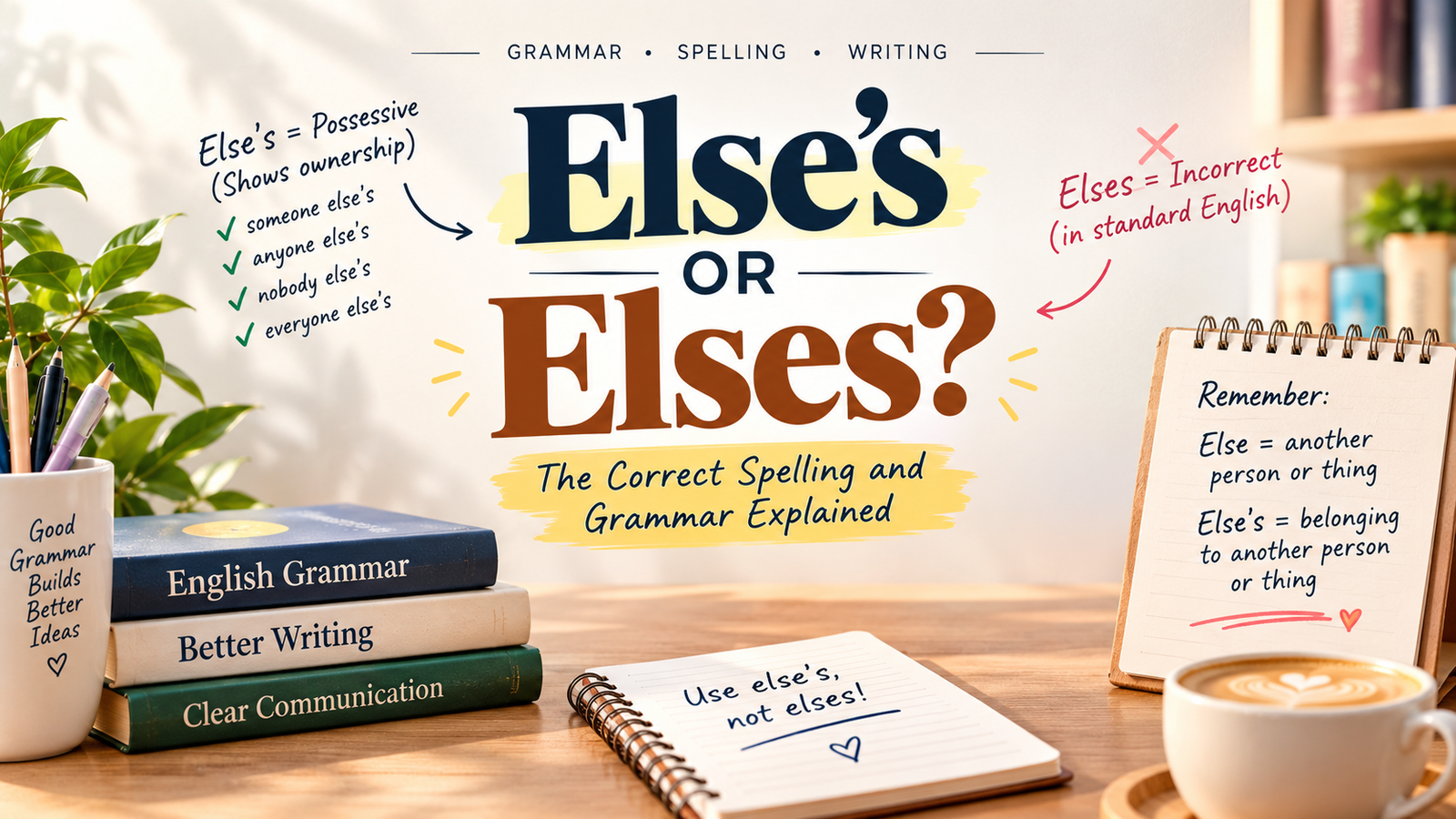
Remember this simple rule:
Else = another person or thing
Else’s = belonging to another person or thing
Elses = generally not the standard form
For clear, professional, and grammatically correct English, write “someone else’s,” not “someone elses.” Once you understand the role of the apostrophe, choosing the correct form becomes much easier.