Me Either or Me Neither: Which Is Correct?
Me Either or Me Neither: Which Is Correct?
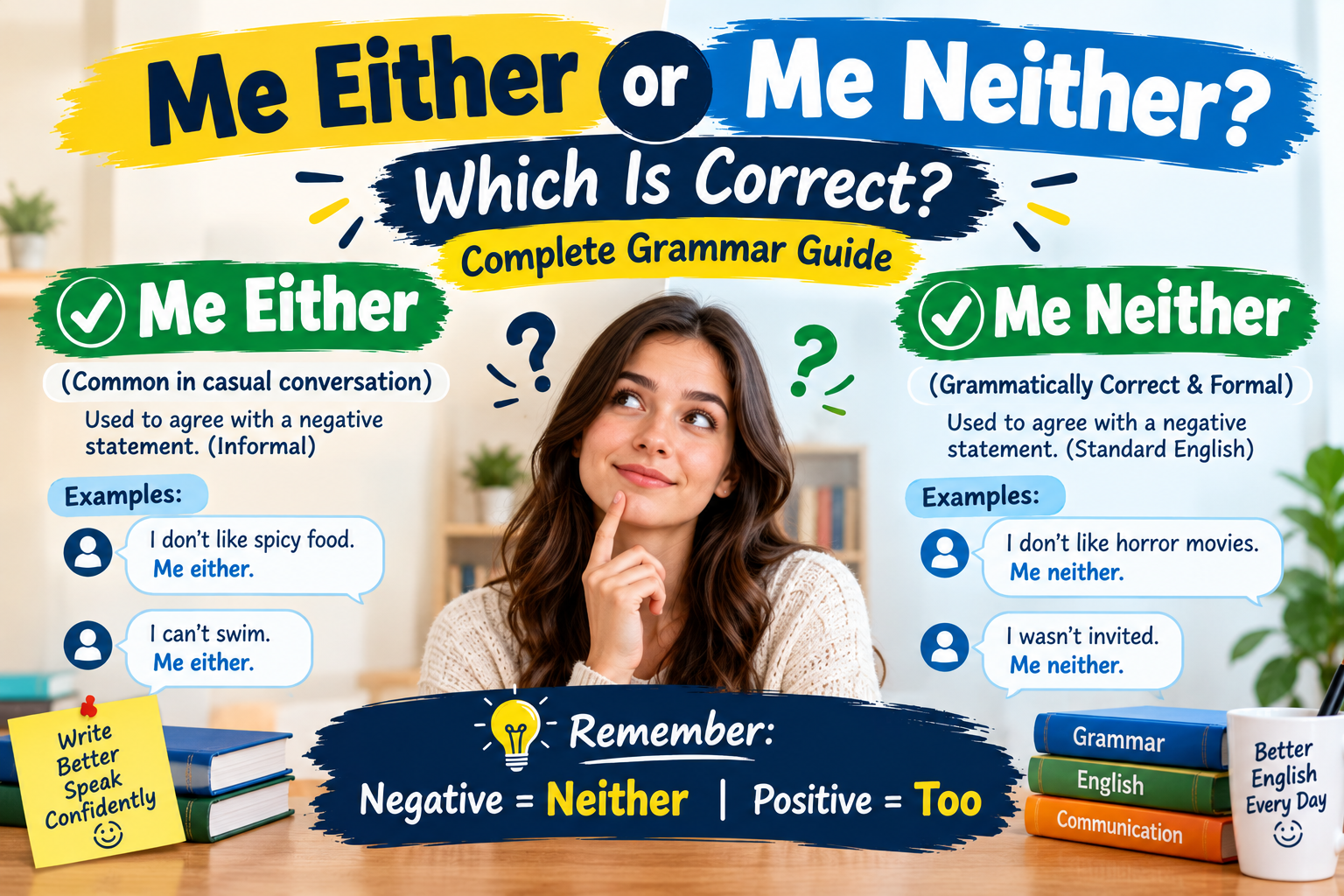
Many English learners struggle with the phrases “me either” and “me neither.” If you have ever wondered which one is correct, you are not alone. These expressions are commonly used in everyday conversations, movies, TV shows, and social media. However, their grammatical usage often causes confusion.
In this comprehensive guide, we will explain the difference between me either and me neither, when to use them, provide examples, discuss common mistakes, and help you sound more natural and confident in English conversations.
Quick Answer: Me Either or Me Neither?
Traditionally and grammatically, “me neither” is considered the correct response to a negative statement.
Example
Person A: “I don’t like spicy food.”
Person B: “Me neither.” ✅
Although many native English speakers also say “me either” in casual conversation, “me neither” is generally regarded as the more grammatically correct form.
What Does “Me Neither” Mean?
The phrase “me neither” means:
“I don’t either.”
It is used to agree with a negative statement made by another person.
Examples
- “I don’t enjoy horror movies.”
- “Me neither.”
- “I can’t swim.”
- “Me neither.”
- “I wasn’t invited.”
- “Me neither.”
In each example, the second speaker is expressing the same negative feeling or experience.
Why Is “Me Neither” Grammatically Correct?
The word neither already carries a negative meaning.
When someone says:
“I don’t like coffee.”
A grammatically correct agreement is:
“Neither do I.”
or
“Me neither.”
Because the original statement is negative, neither naturally fits the response.
Example
- I don’t eat meat.
- Me neither.
This structure has been accepted in English grammar for centuries.
What About “Me Either”?
Interestingly, “me either” is extremely common in spoken English, especially in American English.
Example
Person A:
“I don’t want to go.”
Person B:
“Me either.”
Many native speakers use this response naturally in everyday conversations.
However, some grammar experts consider it informal because either is traditionally associated with positive agreement structures.
Why Do People Say “Me Either”?
Language evolves through common usage.
Over time, millions of English speakers began using:
“Me either”
as a shortened version of:
“I don’t either.”
As a result, the phrase became widespread in casual conversation.
Today, many people use it naturally without even realizing it differs from the traditional grammar rule.
Formal vs Informal Usage
Formal English
In formal writing and professional communication, use:
✅ Me neither
or
✅ Neither do I
Informal Spoken English
In everyday conversation, both are commonly heard:
✅ Me neither
✅ Me either
However, me neither remains the safer choice if you want grammatically standard English.
Examples of “Me Neither”
Conversation Examples
Example 1
- I don’t like cold weather.
- Me neither.
Example 2
- I can’t drive.
- Me neither.
Example 3
- I wasn’t ready for the test.
- Me neither.
Example 4
- I don’t watch reality TV.
- Me neither.
These examples sound natural and grammatically correct.
Examples of “Me Either”
Casual Conversation
Example 1
- I don’t want pizza tonight.
- Me either.
Example 2
- I haven’t seen that movie.
- Me either.
Example 3
- I don’t understand the homework.
- Me either.
These examples are common in everyday speech, especially among native speakers in North America.
Neither Do I vs Me Neither
Many English learners ask which form sounds better.
Standard Grammar
- Neither do I.
Casual Speech
- Me neither.
Both communicate the same idea.
Example
Person A:
I don’t like broccoli.
Person B:
Neither do I.
or
Me neither.
Both responses are correct.
Common Mistakes
Incorrect
- I don’t like coffee.
- Me too.
This is incorrect because me too agrees with positive statements, not negative ones.
Correct
- I don’t like coffee.
- Me neither.
Another Example
Incorrect:
- I can’t swim.
- Me too.
Correct:
- I can’t swim.
- Me neither.
Me Too vs Me Neither
Understanding this difference is very important.
Use “Me Too” for Positive Statements
Example:
- I love chocolate.
- Me too.
Use “Me Neither” for Negative Statements
Example:
- I don’t like chocolate.
- Me neither.
Comparison Table
| Statement Type | Correct Response |
|---|---|
| Positive | Me too |
| Negative | Me neither |
| Positive | So do I |
| Negative | Neither do I |
Real-Life Examples
At School
- I didn’t finish the assignment.
- Me neither.
At Work
- I don’t enjoy long meetings.
- Me neither.
Among Friends
- I can’t stay out late tonight.
- Me neither.
Family Conversation
- I don’t feel hungry.
- Me neither.
These are natural situations where the phrase is commonly used.
Which Form Should You Use?
If you’re learning English and want the safest choice:
Use:
✅ Me neither
It is accepted in both spoken and written English.
You can also use:
✅ Neither do I
for a more formal and grammatically complete response.
Memory Trick
A simple trick can help you remember:
Negative Statement → Neither
Example:
- I don’t like snakes.
- Me neither.
Positive Statement → Too
Example:
- I like pizza.
- Me too.
Remember:
Negative = Neither
Positive = Too
This rule works in most everyday conversations.
Frequently Asked Questions
Is “me either” wrong?
Not necessarily. It is very common in casual speech, especially in American English. However, many grammar guides prefer me neither.
Is “me neither” grammatically correct?
Yes. It is the traditional and grammatically accepted response to a negative statement.
Which sounds more professional?
“Me neither” or “Neither do I” sounds more professional and formal.
Do native speakers use “me either”?
Yes. Millions of native speakers use it every day in informal conversation.
Can I use “me too” after a negative statement?
No.
Incorrect:
- I don’t like coffee.
- Me too.
Correct:
- I don’t like coffee.
- Me neither.
Conclusion
When choosing between me either and me neither, the traditional grammar rule favors me neither. It is the standard response to a negative statement and works well in both formal and informal situations.
Although me either is extremely common in everyday speech, especially in American English, learners and professional writers should generally prefer me neither when aiming for grammatical accuracy.
Quick Summary
✅ I don’t like coffee. → Me neither.
✅ I can’t swim. → Me neither.
✅ I wasn’t invited. → Me neither.
✅ I love pizza. → Me too.
❌ I don’t like coffee. → Me too.
By remembering the simple rule “Positive = Me Too, Negative = Me Neither,” you’ll be able to use these expressions confidently and correctly in everyday English conversations.