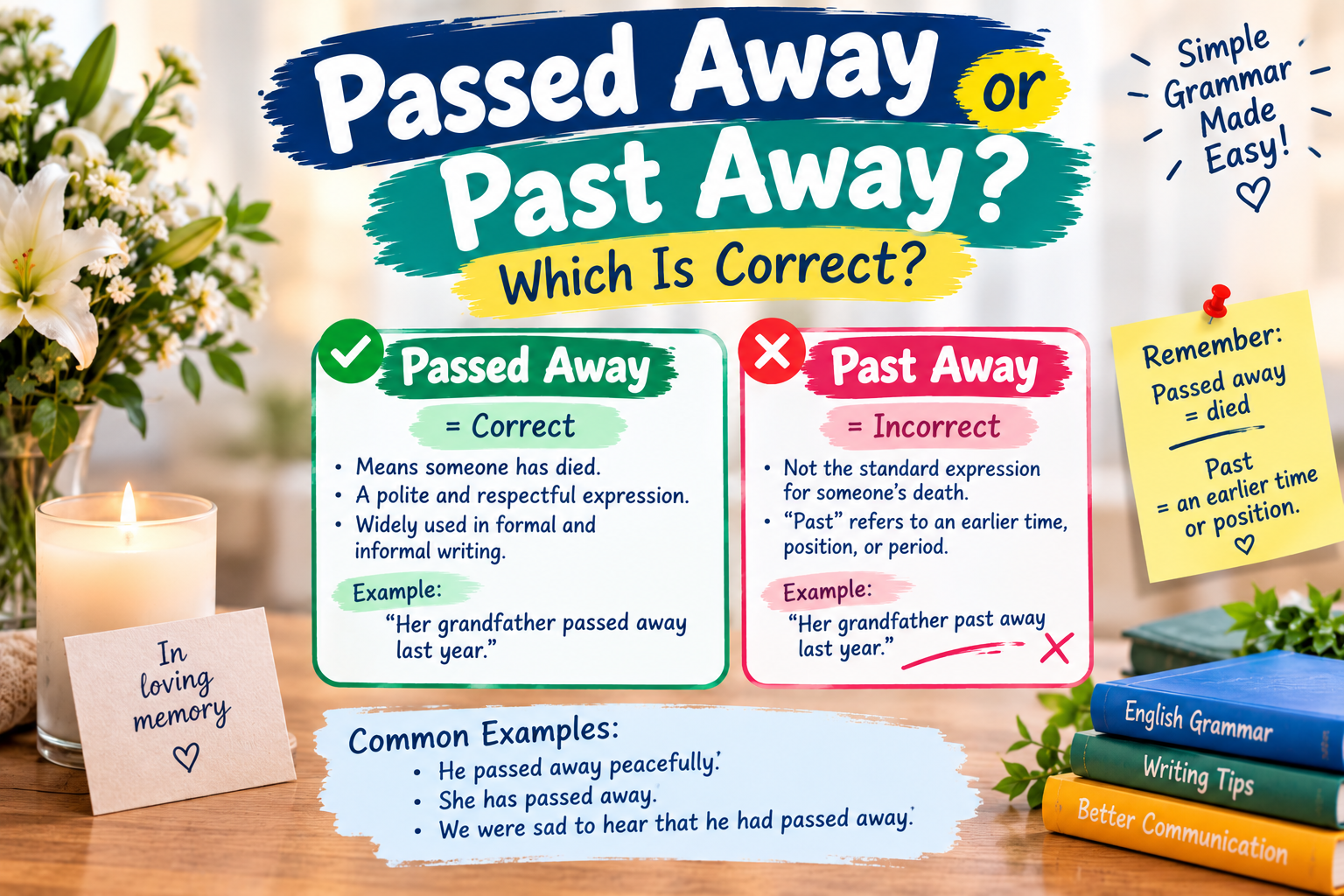
Passed Away or Past Away: Which Is Correct?
Passed Away or Past Away: Which Is Correct?
Have you ever wondered whether the correct phrase is “passed away” or “past away”? These two expressions sound similar when spoken, which is why they are sometimes confused. However, they have completely different grammatical roles.
The correct phrase is “passed away.” It is a polite and commonly used expression meaning that someone has died. “Past away” is not the standard expression and should not be used when referring to someone’s death.
Understanding the difference is especially important when writing an obituary, sympathy message, news article, social media post, or formal announcement. Using the correct phrase helps your writing remain clear, respectful, and grammatically accurate.
In this guide, you will learn why “passed away” is correct, what “past” means, how to use “passed away” in a sentence, and how to avoid common mistakes.
Passed Away or Past Away: The Correct Answer
The correct expression is “passed away.”
“Passed” is the past tense of the verb “pass.” The phrase “passed away” is a common euphemism for saying that someone has died.
For example:
- Her grandfather passed away last year.
- His father passed away peacefully.
- We were saddened to learn that she had passed away.
- My uncle passed away at the age of 82.
By contrast, “past away” is incorrect when referring to someone’s death.
The word “past” usually functions as a preposition, adjective, noun, or adverb referring to time, position, or something that has already happened.
For example:
- We drove past the school.
- The difficult times are in the past.
- It is half past three.
- She walked past me.
Therefore, when you mean that someone has died, use “passed away,” not “past away.”
What Does Passed Away Mean?
“Passed away” is a polite and indirect way of saying that someone has died.
The expression is widely used in everyday English, formal announcements, obituaries, news writing, sympathy messages, and conversations about death.
For example:
“Her mother passed away peacefully surrounded by her family.”
This sentence communicates the person’s death in a softer and more respectful way than simply saying “Her mother died.”
The phrase can be used with different tenses depending on the context.
Present perfect
- She has passed away.
- He has recently passed away.
Simple past
- She passed away last night.
- His grandfather passed away in 2020.
Past perfect
- He had passed away before the family arrived.
The expression itself remains “passed away”; only the auxiliary verb may change according to the tense.
Why Is “Past Away” Incorrect?
The confusion happens because “passed” and “past” sound very similar in many varieties of English.
However, they are different words with different meanings.
Passed is generally a verb form.
For example:
- She passed the exam.
- He passed me the ball.
- They passed the house.
- His grandfather passed away.
Past usually relates to an earlier time, position, or period.
For example:
- We talked about the past.
- He walked past the store.
- The train went past us.
- It is half past six.
When talking about someone’s death, the expression uses the verb “passed.” Therefore, the correct phrase is “passed away.”
Passed vs. Past: What’s the Difference?
Understanding the difference between “passed” and “past” makes this grammar rule easier to remember.
| Word | Common Function | Example |
|---|---|---|
| Passed | Verb | She passed the house. |
| Passed | Verb | He passed away peacefully. |
| Past | Noun | We cannot change the past. |
| Past | Adjective | His past experiences helped him. |
| Past | Preposition | She walked past the door. |
| Past | Adverb | The car drove past. |
A simple way to remember the difference is:
Passed = an action.
Past = time, position, or something earlier.
Since “passed away” describes an action or event, “passed” is the correct word.
Examples of Passed Away in Sentences
Here are several examples showing how to use “passed away” correctly.
- My grandfather passed away peacefully last winter.
- Her aunt passed away after a long illness.
- We were very sad to hear that he had passed away.
- His father passed away when he was young.
- The actor passed away surrounded by family.
- She passed away peacefully at home.
- Their beloved dog passed away last month.
- The family announced that their mother had passed away.
- We remember him with love after he passed away.
- I was sorry to hear that your grandmother passed away.
These examples show that “passed away” can be used in personal conversations as well as formal writing.
Is Passed Away More Polite Than Died?
“Passed away” is generally considered a softer or more euphemistic expression for “died.”
Both phrases are grammatically correct, but they can create different tones.
“Died” is direct and factual:
- Her father died in 2018.
“Passed away” is more indirect and often sounds gentler:
- Her father passed away in 2018.
The choice depends on the context.
In a news report, medical or historical context, “died” may be the clearest choice. In condolences, obituaries, personal announcements, and sensitive conversations, “passed away” is often preferred because it has a more respectful and gentle tone.
Is It “Has Passed Away” or “Had Passed Away”?
Both can be correct, depending on the timeline.
Use “has passed away” when discussing a recent event or an event connected to the present.
Example:
- We have just learned that her father has passed away.
Use “had passed away” when describing an event that occurred before another event in the past.
Example:
- By the time the family arrived, he had passed away.
Use “passed away” for a straightforward past event.
Example:
- Her grandfather passed away in 2015.
The important point is that the expression uses “passed,” not “past.”
Passed Away vs. Passed On
Another expression you may encounter is “passed on.”
“Passed on” can also be used as a euphemism for death, although it has other meanings depending on context.
For example:
- Her grandmother passed away peacefully.
- Her grandmother passed on peacefully.
Both can communicate the same general idea in a suitable context.
However, “passed away” is especially common in standard English when referring to someone’s death.
Be careful not to confuse “passed on” with the unrelated meaning of transferring something to another person.
For example:
- She passed the information on to her colleague.
Here, “passed on” does not refer to death.
Common Mistakes to Avoid
Mistake 1: Past Away
Incorrect: Her grandfather past away last year.
Correct: Her grandfather passed away last year.
Mistake 2: Past Away Peacefully
Incorrect: He past away peacefully.
Correct: He passed away peacefully.
Mistake 3: Passed Away From a Place
“Passed away” has a specific meaning when discussing death. If you are describing movement beyond a location, use “passed” with the appropriate preposition.
For example:
- She passed the store.
- He walked past the store.
These have nothing to do with death.
Frequently Asked Questions
1. Is it passed away or past away?
“Passed away” is correct. “Past away” is incorrect when referring to someone’s death.
2. What does passed away mean?
“Passed away” is a polite or indirect expression meaning that someone has died.
3. Why do people say passed away instead of died?
“Passed away” is often used because it sounds softer and more respectful, particularly in condolences, obituaries, and personal announcements.
4. Is “past away” ever correct?
Not as the standard expression meaning “died.” When referring to someone’s death, use “passed away.”
5. Is it “has passed away” or “has past away”?
The correct form is “has passed away.” “Passed” is the past participle needed after “has.”
6. What is the difference between passed and past?
“Passed” is commonly a verb referring to an action, while “past” commonly refers to an earlier time, position, or period.
7. Can I use “passed away” in formal writing?
Yes. “Passed away” is widely used in formal and respectful writing, including obituaries, announcements, condolences, and other sensitive communications.
Final Thoughts
When choosing between “passed away” and “past away,” the correct phrase is “passed away.”
“Passed” is the past tense and past participle of the verb “pass,” while “past” refers to an earlier time, position, or period. Because “passed away” is an established expression meaning “died,” “past away” should not be used in standard English for this meaning.
The easiest rule to remember is:
Passed away = died.
Past = an earlier time or position.
So, if you are writing a condolence message, obituary, announcement, article, or personal note, write “passed away,” not “past away.”