People’s or Peoples: What Is the Difference?
People’s or Peoples: What Is the Difference?
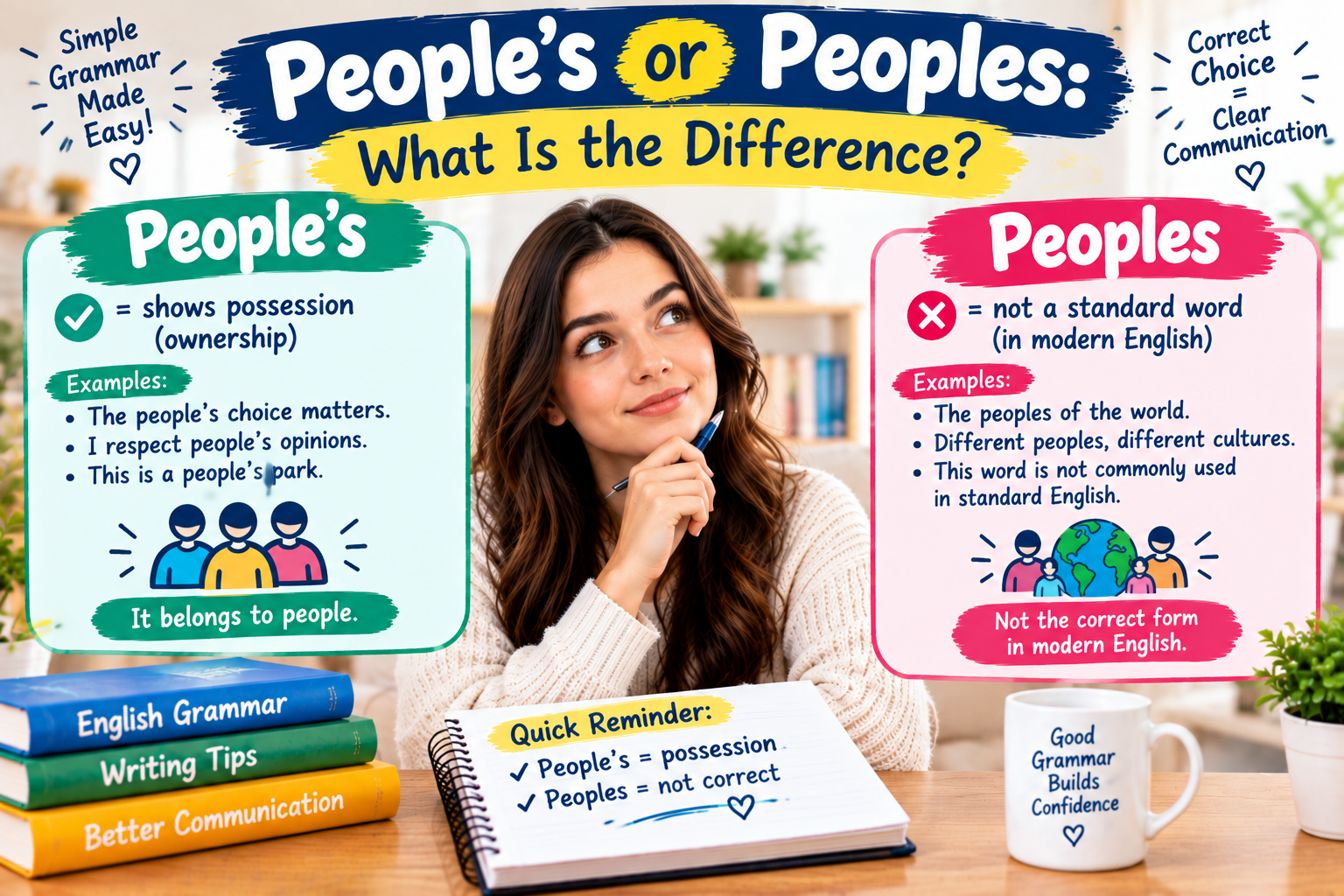
The words “people’s” and “peoples” look very similar, but they have different meanings and grammatical functions. This small difference can cause confusion, especially when writing about communities, society, culture, ownership, or groups of people. People’s or Peoples: What Is the Difference?
The easiest way to remember the difference is:
- People’s = possessive form, meaning something belongs to or is associated with people.
- Peoples = plural of people when referring to distinct groups or populations.
- Peoples’ = possessive form of peoples, meaning something belongs to multiple distinct groups.
For example:
The people’s choice was clear.
Here, the apostrophe shows possession or association.
But:
The indigenous peoples of the region have different languages and traditions.
Here, peoples refers to multiple distinct groups.
Understanding the difference between people’s, peoples, and peoples’ will help you write more accurately in academic, professional, journalistic, and everyday English.
People’s or Peoples: The Quick Answer
If you are trying to decide between people’s and peoples, ask yourself what you mean.
Use “people’s” when showing possession
The people’s opinions were collected in a survey.
This means the opinions belong to or are held by the people.
Use “peoples” when referring to distinct groups
The world is home to many different peoples.
Here, “peoples” means different populations, ethnic groups, or cultural groups.
Use “peoples’” when showing possession by multiple distinct groups
The rights of indigenous peoples must be respected.
In this sentence, “peoples” itself is plural, but if you write the possessive form, you would use:
The peoples’ rights must be respected.
The apostrophe comes after the s because peoples is already plural.
What Does “People’s” Mean?
People’s is normally the possessive form of people.
It indicates that something belongs to, is associated with, or relates to people.
For example:
The people’s decision surprised everyone.
The government listened to the people’s concerns.
The people’s voices were heard.
This policy could affect ordinary people’s lives.
In each sentence, the apostrophe and “s” indicate a relationship between people and the following noun.
More Examples of People’s
The people’s choice matters.
We should respect people’s opinions.
The organization protects people’s rights.
The article examines people’s experiences.
Technology has changed people’s lives.
A useful way to understand people’s is to mentally replace it with “of the people.”
For example:
People’s rights
can be understood as:
The rights of the people.
Similarly:
People’s opinions
means:
The opinions of the people.
What Does “Peoples” Mean?
Peoples is the plural form used when people refers to separate or distinct groups.
Normally, people already functions as the plural of person:
One person
Two people
So why would we ever use peoples?
The word peoples is generally used when emphasizing that there are different groups of people, especially groups with distinct cultural, ethnic, national, linguistic, or historical identities.
For example:
The indigenous peoples of the Americas have diverse cultures.
Here, “peoples” does not simply mean a large number of individuals. It refers to multiple distinct peoples or communities.
Another example:
Many peoples have contributed to the region’s history.
This emphasizes different groups rather than individuals.
People vs. Peoples
This distinction is important.
People
People can mean human beings collectively or a group of individuals.
Many people live in the city.
The people voted in the election.
Thousands of people attended the event.
Peoples
Peoples emphasizes multiple distinct groups.
The region is home to several indigenous peoples.
Different peoples have preserved their languages for centuries.
The history of the area includes many different peoples.
In everyday conversation, people is much more common. Peoples is more specialized and is frequently found in historical, anthropological, cultural, political, and academic writing.
What Does “Peoples’” Mean?
There is a third form that is often confused with the other two:
Peoples’
This is the possessive form of peoples.
Because peoples is already plural, the apostrophe comes after the s.
For example:
The peoples’ traditions should be preserved.
This means the traditions belonging to multiple distinct peoples.
Another example:
The peoples’ languages reflect the region’s diverse history.
Here, multiple distinct groups have languages, so peoples’ is appropriate.
Compare the three forms:
- People = individuals or a collective group
- People’s = belonging to people
- Peoples = multiple distinct groups
- Peoples’ = belonging to multiple distinct groups
People’s vs. Peoples: Examples
Let’s compare the words in complete sentences.
Example 1: People’s
The people’s opinions were important to the researchers.
The apostrophe indicates possession or association.
Example 2: Peoples
The country is home to many different peoples.
Here, “peoples” means distinct cultural or ethnic groups.
Example 3: Peoples’
The peoples’ traditions have been passed down through generations.
The possessive form refers to traditions belonging to multiple distinct peoples.
How to Know Which One to Use
A simple three-question test can help.
Question 1: Does something belong to people?
If yes, use people’s.
People’s rights
People’s opinions
People’s lives
Question 2: Are you talking about several distinct groups?
If yes, use peoples.
Indigenous peoples
Ancient peoples
Different peoples
Question 3: Does something belong to those distinct groups?
If yes, use peoples’.
Indigenous peoples’ traditions
Different peoples’ languages
Ancient peoples’ customs
This simple test covers most situations.
Common Mistake: “Peoples” Instead of “People’s”
One common mistake is writing peoples when you actually mean possession.
For example:
Incorrect: The peoples rights should be protected.
The intended meaning is that the rights belong to the people.
Therefore, write:
Correct: The people’s rights should be protected.
The apostrophe is important because it shows possession.
Common Mistake: “People’s” Instead of “Peoples”
The opposite mistake also happens.
Suppose you are discussing several distinct cultural groups:
The region is home to several indigenous peoples.
Writing:
The region is home to several indigenous people’s.
would change the grammatical structure and meaning.
In this context, peoples is the appropriate plural noun because the sentence refers to distinct groups.
Is “Peoples” Grammatically Correct?
Yes. Peoples is a legitimate English word.
However, it is not simply the ordinary plural of people in every situation.
For most sentences involving multiple individuals, use people:
Millions of people live in the country.
You would not normally write:
Millions of peoples live in the country.
But when discussing multiple distinct populations or cultural groups, peoples can be correct:
Several indigenous peoples live in the region.
The context determines which form is appropriate.
People’s in Everyday English
People’s is extremely common in everyday English.
You will often see it in expressions such as:
- people’s rights
- people’s opinions
- people’s lives
- people’s choices
- people’s needs
- people’s homes
- people’s money
- people’s experiences
- people’s health
- people’s concerns
For example:
Social media can influence people’s opinions.
The program aims to improve people’s lives.
Businesses need to understand people’s needs.
In all these examples, the apostrophe indicates possession or association.
Peoples in Academic and Historical Writing
The word peoples appears particularly often in academic and historical writing.
For example:
Ancient peoples developed complex systems of trade.
The migration of different peoples shaped the region’s history.
Indigenous peoples have maintained cultural traditions for generations.
In these examples, the writer is emphasizing distinct communities rather than simply counting individuals.
You may therefore encounter peoples more frequently in subjects such as:
- History
- Anthropology
- Sociology
- Cultural studies
- Indigenous studies
- International relations
- Linguistics
Frequently Asked Questions
Is it people’s or peoples?
It depends on the meaning.
Use people’s to show possession or association:
People’s rights
Use peoples to refer to multiple distinct groups:
Indigenous peoples
What is the plural of people?
In ordinary usage, people is already the plural of person.
One person → two people
Peoples is used in a more specific sense to refer to distinct groups or populations.
Is “people’s” possessive?
Yes. People’s is generally the possessive form of people.
For example:
People’s opinions
means:
The opinions of the people.
What is the difference between peoples and peoples’?
Peoples is a plural noun referring to distinct groups.
Peoples’ is the possessive form of that plural noun.
For example:
Indigenous peoples have diverse cultures.
Indigenous peoples’ cultures are diverse.
Is “people’s lives” correct?
Yes.
The decision affected many people’s lives.
Here, people’s shows that the lives belong to or are associated with people.
Is “peoples rights” correct?
Not when you mean “the rights of the people.”
The correct form is:
People’s rights
If you are referring to multiple distinct peoples, you could write:
Peoples’ rights
The exact choice depends on the intended meaning.
Can “peoples” refer to ethnic groups?
Yes. Peoples is commonly used to refer to distinct ethnic, cultural, linguistic, or national groups.
Should I use “people” or “peoples” in normal conversation?
For ordinary references to human beings, use people.
Use peoples when you specifically need to distinguish between different groups or populations.
Final Answer: People’s or Peoples?
The difference between people’s and peoples becomes much easier once you understand their grammatical roles.
Use “people’s” for possession:
People’s rights are important.
We should respect people’s opinions.
The decision affected people’s lives.
Use “peoples” for distinct groups:
Indigenous peoples have diverse traditions.
Several peoples lived in the region.
Use “peoples’” for possession by distinct groups:
The peoples’ traditions are important.
The peoples’ languages are being documented.
The most important point is that people is normally already plural when it means more than one person. Peoples has a more specific meaning: it refers to multiple distinct groups.
So, when deciding between the forms, ask yourself whether you are talking about possession or distinct groups.
If something belongs to people, use people’s.
If you are referring to multiple distinct groups, use peoples.
If something belongs to those distinct groups, use peoples’.
Once this distinction is clear, these three commonly confused forms become much easier to use correctly in professional, academic, and everyday English.