Never Mind or Nevermind: Which Is Correct?
Never Mind or Nevermind: Which Is Correct?
Never mind or nevermind? If you have ever wondered whether this common English expression should be written as two words or one, you are not alone. Both “never mind” and “nevermind” appear frequently in conversations, text messages, social media posts, books, and online content.
But which spelling is correct?
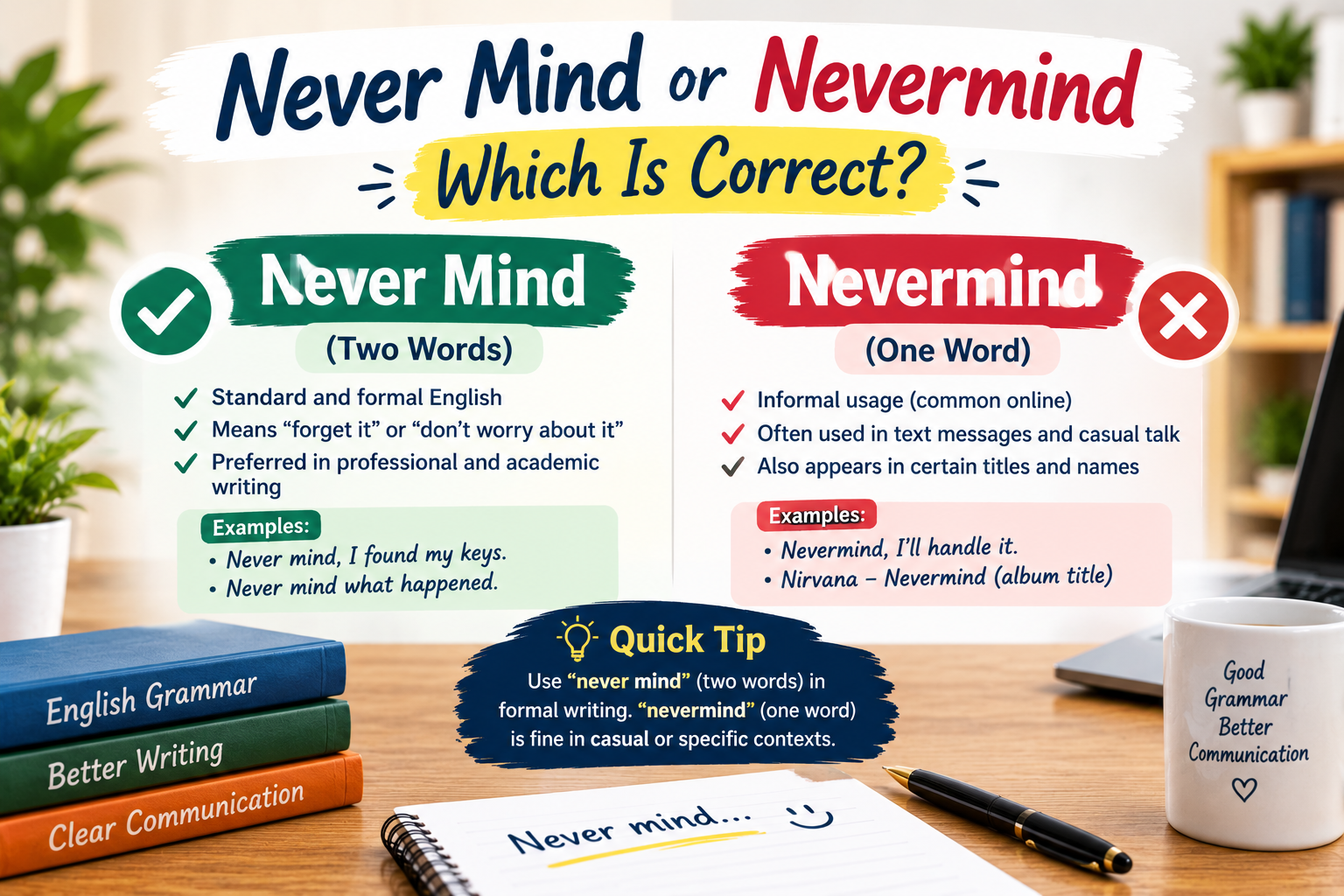
In standard English, “never mind” is generally the preferred form when the expression means “forget it,” “don’t worry about it,” or “it doesn’t matter.”
For example:
Never mind, I found my phone.
Never mind what I said earlier.
Never mind, we can try again tomorrow.
The one-word form “nevermind” is also encountered, especially in informal American English and in specific titles or names. However, when you want to use the conventional expression in professional, academic, or polished writing, “never mind” is the safest choice.
Never Mind or Nevermind: Quick Answer
The basic rule is straightforward:
Use “never mind” as two words when you mean “forget it,” “don’t worry,” or “it doesn’t matter.”
Correct:
Never mind, I’ll handle it.
Standard form:
Never mind what happened.
Informal variant:
Nevermind, I’ll handle it.
Although many people use the one-word spelling in casual communication, never mind is the traditional standard form for the expression.
What Does “Never Mind” Mean?
The expression never mind can have several closely related meanings depending on the context.
It can mean:
- Forget what I just said.
- Don’t worry about it.
- It doesn’t matter.
- Don’t pay attention to something.
- Don’t concern yourself with something.
- The problem has been resolved.
For example:
“Where are my glasses? Oh, never mind. I found them.”
In this sentence, never mind means that the speaker no longer needs help because the problem has been solved.
Another example is:
Never mind the noise and continue working.
Here, it means don’t pay attention to the noise.
Why Is “Never Mind” Usually Written as Two Words?
The traditional expression consists of two separate words: never and mind.
The word never functions as an adverb, while mind functions as a verb or noun depending on the construction.
Together, the phrase developed into an established expression meaning something similar to “do not concern yourself with this” or “forget about it.”
Because the expression has traditionally been written as two words, never mind remains the preferred form in standard usage.
This is particularly important when writing:
- Academic papers
- Business emails
- Professional articles
- News content
- Reports
- Formal letters
- Website copy
What Does “Nevermind” Mean?
Nevermind is a one-word spelling that appears in modern informal English.
You may see it frequently in:
- Text messages
- Social media
- Online forums
- Casual conversations
- Informal blogs
- Song titles
- Names and brands
For example:
Nevermind, I already solved it.
Most English speakers will understand this immediately.
However, frequent appearance does not necessarily mean it is the preferred form for every context. If you are trying to follow traditional standard-English conventions, never mind is generally the better choice.
Never Mind vs. Nevermind in Formal Writing
The difference becomes especially important when you are writing for a professional or academic audience.
Consider:
Never mind, we have received the documents.
This follows the conventional spelling.
You might also see:
Nevermind, we have received the documents.
The meaning is clear, but the one-word form is more informal.
For polished writing, choose never mind.
Professional example
Never mind the earlier version of the report. Please use the revised document attached to this email.
Academic example
Never mind the previous assumption; the latest evidence suggests a different conclusion.
Using the two-word form keeps the expression consistent with traditional standard English.
When Should You Use “Never Mind”?
There are several common situations where never mind is appropriate.
1. When You Want Someone to Forget Something
Never mind what I said earlier.
Here, you are asking the listener to disregard your previous statement.
2. When a Problem Has Been Solved
Never mind, I found the missing file.
The speaker no longer needs assistance.
3. When Something Is Not Important
Never mind the cost for now.
The speaker is telling someone not to focus on the cost.
4. When You Want Someone Not to Worry
Never mind about the mistake. We can fix it.
Here, the phrase reassures the other person.
5. When You Change Your Mind
I was going to ask you something, but never mind.
The speaker decides not to ask the question.
Common Examples of “Never Mind”
Here are some natural examples:
Never mind, I’ll do it myself.
Never mind, everything is fine now.
Never mind what they think.
Never mind about dinner; I’ve already eaten.
Never mind the delay.
Never mind, I remembered where I put it.
I wanted to ask a question, but never mind.
Never mind what happened yesterday.
These examples show why the expression is so common in everyday English.
Is “Nevermind” Wrong?
It is better to avoid saying that nevermind is always wrong.
English usage changes over time, and the one-word form does appear in established informal usage. It is also found in specific names and titles.
For example, Nevermind is the official title of Nirvana’s famous 1991 album.
In a proper title, you should reproduce the official spelling:
Nevermind by Nirvana
That does not mean that nevermind should replace never mind in ordinary formal sentences.
For general writing, the distinction can be summarized as:
Never mind = standard expression
Nevermind = informal or context-specific spelling
Never Mind in Text Messages
Text messaging is one place where nevermind is particularly common.
For example:
Nevermind, I figured it out.
However, this is casual communication. If the same sentence appears in a business email, a formal article, or an academic assignment, you would normally write:
Never mind, I figured it out.
The meaning does not change. The difference is mainly related to writing style and conventional spelling.
Never Mind vs. Nevermind: Examples
Let’s compare the two forms directly.
Standard
Never mind, I don’t need help anymore.
Informal
Nevermind, I don’t need help anymore.
Both are easily understood, but the first follows the conventional spelling of the expression.
Another example:
Standard
Never mind what happened.
Informal
Nevermind what happened.
Again, never mind is the safer choice for standard writing.
“Never Mind” and “Never Mind About”
Both constructions can be correct.
Never mind + noun
Never mind the mess.
This can mean don’t worry about the mess or don’t concern yourself with the mess.
Never mind about + noun
Never mind about the mess.
This more directly tells someone not to worry about it.
Both forms are natural in conversation.
Never Mind vs. Forget It
In many situations, never mind and forget it can communicate a similar idea.
For example:
Never mind, I already found the answer.
and:
Forget it, I already found the answer.
However, the tone can be different.
Never mind is often neutral or gentle, while forget it can sometimes sound more abrupt depending on the context.
For professional communication, the exact wording should be chosen according to the intended tone.
Common Mistakes With Never Mind
Mistake 1: Always Writing “Nevermind”
Because the one-word form is common online, some writers use it everywhere.
For standard writing, it is better to use:
Never mind
rather than:
Nevermind
unless the context specifically calls for the one-word form.
Mistake 2: Capitalizing Both Words
In the middle of a normal sentence, write:
Please never mind the earlier message.
Not:
Please Never Mind the earlier message.
The phrase should follow normal capitalization rules.
Mistake 3: Assuming the Meaning Changes Completely
The difference between the two forms is generally not a major difference in meaning. It is primarily a matter of conventional spelling, register, and context.
Is “Never Mind” One Word or Two?
For the standard expression, the answer is:
Two words: never mind
If you are writing a professional email, academic assignment, news article, website article, or other formal content, never mind is the recommended choice.
The one-word nevermind can appear in informal usage and established titles, but it should not automatically be used in every situation.
Frequently Asked Questions
Is it never mind or nevermind?
The conventional standard form is never mind, written as two words.
Is “nevermind” grammatically correct?
Nevermind is used in informal English and in certain established contexts. However, never mind is generally preferred when writing the standard expression in formal or professional English.
What does never mind mean?
Depending on context, never mind can mean “forget it,” “don’t worry,” “it doesn’t matter,” or “don’t pay attention to that.”
Is never mind formal or informal?
The expression itself can be used in both everyday and formal communication. However, the two-word spelling is the safer conventional form for formal writing.
Should I use never mind in a professional email?
Yes. If you need this expression in a professional email, never mind is generally the preferred spelling.
Is “Nevermind” a real word?
The one-word form occurs in modern informal usage and in established names and titles. However, the standard expression meaning “forget it” is generally written never mind.
Is Nevermind a proper noun?
It can be when it forms part of a specific title or name. For example, Nevermind is the title of Nirvana’s 1991 album.
Can I use nevermind in texting?
Yes. It is commonly encountered in casual digital communication. However, if you want to maintain standard spelling, use never mind.
Final Verdict: Never Mind or Nevermind?
When you are asking “Never mind or nevermind?”, the safest answer for standard English is:
Never mind
Use never mind when you mean:
- Forget it.
- Don’t worry about it.
- It doesn’t matter.
- Don’t pay attention to it.
- Don’t concern yourself with it.
For example:
Never mind, I found my keys.
Never mind what I said earlier.
Never mind about the mistake.
The one-word form nevermind is common in informal writing and appears in specific names and titles, but it should not automatically replace the traditional two-word expression.
The easiest rule to remember is:
If you mean “forget it” or “don’t worry about it,” write “never mind” as two words.
That form is appropriate for everyday standard English as well as professional, academic, and website writing.