
These Giant Buffalo Puppets Have a Powerful Message: See Them Roam New York
These Giant Buffalo Puppets Have a Powerful Message: See Them Roam New York
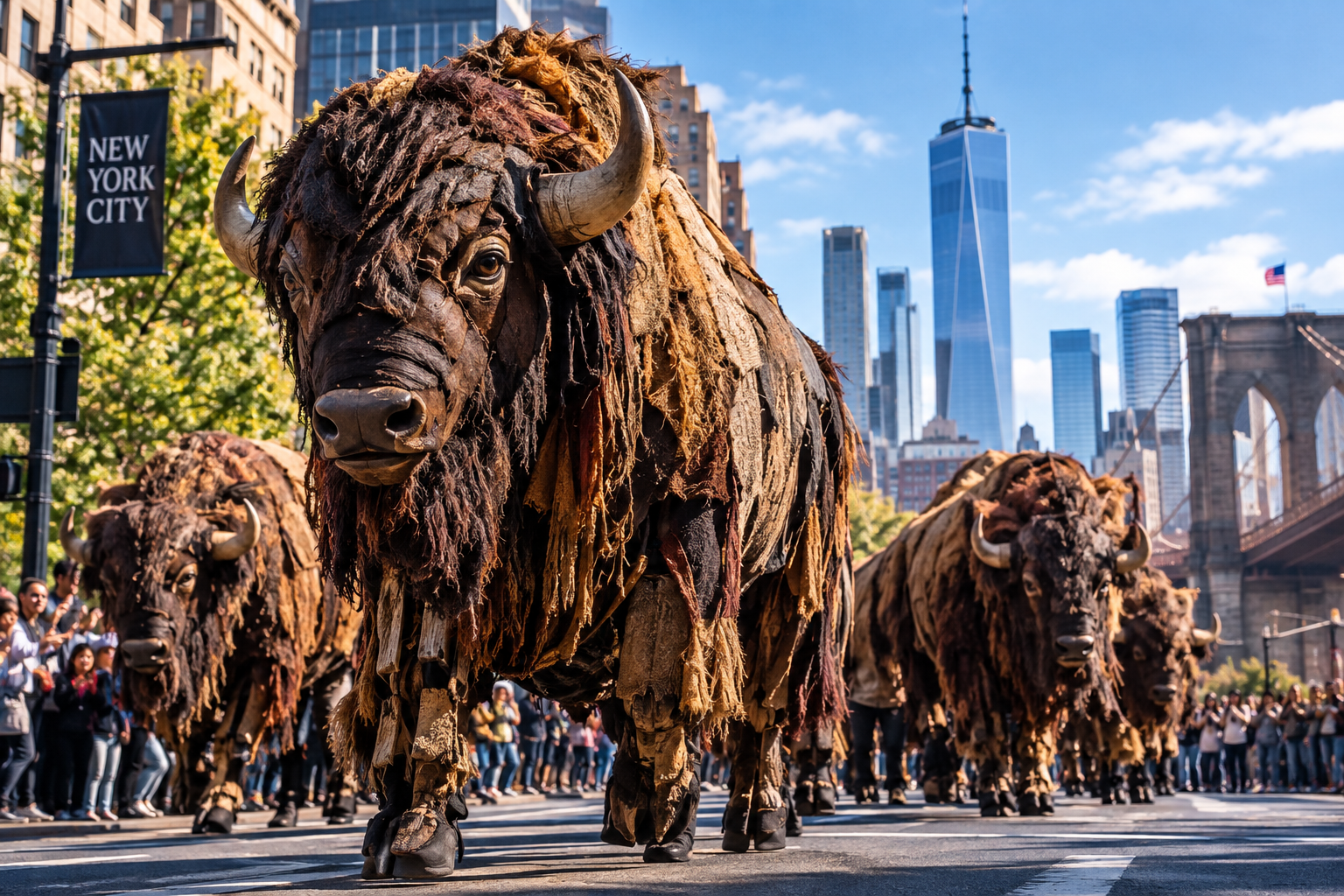
New York City recently witnessed an extraordinary sight as a herd of giant, life-size buffalo puppets moved through the streets of Lower Manhattan and Downtown Brooklyn. The unusual public-art spectacle, called “Return of the Buffalo: Tatanka Owe Akupi,” brought dozens of enormous buffalo puppets into one of the world’s busiest cities, transforming ordinary streets, parks and public spaces into a moving cultural performance.
The event took place on September 18 and 19, 2026, and was designed as much more than a spectacular parade. Created by artist and director Amir Nizar Zuabi in partnership with elders from the Lenape and Lakota communities, the project used the buffalo as a powerful symbol of history, survival, renewal and healing. It also invited audiences to think about the complicated relationship between people, animals and the land.
The production was presented by St. Ann’s Warehouse, The Walk Productions and KBH Arts, the team behind other large-scale public-art projects including the famous Little Amal puppet. According to the organizers, the buffalo were intended to roam, graze and run through the city while audiences followed them and encountered music, poetry, ceremonies, dance and other performances along the way.
What Is “Return of the Buffalo: Tatanka Owe Akupi”?
“Return of the Buffalo: Tatanka Owe Akupi” is a large-scale participatory public-art project centered on the American bison.
Rather than presenting the animals inside a theater or museum, the creators brought the buffalo directly into New York City streets. The idea was to make the city itself part of the performance.
The official presentation described the project as part spectacle and part ritual. Over two days, life-size buffalo puppets moved through Lower Manhattan and Downtown Brooklyn, encountering public spaces, historic locations, musicians, performers and ceremonies.
The project was created by Amir Nizar Zuabi in collaboration with elders from the Lenape and Lakota tribes. The partnership was important because the performance was not simply using the buffalo as a visual attraction. It was built around cultural and historical relationships with the animal and the land.
The organizers connected the buffalo’s return with a broader idea of healing and renewal. That message became especially striking when the huge animals appeared against the modern architecture and crowded streets of New York.
How Many Buffalo Puppets Were in New York?
Current reporting from The New York Times and other sources puts the number at 40 life-size buffalo puppets.
The puppets were not small theatrical props. They were enormous creations approximately six feet tall and around nine to ten feet long. Each animal required multiple puppeteers to make it move convincingly.
The puppets were designed by the South African company Ukwanda Puppets and constructed in New York using materials including steel, plywood, burlap and paper.
That construction process was itself a major undertaking. The puppets had to be strong enough to withstand movement through busy city streets while remaining light and flexible enough for performers to operate them.
According to reporting from The New York Times, each buffalo was operated by three puppeteers. Two performers worked inside the body while another operated near the animal’s head.
This approach allowed the buffalo to appear more like living animals than conventional parade floats.
Why Did Giant Buffalo Puppets Roam New York City?
At first glance, a herd of buffalo walking through Manhattan might seem like an entertaining piece of street theater.
But the meaning behind the project goes much deeper.
The American bison has an important place in North American history. Buffalo once existed in enormous numbers across much of the continent. During the 19th century, however, intensive hunting and westward expansion caused their populations to collapse.
For many Indigenous communities, the destruction of buffalo herds was not simply an environmental disaster. The animal was deeply connected to food, culture, community and spiritual life.
That history gives the image of buffalo returning to an American city a symbolic meaning.
The project organizers describe the buffalo’s return as a story connected to renewal and healing. Reuters also reported comments from puppetry director Craig Leo explaining that, within Lakota perspectives, animals and nature are deeply interconnected with human life.
The performance therefore asks audiences to look at the buffalo not merely as an animal, but as a symbol of relationships between humans, nature, history and community.
The Powerful Historical Message Behind the Buffalo
One of the strongest themes of the New York buffalo spectacle is the contrast between disappearance and return.
The buffalo was pushed close to extinction before conservation and population-recovery efforts helped the species return.
That history provides the foundation for the performance’s message.
The buffalo’s movement through New York can be interpreted as a visual reminder that something nearly lost can return. But the project also encourages audiences to remember the circumstances that caused the loss in the first place.
The New York Times reported that creator Amir Nizar Zuabi views the historical slaughter of buffalo through a political and ecological lens, connecting it to violence against Native communities and the land.
The organizers subsequently placed greater emphasis on ideas of reckoning, repair and renewal rather than simply using the project as an anniversary celebration.
This gives the spectacle two dimensions.
On one level, people see enormous handmade animals moving through the streets.
On another level, the animals represent a history that continues to shape conversations about Indigenous communities, environmental stewardship and America’s relationship with its natural world.
The Buffalo as a Symbol of Renewal
The idea of renewal is central to “Return of the Buffalo.”
The American bison is now the national mammal of the United States, a status that gives the animal an additional layer of national symbolism.
Its story contains a dramatic contrast: enormous historic populations were reduced to dangerously low levels, yet the species survived and has experienced recovery.
That makes the buffalo an especially powerful subject for a public artwork about change.
The organizers describe the project as being inspired by the buffalo’s journey from near extinction to repopulation.
The giant puppets therefore represented more than a recreation of an animal.
They represented the possibility of return.
When dozens of buffalo moved through streets filled with skyscrapers, cars and pedestrians, the contrast between the natural world and the modern city became part of the artwork itself.
Where Did the Buffalo Puppets Go?
The event was divided between Lower Manhattan and Downtown Brooklyn.
On Friday, September 18, the buffalo herd moved through Lower Manhattan. The published route began at Bowling Green Park and continued toward Foley Square, with performances and artistic activities appearing along the route.
On Saturday, September 19, the procession moved through Downtown Brooklyn, beginning around Abolitionist Place and continuing toward Brooklyn Bridge Park.
This route was significant because the buffalo were not isolated from ordinary city life.
They moved through public spaces where residents, workers, tourists and visitors could encounter them.
The organizers encouraged people to join the herd rather than simply stand on the sidelines.
That participatory element helped turn the project from a traditional parade into a moving public performance.
Buffalo Puppets Appeared in Times Square
Before the main event, two life-size buffalo puppets were also seen in Times Square.
Reuters documented the puppets being operated by performers in Manhattan on September 15, ahead of the larger public-art event.
The appearance offered New Yorkers an early look at what was coming.
Seeing a giant buffalo standing among Times Square’s enormous digital screens and crowds created an unusual visual contrast. It also helped introduce the project’s themes to people who might not otherwise have encountered the performance.
The Times Square appearance demonstrated how effectively the puppets could transform a familiar urban environment.
A place normally associated with advertising, tourism and entertainment suddenly became a meeting point between contemporary city life and an animal deeply connected to North American history.
How Were the Giant Buffalo Puppets Made?
Creating a life-size buffalo puppet is considerably more complicated than making a conventional parade costume.
The project required large-scale construction, engineering, puppetry and choreography.
According to The New York Times, the buffalo were handmade at St. Ann’s Warehouse in Brooklyn. Their structures used steel, plywood, paper and burlap, with the exterior designed to create the appearance of animal hides.
The work required artists to build individual body parts, assemble them into large animal forms and then test how performers could move them.
The puppets also needed to communicate recognizable animal behavior.
They had to walk.
They had to turn.
They had to appear to breathe.
They could graze or move together as a herd.
And, when required by the performance, they could run or stampede.
These movements depended on coordination between the puppeteers.
Three Puppeteers Controlled Each Buffalo
One of the most fascinating technical aspects of the performance was the number of people required to operate each buffalo.
The New York Times reported that three puppeteers operated each bison. Two performers were positioned inside the body while another worked near the head.
That means the herd represented a significant human performance effort as well as a visual spectacle.
The performers needed to learn how to coordinate their movements so that the puppet appeared to have a single body.
Training was therefore an important part of the project.
The volunteer performers were taught how to manipulate the giant puppets and respond to commands while moving through public spaces.
The goal was not simply to make the puppets move from one location to another.
The objective was to make them appear alive.
More Than 100 People Helped Bring the Buffalo to Life
The project depended heavily on volunteers and performers.
UNIMA-USA reported earlier in the year that St. Ann’s Warehouse was seeking 150 volunteers for puppeteer training connected to the September public-art performance.
The volunteers became part of the artistic machinery behind the spectacle.
This community participation was important because the creators wanted the public to become part of the experience.
Instead of having a small professional cast perform behind barriers, the project invited members of the community to take part directly.
That approach also fits the larger philosophy of The Walk Productions, which has worked on large public-art projects designed to bring people together in shared outdoor experiences.
What Does “Tatanka Owe Akupi” Mean?
The project’s subtitle, “Tatanka Owe Akupi,” is associated with the Lakota language and the idea of the buffalo’s return.
The name reinforces the cultural context of the performance.
Rather than presenting the event simply as “giant buffalo in New York,” the full title emphasizes that the artwork is rooted in Indigenous perspectives and historical relationships with the buffalo.
The collaboration with Lenape and Lakota elders was therefore a central part of the project’s development.
This is important because public art dealing with Indigenous history can raise questions about representation, cultural respect and who gets to tell historical stories.
The creators sought to address those questions through direct collaboration with Indigenous elders and artists.
The Role of Lenape and Lakota Communities
The performance was developed in partnership with elders from the Lenape and Lakota tribes.
That partnership helped shape the cultural and historical framework of the project.
The buffalo has long been important to numerous Indigenous nations, although traditions and relationships vary between communities. The project specifically worked with Lenape and Lakota partners rather than presenting a generalized Indigenous narrative.
That distinction matters.
The performance was not simply using Indigenous imagery as decoration. Its stated purpose included reflection on history, healing and the relationship between people and nature.
Reports about the event also describe tribal ceremonies and participation by Indigenous artists and community members.
Live Music, Dance and Poetry Joined the Buffalo
The buffalo were only one part of the event.
As the herd moved through New York, audiences encountered a range of performances.
The organizers planned live music, poetry, readings, dance, ceremonies, marching bands and other artistic events at locations along the route.
That structure meant that the event functioned more like a moving festival than a traditional parade.
The audience could follow the buffalo while encountering different performances along the way.
Among the artists associated with the event were well-known names including Rosario Dawson, Susan Sarandon, Sam Waterston and Laurie Anderson, according to event reporting.
The combination of large puppets and live performance created a theatrical experience that could unfold across multiple city blocks.
Why New York Was Chosen for the Performance
New York City might seem like an unlikely place for a buffalo herd.
There are few environments more different from the open prairie traditionally associated with American bison.
That contrast was precisely what made the project visually and conceptually powerful.
The buffalo were intentionally placed in one of the world’s most heavily urbanized environments.
Skyscrapers, traffic, sidewalks and crowds became the backdrop.
The project effectively asked what happens when an animal associated with open landscapes suddenly occupies the center of a modern city.
The answer was not simply spectacle.
The juxtaposition created a conversation about who belongs in public space, how cities remember history and how nature can be represented inside an urban environment.
“Negotiating Space” Became Part of the Message
The creators also saw the movement of the buffalo through the city as a way to think about public space.
A large herd cannot quietly pass through Manhattan.
Pedestrians have to react.
People have to move.
The city temporarily changes around the animals.
The project’s creators used that physical disruption as part of its meaning. The New York Times reported Zuabi describing the herd’s movement through a city as a way of raising questions about ownership, passage and who has to make room for whom.
That makes the procession itself part of the message.
The audience is not simply watching a performance.
The audience is forced to negotiate with it.
A Story About Survival and Restoration
The buffalo’s history also connects the project to broader questions about conservation.
The species once numbered in the tens of millions across North America before dramatic population declines.
Its later recovery became one of the most recognizable examples of wildlife conservation and restoration in the United States.
That history is central to the artwork.
The return of the buffalo is presented as a metaphor for something that survives an enormous historical disruption and begins again.
The symbolism is especially significant because the buffalo is now the national mammal of the United States.
The animal’s journey therefore intersects with national history, Indigenous history and environmental history.
Why the Event Matters Beyond the Spectacle
It would be easy to describe the event simply as a strange and impressive parade.
Forty giant buffalo puppets walking through New York is certainly a striking visual story.
But reducing the project to its visual spectacle would leave out its central purpose.
The creators wanted audiences to think about the historical destruction of buffalo populations, Indigenous relationships with the animal, the consequences of expansion and the possibility of restoration.
The event also presented public art as a way to bring people together without requiring them to enter a theater or purchase a ticket.
The official organizers described it as a free, public event.
That accessibility was an important part of the concept.
The Connection to Little Amal
People who followed large-scale public art in New York may recognize the creative team behind “Return of the Buffalo.”
The Walk Productions was also associated with Little Amal, the enormous puppet representing a young Syrian refugee girl who traveled through New York City in 2022.
Like Little Amal, the buffalo project used a giant puppet to create an emotional and communal experience in public spaces.
The difference is in the subject.
Little Amal focused on displacement and the experience of a refugee child.
“Return of the Buffalo” focuses on the history and symbolism of the American buffalo, Indigenous communities and renewal.
Both projects demonstrate how puppetry can move beyond traditional theater and become a citywide public-art experience.
A Public Artwork for America’s 250th Anniversary Era
The project was initially connected to plans surrounding the 250th anniversary of the United States.
As the project developed, however, its creators moved away from making the event simply an anniversary celebration.
Instead, the focus shifted toward a broader public experience involving history, art, nature and renewal. The New York Times reported that the original conceptual link to the semiquincentennial eventually faded as the project developed.
That change allowed the buffalo to carry a message that was not limited to a single anniversary.
The animals became a way of asking broader questions about America’s past and its relationship with the natural world.
What People Saw in New York
For people standing along the route, the experience was unlike a conventional parade.
Instead of floats covered in decorations, the audience saw giant buffalo bodies moving with coordinated gestures.
Heads turned.
Bodies walked.
The herd moved as a group.
The puppeteers were partly hidden inside the animals, allowing the buffalo to appear almost autonomous.
At times, the animals could seem strangely realistic despite their obvious construction from theatrical materials.
That effect is one of the defining strengths of large-scale puppetry.
The audience knows the animal is not real, yet the coordinated movement can create a powerful emotional response.
Why Giant Puppets Can Tell Powerful Stories
Puppetry has a unique ability to make abstract ideas physical.
A speech about conservation may be informative.
A museum exhibition may provide historical evidence.
A giant buffalo walking directly toward a crowd produces a completely different kind of response.
The audience sees the animal at human scale.
It occupies the same physical space.
It becomes impossible to ignore.
That is particularly effective in public art because people do not have to seek out the artwork.
The artwork finds them.
Someone walking through downtown New York can suddenly encounter a buffalo.
That surprise can create curiosity.
Curiosity can lead to questions.
And those questions can lead people toward the history behind the performance.
The Event Was Free and Open to the Public
Another important aspect of “Return of the Buffalo” was accessibility.
The event was presented as a free public-art spectacle rather than a traditional ticketed theatrical production.
That meant the audience could encounter the buffalo as part of ordinary city life.
There was no requirement to sit inside a theater for two hours.
People could watch the herd pass.
They could follow it.
They could encounter individual performances along the route.
The event therefore blurred the boundary between performer and spectator.
Frequently Asked Questions
What are the giant buffalo puppets in New York?
The giant buffalo puppets were part of “Return of the Buffalo: Tatanka Owe Akupi,” a large-scale public-art project created by Amir Nizar Zuabi in partnership with Lenape and Lakota elders and presented by St. Ann’s Warehouse, The Walk Productions and KBH Arts.
How many buffalo puppets were there?
Current reporting around the event described 40 life-size buffalo puppets. Earlier promotional material sometimes referred to a planned herd of 50, but the completed project was reported as a 40-buffalo herd.
Where did the buffalo puppets appear?
The herd moved through Lower Manhattan and Downtown Brooklyn. The published route included Bowling Green Park and Foley Square in Lower Manhattan, followed by a Brooklyn route beginning around Abolitionist Place and continuing toward Brooklyn Bridge Park.
When did the New York buffalo event happen?
The main public performances took place on September 18 and 19, 2026.
What is the message behind the buffalo puppets?
The performance explores themes including Indigenous history, the buffalo’s near-extinction and recovery, environmental relationships, renewal, healing and the relationship between people and land.
Who created “Return of the Buffalo”?
The project was created by Amir Nizar Zuabi in partnership with elders from the Lenape and Lakota communities. It was presented by St. Ann’s Warehouse, The Walk Productions and KBH Arts.
How are the buffalo puppets operated?
Each buffalo was operated by three puppeteers, with two performers inside the body and another operating near the head.
Were the buffalo puppets real animals?
No. They were large theatrical puppets constructed from materials including steel, plywood, paper and burlap.
Why is the buffalo important to Indigenous communities?
The buffalo has deep cultural and historical importance for numerous Indigenous nations. The project specifically involved Lenape and Lakota elders and used the buffalo’s return as a framework for discussing history, resilience and renewal.
Final Thoughts: Why New York’s Buffalo Herd Will Be Remembered
The sight of giant buffalo moving through New York City was certainly unusual, but the spectacle was designed to leave audiences with more than an unforgettable photograph.
“Return of the Buffalo: Tatanka Owe Akupi” used public art to place a powerful symbol of North American history directly into the middle of modern urban life.
The buffalo’s story is one of dramatic loss and recovery. Its presence in the streets of New York turned that history into something physical and visible.
For some viewers, the experience may have been primarily artistic: enormous handmade animals moving through one of the world’s greatest cities.
For others, it offered an opportunity to think about Indigenous history, environmental destruction, conservation, cultural memory and the possibility of renewal.
That combination is what made the project distinctive.
The buffalo did not simply appear in New York.
They temporarily changed the way people experienced the city around them.
And that may be the most important idea behind the project: sometimes history becomes easier to understand when it is no longer confined to a page, a museum or a classroom. Sometimes it can walk directly into the street, move alongside you and ask you to make room.
The giant buffalo puppets have now left the streets, but the questions raised by their journey remain—about the land, the animals, the people who have lived alongside them and what it means for something nearly lost to return.
Sources and Further Reading
The event’s official information is available from St. Ann’s Warehouse and The Walk Productions, while recent reporting from The New York Times, Smithsonian Magazine and Reuters provides additional details about the puppets, their construction, cultural context and the New York performances.