
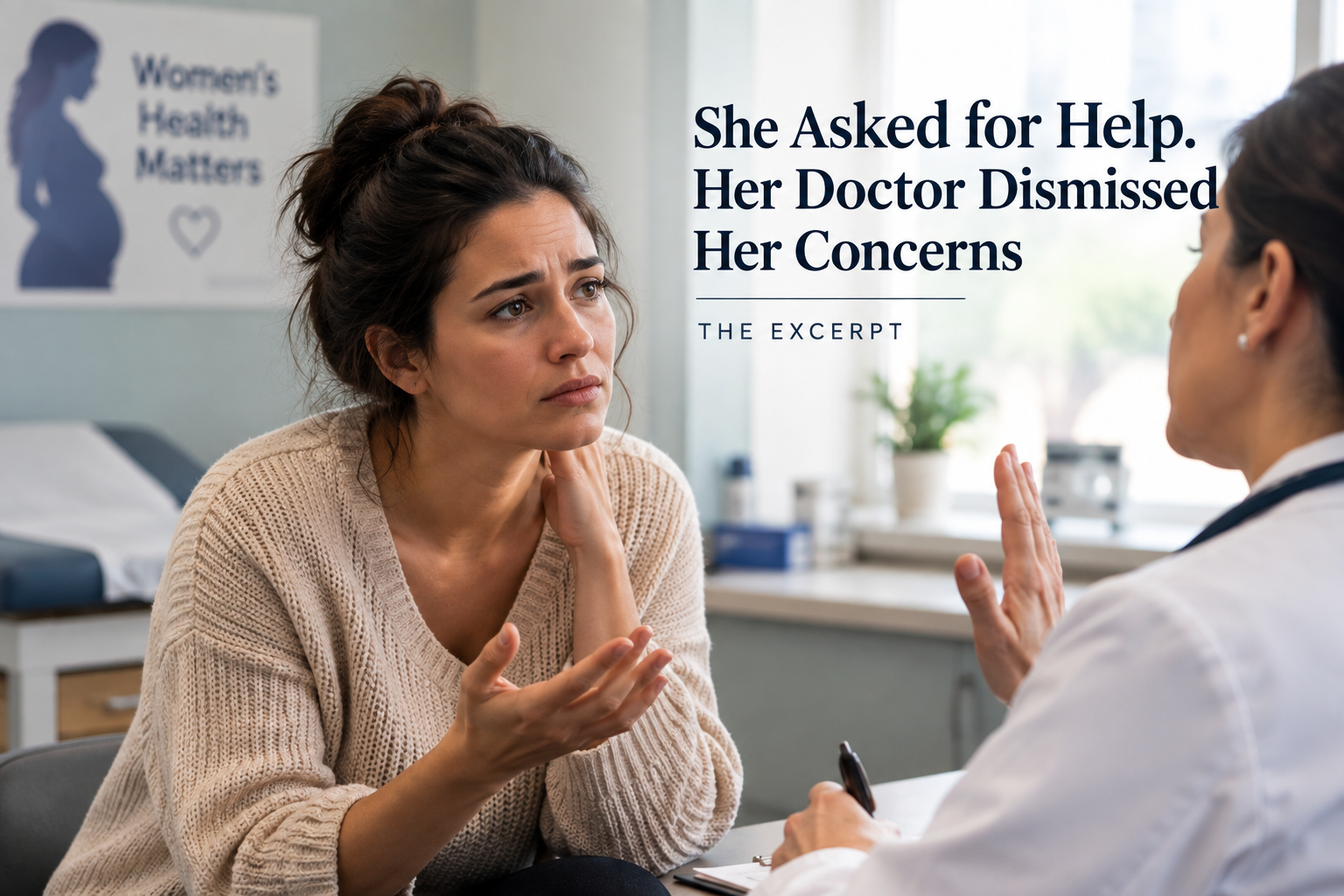
She Asked for Help. Her Doctor Dismissed Her Concerns | The Excerpt
She Asked for Help. Her Doctor Dismissed Her Concerns | The Excerpt
A recent episode of USA TODAY’s The Excerpt is drawing attention to a difficult issue in women’s healthcare: what happens when patients ask for help but feel that their concerns are not taken seriously.
The September 21, 2026 episode examined the experience of Nydrianna Raines, a mother from Little Rock, Arkansas, whose struggle with severe depression during and after pregnancy became an example of how gaps in communication, access to care and patient trust can affect a person’s health and family life.
Raines said that while she was pregnant with her son in 2020, she told a doctor at an Arkansas women’s clinic that she was experiencing serious depression. According to her account, the doctor characterized her symptoms as seasonal depression and suggested that they would pass. Raines said she was not offered medication, mental-health services or other assistance at that time.
Her symptoms continued during pregnancy and after the birth of her son, Jaxon, in November 2020. Eventually, the situation became so overwhelming that she asked her mother in Florida to temporarily care for her two daughters while she focused on caring for her newborn son.
Her story is now being discussed alongside new national survey data suggesting that many women report difficulties navigating the U.S. healthcare system.
What Happened to Nydrianna Raines?
Nydrianna Raines was pregnant with her third child after experiencing the deaths of her grandmother and father. During the later stages of pregnancy, she began experiencing significant depression.
She sought help from a doctor at a women’s clinic that was providing pregnancy and maternal care.
According to Raines, however, she did not feel that her concerns were adequately addressed. The doctor reportedly described the symptoms as seasonal depression and suggested that they would eventually disappear.
Raines later told USA TODAY that she was not given recommendations for mental-health services or medication.
The lack of support became particularly difficult because her symptoms did not disappear.
Instead, they continued through the pregnancy and after she gave birth to Jaxon in November 2020.
At one point, the situation became so overwhelming that Raines asked her mother, who lived in Florida, to temporarily take custody of her two daughters, Kehlani and Nyla. She remained responsible for caring for her newborn son.
Her experience also occurred during a period of housing instability, adding another source of stress to an already difficult situation.
Her Depression Continued After Giving Birth
The challenges did not end when Raines delivered her son.
According to USA TODAY’s reporting, she continued experiencing symptoms after the birth. She also described difficulty breastfeeding and eventually had to use formula after she could no longer produce enough milk.
The experience affected her relationship with the healthcare system.
Rather than feeling supported by the medical system, Raines turned increasingly toward family members and her children’s father for support.
The events occurred in 2020, but their impact continued years later.
Her story became part of a broader examination of how women experience healthcare and why some patients may stop seeking help after feeling dismissed or misunderstood.
The September 21 episode of The Excerpt, hosted by Dana Taylor, featured USA TODAY national correspondent Ken Alltucker discussing Raines’ experience and new research examining healthcare access and women’s experiences with medical providers.
New Survey Finds Many Women Report Negative Healthcare Experiences
Raines’ experience comes as Gallup and Pivotal have released new findings on women’s healthcare in the United States.
According to the Gallup-Pivotal Women’s Health Survey, 51% of U.S. women said they had experienced at least one of four negative healthcare experiences during the previous five years.
Among men, the corresponding figure was 39%.
The survey examined several types of experiences, including whether healthcare providers minimized or dismissed symptoms, whether patients were misdiagnosed or unable to receive a diagnosis, whether they failed to receive needed answers or next steps, and whether they received conflicting recommendations.
The results showed:
- 34% of women said a healthcare provider minimized or dismissed their symptoms or pain.
- 33% said they had been misdiagnosed or unable to get a diagnosis.
- 31% said they did not receive needed answers or clear next steps.
- 25% reported receiving conflicting recommendations.
- 51% reported at least one of these negative experiences.
- Among men, 39% reported at least one of the four experiences.
The survey was conducted online from July 14 through July 22, 2026, among 3,845 women and 1,296 men through the Gallup Panel.
Women Are Also Reporting Longer Waits for Diagnoses
Another significant finding involved the time patients waited before receiving a diagnosis.
Among women who had received a diagnosis for their most recent health condition, 47% said they waited three months or longer.
About 22% said they waited at least one year.
The Gallup report also found that women were more likely to experience conditions involving longer diagnostic processes, including mental-health conditions and chronic pain. However, the researchers noted that even when women and men had the same conditions, women generally reported longer paths toward diagnosis.
That does not mean every delayed diagnosis is caused by a provider dismissing a patient. Medical conditions can be complicated, symptoms can overlap, and some diseases are inherently difficult to diagnose.
But the survey highlights a broader concern: getting through the healthcare system is not necessarily the same as receiving clear, timely and effective care.
Why Being Heard by a Doctor Matters
Healthcare depends heavily on communication.
A patient provides information about symptoms, medical history, changes in their health and circumstances that may affect their wellbeing. A healthcare professional then uses that information, along with examinations and testing when appropriate, to determine what should happen next.
When communication breaks down, important information can be missed.
The Gallup-Pivotal findings suggest that many women have experienced situations where they felt their symptoms were minimized or where they did not receive the information they needed.
In the case described by USA TODAY, Raines says she specifically asked for mental-health assistance during pregnancy but did not feel that her request resulted in meaningful support.
Her story illustrates why patient-provider communication is an important part of healthcare, particularly when someone is experiencing mental-health symptoms during pregnancy or after childbirth.
The Difference Between Accessing Care and Receiving the Right Support
One of the central points raised in the The Excerpt discussion is that healthcare access is about more than simply getting an appointment.
A person may successfully enter a doctor’s office and still leave without a clear understanding of what is happening, what steps to take next or where to find additional support.
Gallup’s research specifically examined this distinction.
The survey found that women were more likely than men to report needing to advocate for their health. Over the previous five years, 42% of women said they had needed to speak up or advocate for themselves, compared with 26% of men.
That difference is significant because advocacy can require additional time, energy and knowledge.
Patients may need to request another appointment, ask for additional testing, seek another medical opinion or search for a specialist.
For someone already dealing with illness, financial pressure, family responsibilities or mental-health challenges, navigating those additional steps can become difficult.
Cost Is Another Barrier to Healthcare
The survey also examined financial barriers.
USA TODAY reported that about one in three women had skipped or delayed healthcare because of cost during the previous year, compared with about one in four men.
The problem is not limited to the cost of an appointment.
Healthcare expenses can include insurance premiums, deductibles, prescription medications, specialist visits, diagnostic testing, transportation and time away from work.
For people who already have financial difficulties, even a relatively small medical expense can influence whether they seek care.
This becomes particularly important when healthcare involves ongoing treatment.
A person may be able to attend one appointment but struggle to afford repeated appointments or prescriptions.
Doctor Shortages Can Make the Problem Worse
The availability of healthcare providers is another factor discussed in the The Excerpt episode.
Some parts of the United States have shortages of doctors and other healthcare professionals. Mental-health services can be particularly difficult to access in certain communities.
When appointment calendars are full, patients may have to wait weeks or months before seeing an appropriate provider.
The result can be a cycle in which a person knows they need help but cannot easily find it.
For someone experiencing depression or another mental-health condition, waiting for an appointment can be especially challenging.
That is one reason the conversation around women’s healthcare includes both access and quality of care.
Getting an appointment is important, but so is receiving an appropriate response once the appointment happens.
What the Gallup-Pivotal Survey Says About Women’s Lives
The impact of healthcare problems can extend beyond a doctor’s office.
Pivotal reported that 42% of women said their health had caused them to feel they could not do everything they wanted to do in life during the previous five years.
More than half, 54%, reported at least one health-related impact on family life or relationships.
Another 42% reported an impact on work or career, while 32% reported an impact on their community participation or voice.
The effects were even more pronounced among women who said they had been unable to obtain needed healthcare despite trying.
Among that group:
- 79% reported an impact on family life or relationships.
- 66% reported an impact on work or career.
- 59% reported an impact on community participation or voice.
These figures do not prove that every negative life outcome was directly caused by a particular healthcare interaction. They show an association reported by survey participants between health-related problems and broader effects on their lives.
Women’s Mental Health Is Part of the Larger Conversation
The survey also highlighted the prevalence of mental-health concerns among women.
Pivotal reported that nearly half of women surveyed, 48%, had a current or past mental-health condition such as depression, anxiety or PTSD.
This makes conversations about mental-health care especially relevant.
Mental health can affect employment, relationships, parenting, sleep, physical health and daily activities. At the same time, people may face stigma or uncertainty about discussing symptoms.
When someone asks for help, the quality of that interaction can influence whether they feel comfortable seeking additional care.
Raines’ story illustrates one possible consequence of a patient losing confidence in the healthcare system.
The Importance of Postpartum Mental Health
Pregnancy and the period following childbirth can involve major physical, emotional and social changes.
Mental-health symptoms during pregnancy or after childbirth can be serious and deserve appropriate medical attention.
However, an individual diagnosis cannot be made from a news story alone.
Anyone experiencing severe depression, thoughts of self-harm, thoughts of harming someone else, confusion, hallucinations or other urgent symptoms should seek immediate professional medical assistance or emergency help.
For less immediate concerns, speaking with an obstetrician, primary-care clinician, mental-health professional or another qualified healthcare provider can be an important starting point.
The broader lesson from Raines’ experience is not that every symptom has one obvious explanation. It is that patients need a healthcare environment where concerns can be communicated, assessed and followed up appropriately.
When Patients Feel Dismissed, Trust Can Break Down
Trust is an important part of healthcare.
Patients need to feel comfortable telling clinicians about symptoms that may be difficult, embarrassing or emotionally painful.
If a person expects to be judged or dismissed, they may share less information.
That can make communication more difficult.
The September 21 The Excerpt episode discussed a new book, “Seen But Not Heard: What Medical Records Don’t Tell Us About Women’s Lives,” by sociologist Jennifer M. Silva and epidemiologist Annemarie G. Hirsch.
The authors examined the difference between information documented in electronic health records and the experiences women described during interviews. Their research drew on interviews with 87 economically disadvantaged, non-college-educated women living in rural America and their health records from a large nonprofit health system.
The book argues that medical records may not always capture the full story of a patient’s life or healthcare experience.
What Medical Records May Leave Out
Medical records are designed to document clinical information.
They can include symptoms, diagnoses, test results, medications, observations and treatment plans.
But a medical record may not fully capture how a patient felt during an appointment or why they chose not to disclose certain information.
According to the authors of Seen But Not Heard, some of the women’s experiences were missing from their electronic health records.
The book describes differences between what clinicians documented and what patients later reported about their experiences.
That distinction is important because healthcare decisions are based partly on information exchanged between patients and providers.
If a patient does not feel safe or comfortable sharing something, the provider may not have the complete picture.
Why Some Patients May Withhold Information
The The Excerpt discussion also examined reasons patients sometimes leave information out of conversations with doctors.
Some patients may worry about stigma.
Others may fear that certain information could have consequences outside the medical setting.
USA TODAY’s discussion referenced women who were dealing with sensitive family or legal circumstances and were concerned about having information documented.
There can also be simpler reasons: patients may forget details, feel embarrassed, believe a symptom is unrelated or assume the doctor is too busy to hear the full story.
These factors can make medical communication more complicated than simply asking a patient to “tell the doctor everything.”
The Challenge of Time-Pressured Doctors
Healthcare professionals often work under significant time constraints.
Doctors may have full schedules, large patient loads and extensive documentation responsibilities.
The The Excerpt conversation noted that clinicians may be trying to address many patients during the same day.
This creates a difficult situation.
Patients need enough time to explain what is happening, while clinicians need enough information to make appropriate decisions.
The challenge is therefore not necessarily about blaming individual doctors or patients.
It is about improving systems so that important symptoms, questions and concerns are not lost during short or rushed encounters.
What Can Healthcare Systems Do?
The Gallup-Pivotal findings provide information that healthcare organizations can use to examine how patients experience care.
Potential areas for improvement include clearer communication, better follow-up procedures, improved access to specialists and stronger systems for helping patients understand what happens after an appointment.
Mental-health services can also play an important role, particularly for people experiencing depression or other serious symptoms during pregnancy and after childbirth.
The Pivotal report says the survey is intended to highlight the relationship between women’s health and their ability to participate fully in family, work and community life.
Improving healthcare access therefore has implications beyond individual medical appointments.
What Patients Can Do When They Feel Unheard
Patients who feel that their concerns have not been addressed may consider several practical steps, depending on their circumstances.
They can ask the clinician to explain the diagnosis or reasoning in plain language.
They can ask what symptoms should prompt another appointment or urgent care.
They can request clarification about the next steps.
They can keep a written record of symptoms, medications and questions before an appointment.
If appropriate, they can seek a second opinion or another qualified healthcare professional.
For mental-health concerns, patients may also ask directly about available counseling, psychiatric services or other evidence-based treatment options.
These steps do not replace professional medical evaluation, and the appropriate action depends on the individual’s symptoms and circumstances.
A Second Opinion Can Be Part of Healthcare
Seeking another medical opinion does not automatically mean that the first healthcare provider was wrong.
Medical conditions can be complicated, and reasonable clinicians may sometimes reach different conclusions based on the available information.
A second opinion can provide another perspective, additional evaluation or clarification.
For patients who feel their symptoms have not been adequately investigated, discussing the concern with another qualified professional may be one way to continue the diagnostic process.
The important point is to remain focused on obtaining appropriate care rather than treating healthcare as a confrontation between patients and doctors.
What This Story Says About Women’s Healthcare
The story of Nydrianna Raines is personal, but the survey data suggest that her experience exists within a much larger pattern reported by women across the United States.
The Gallup-Pivotal research found that women were more likely than men to report having symptoms minimized or dismissed, experiencing diagnostic problems, failing to receive needed answers and receiving conflicting recommendations.
At the same time, the survey should be interpreted carefully.
It measures people’s reported experiences rather than independently determining whether each medical decision was clinically correct.
A patient feeling dismissed does not necessarily establish that a doctor provided medically inappropriate care.
However, patient experience remains important because communication and trust influence whether people continue seeking healthcare and whether they feel able to share relevant information.
The Broader Impact on Families
Raines’ experience also shows how healthcare problems can affect an entire family.
Her depression did not exist in isolation.
She was pregnant, caring for children and dealing with difficult personal circumstances.
When her symptoms became overwhelming, she relied on her mother for help with her daughters.
The Gallup-Pivotal survey similarly found that more than half of women reported at least one health-related impact on family life or relationships.
This suggests that healthcare problems can have consequences far beyond an individual’s medical condition.
When someone is unable to receive appropriate care, family members may need to provide additional support.
Work responsibilities can also be affected.
Community participation may decline.
In this way, health becomes connected to nearly every part of daily life.
Why the Story Is Receiving Attention Now
The timing of the The Excerpt episode is significant because it coincides with the release of new national survey data.
The Gallup-Pivotal survey provides a large-scale statistical picture, while Raines’ story provides a personal example of what those healthcare challenges can look like in real life.
Together, they create two different ways of understanding the same issue.
The survey provides percentages and comparisons.
The personal story demonstrates how a healthcare experience can unfold over months and years.
Neither perspective alone provides the complete picture.
The combination helps illustrate why patient experience has become an important part of conversations about healthcare quality.
The Role of “The Excerpt”
The Excerpt is USA TODAY’s podcast focused on major news stories and interviews with journalists covering those stories.
The September 21 episode featured host Dana Taylor and national correspondent Ken Alltucker.
Their discussion connected Raines’ experience with the broader Gallup-Pivotal findings on women’s healthcare.
The episode also examined questions surrounding diagnosis delays, healthcare access, communication between doctors and patients and the ways health problems can affect other areas of life.
For readers who want to understand the issue beyond the headline, the podcast discussion provides additional context about the research and the reporting behind the story.
Key Takeaways From the Latest Research
Several findings stand out from the current data.
First, a majority of women surveyed by Gallup reported at least one negative healthcare experience over the previous five years.
Second, women reported higher rates than men for several measures of negative healthcare experiences.
Third, nearly half of women who received a diagnosis for their most recent health condition said they waited at least three months for it.
Fourth, healthcare difficulties can affect family life, careers and participation in communities.
Finally, the research suggests that healthcare access is not only about whether a person can make an appointment. The quality of communication and whether patients receive useful answers and next steps also matter.
Frequently Asked Questions
What is “The Excerpt” about?
“The Excerpt” is a USA TODAY podcast that discusses major news stories with journalists and experts. The September 21, 2026 episode examined women’s healthcare experiences and featured national correspondent Ken Alltucker discussing recent reporting and research.
Who is Nydrianna Raines?
Nydrianna Raines is a mother from Little Rock, Arkansas, whose experience seeking help for depression during pregnancy was reported by USA TODAY. Her story became part of the discussion surrounding women’s healthcare access and patient-provider communication.
What happened when Raines asked her doctor for help?
Raines said she told a doctor at an Arkansas women’s clinic about depression during pregnancy. According to her account, the doctor characterized it as seasonal depression and did not recommend mental-health services or medication.
When was Raines’ son born?
Raines gave birth to her son Jaxon in November 2020. Her depression symptoms continued after childbirth, according to USA TODAY’s reporting.
How many women reported negative healthcare experiences?
The Gallup-Pivotal survey found that 51% of U.S. women reported at least one of four negative healthcare experiences during the previous five years, compared with 39% of men.
What percentage of women said their symptoms were dismissed?
Gallup reported that 34% of U.S. women said a healthcare provider had minimized or dismissed their symptoms or pain at some point during the previous five years.
How long did many women wait for a diagnosis?
Among women who received a diagnosis for their most recent health condition, 47% reported waiting three months or longer, while 22% waited a year or more.
Why is communication between doctors and patients important?
Clear communication allows patients to explain symptoms and circumstances while helping healthcare professionals determine appropriate next steps. Poor communication can make it harder for patients to understand their care or feel comfortable sharing important information.
What is “Seen But Not Heard”?
“Seen But Not Heard: What Medical Records Don’t Tell Us About Women’s Lives” is a 2026 book by Jennifer M. Silva and Annemarie G. Hirsch. It examines differences between information contained in electronic health records and women’s accounts of their healthcare experiences.
Conclusion
The story highlighted by USA TODAY’s The Excerpt is ultimately about more than one doctor’s appointment.
Nydrianna Raines asked for help during a difficult pregnancy and said she did not feel that her concerns received the response she needed. Her symptoms continued, her family circumstances became more difficult and her trust in the healthcare system was affected.
Her experience is now being discussed alongside new Gallup-Pivotal research showing that many women across the United States report problems when seeking and receiving healthcare.
The statistics are significant: 51% of women surveyed reported at least one negative healthcare experience during the previous five years, 34% said providers had minimized or dismissed symptoms or pain, and 47% of women who received a recent diagnosis said they waited at least three months for it.
The research also shows that healthcare problems can extend into family relationships, careers and community participation.
At the center of the issue is a basic part of medical care: listening.
Patients need opportunities to explain what they are experiencing. Healthcare professionals need reliable information to evaluate those concerns. And healthcare systems need to make it possible for patients to receive appropriate follow-up when an initial appointment does not resolve the problem.
Raines’ story cannot represent every woman’s experience, and the survey results do not establish that every negative patient experience reflects inappropriate medical care. But together, the personal account and national research highlight an important question for healthcare providers, health systems and patients: What happens when someone asks for help and does not feel heard?
That question is at the heart of the latest episode of The Excerpt and the wider conversation about women’s healthcare in the United States.