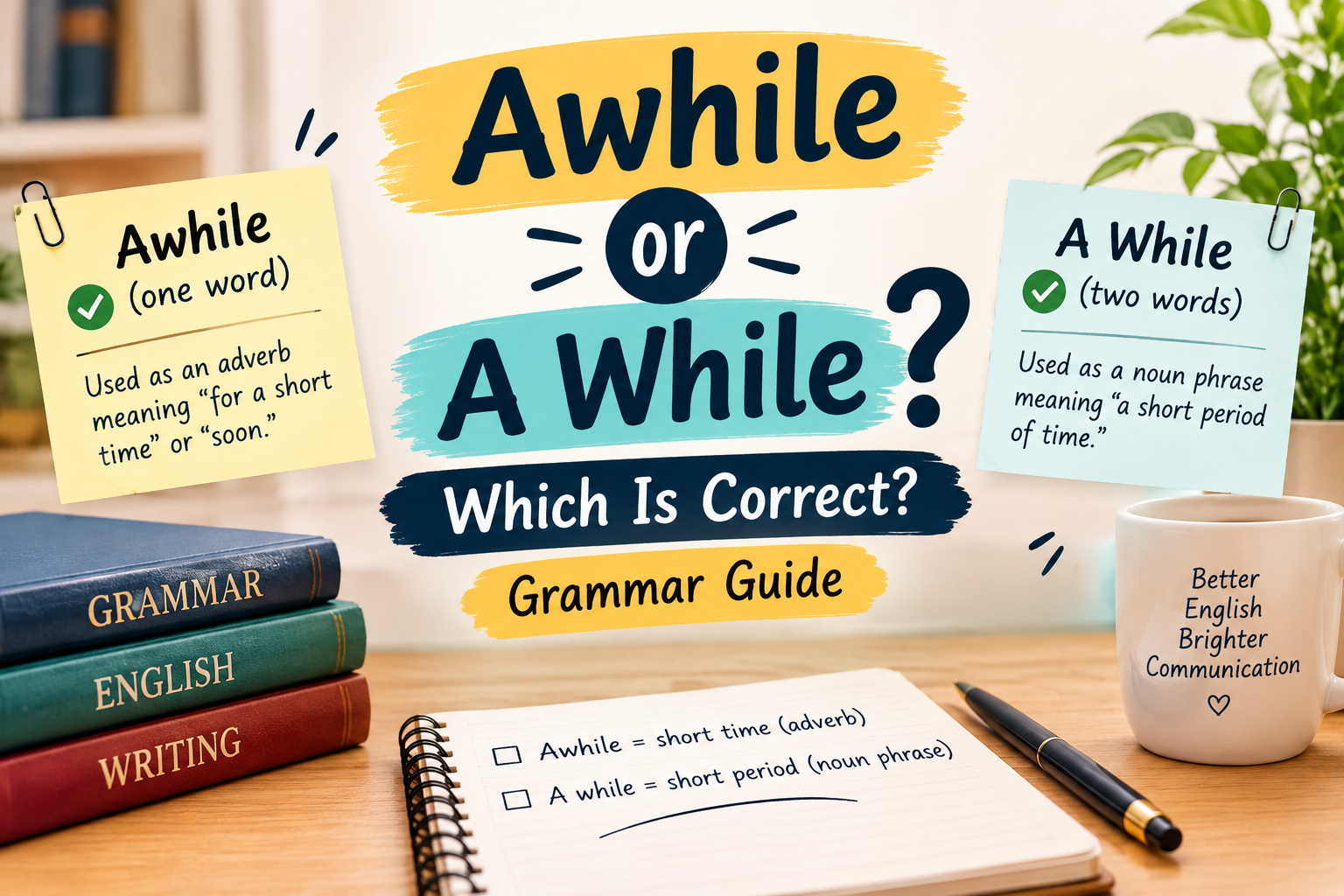
Awhile or A While: Which Is Correct? Grammar Guide
Awhile or A While: Which Is Correct? Grammar Guide
Have you ever wondered whether to write “awhile” or “a while”? These two expressions sound almost identical and are often confused in everyday English. However, they have different grammatical functions, and understanding when to use each one can help you write more clearly and professionally.
The good news is that both “awhile” and “a while” are correct, but they are not always interchangeable. “Awhile” is an adverb meaning for a short time, while “a while” is a noun phrase referring to a period of time.
In this guide, you will learn the difference between awhile and a while, discover how to use them correctly, explore practical sentence examples, and avoid common grammar mistakes.
Awhile or A While: The Correct Answer
Both “awhile” and “a while” are accepted in standard English. The correct choice depends on how the expression functions in a sentence.
“Awhile” is a single-word adverb meaning for a period of time.
“A while” is a two-word noun phrase consisting of the article “a” and the noun “while.” It refers to an unspecified period of time.
For example:
- Please stay awhile.
- Please stay for a while.
- I haven’t seen her in a while.
- Let’s rest awhile before continuing.
All four sentences are correct.
Quick answer: Use “awhile” when it means “for a time” without a preceding preposition. Use “a while” when referring to a period of time, particularly after prepositions such as “for” or “in.”
What Does Awhile Mean?
“Awhile” is an adverb that means for a short time or for a period of time.
It describes how long an action continues and is commonly used in everyday conversation, storytelling, and informal writing.
For example:
- Sit awhile and enjoy the view.
- She waited awhile before answering.
- Let’s stay awhile longer.
- He rested awhile after lunch.
In these sentences, “awhile” modifies the verbs “sit,” “waited,” “stay,” and “rested” by indicating the duration of the actions.
A useful way to remember the meaning is to replace “awhile” with “for a time.” If the sentence still makes sense, the single-word form may be appropriate.
For example:
“Please wait awhile.”
This means “Please wait for a time.”
However, when you use the preposition “for” before the expression, the two-word form is generally required: “Please wait for a while.”
What Does A While Mean?
“A while” is a noun phrase that refers to an unspecified period of time.
It is commonly used after prepositions, including “for” and “in,” and can also function as the object of a verb or preposition.
For example:
- I haven’t visited my hometown in a while.
- We talked for a while after dinner.
- It took a while to understand the instructions.
- She stayed there for a while.
In these sentences, “a while” refers to a period of time rather than functioning as an adverb.
The expression can refer to a short or relatively long period, depending on the context.
For example, “I’ll be there in a while” means that the speaker expects to arrive after some unspecified amount of time.
The exact duration is not defined.
Awhile vs. A While: Key Differences
Understanding the grammatical difference between these expressions makes choosing the correct form much easier.
| Feature | Awhile | A While |
|---|---|---|
| Spelling | One word | Two words |
| Part of speech | Adverb | Noun phrase |
| Meaning | For a period of time | An unspecified period of time |
| Common usage | Sit awhile; wait awhile | For a while; in a while |
| Example | Stay awhile. | Stay for a while. |
Both expressions communicate duration, but their grammatical structures differ.
The easiest rule to remember is that “awhile” can often be replaced with “for a time,” while “a while” refers to a period of time as a noun phrase.
Examples of Awhile and A While in Sentences
Here are ten practical examples showing how both expressions are used correctly.
Examples Using Awhile
- We sat awhile and watched the sunset.
- Please wait awhile before opening the door.
- She rested awhile after finishing her work.
- Let’s stay awhile longer.
- He listened awhile before responding.
In each sentence, “awhile” is an adverb describing the duration of an action.
Examples Using A While
- I haven’t seen my old friend in a while.
- We talked for a while after the meeting.
- It took a while to complete the assignment.
- She will return in a while.
- They stayed at the hotel for a while.
Here, “a while” functions as a noun phrase, often following a preposition.
Is It For Awhile or For A While?
The standard expression is “for a while,” written as two words.
For example:
- I waited for a while.
- We stayed at the beach for a while.
- She studied for a while before taking a break.
The reason is that “for” is a preposition, and “a while” is the noun phrase that follows it.
Writing “for awhile” is generally considered incorrect in standard edited English.
Although the single-word form means “for a time,” it already contains the sense of duration. Adding “for” before it creates a construction that standard usage generally avoids.
Remember: Write “for a while,” not “for awhile,” in professional and academic writing.
Is It In Awhile or In A While?
The correct standard expression is “in a while.”
For example:
- I’ll call you in a while.
- She hasn’t visited us in a while.
- We will know the results in a while.
The phrase “in a while” refers to a period of time, either in the future or in the time that has elapsed since something last happened.
Because “in” is a preposition, it is followed by the noun phrase “a while.”
Therefore, “in awhile” should generally be avoided in formal or edited writing.
Common Mistakes to Avoid
Even experienced English speakers sometimes confuse these expressions.
Here are three common mistakes and their corrections.
Incorrect: I will be back in awhile.
Correct: I will be back in a while.
Use the two-word form after “in.”
Incorrect: We waited for awhile.
Correct: We waited for a while.
The preposition “for” takes the noun phrase “a while.”
Incorrect: Please stay a while longer. (Not incorrect, but different in structure.)
Also correct: Please stay awhile longer.
Both are acceptable because “awhile” can function as an adverb modifying “stay.”
The key is to consider the grammatical role of the expression rather than simply memorizing its spelling.
Frequently Asked Questions
1. Is awhile one word or two?
“Awhile” is one word and functions as an adverb meaning for a period of time. “A while” is two words and functions as a noun phrase referring to a period of time.
2. Is it awhile or a while after a preposition?
Use “a while” after prepositions such as “for” and “in.” For example, “I waited for a while” and “I’ll return in a while.”
3. Is awhile grammatically correct?
Yes. “Awhile” is grammatically correct when used as an adverb, as in “Please sit awhile.”
4. Is for awhile correct?
In standard edited English, “for a while” is preferred. The two-word form is appropriate because “a while” functions as the object of the preposition “for.”
5. What is another word for awhile?
Depending on the context, alternatives include “briefly,” “temporarily,” “for a time,” and “for a short period.”
6. Is a while the same as a long time?
Not necessarily. “A while” refers to an unspecified period of time. It may be short or long depending on the context.
Final Thoughts
When choosing between “awhile” and “a while,” remember that both expressions are correct, but they have different grammatical functions.
Use “awhile” as an adverb meaning for a period of time, as in “Please stay awhile.”
Use “a while” as a noun phrase, especially after prepositions such as “for” and “in,” as in “We stayed for a while” or “I’ll return in a while.”
Simple rule to remember: Write “for a while” and “in a while,” but use “awhile” when it stands alone as an adverb.