Early 2028 primary poll
Early 2028 primary poll
Early 2028 Primary Polling Puts Kamala Harris and JD Vance at the Top of Their Party Fields
The 2028 presidential election is still more than two years away, but early national primary polling is already beginning to shape the political conversation in both major parties.
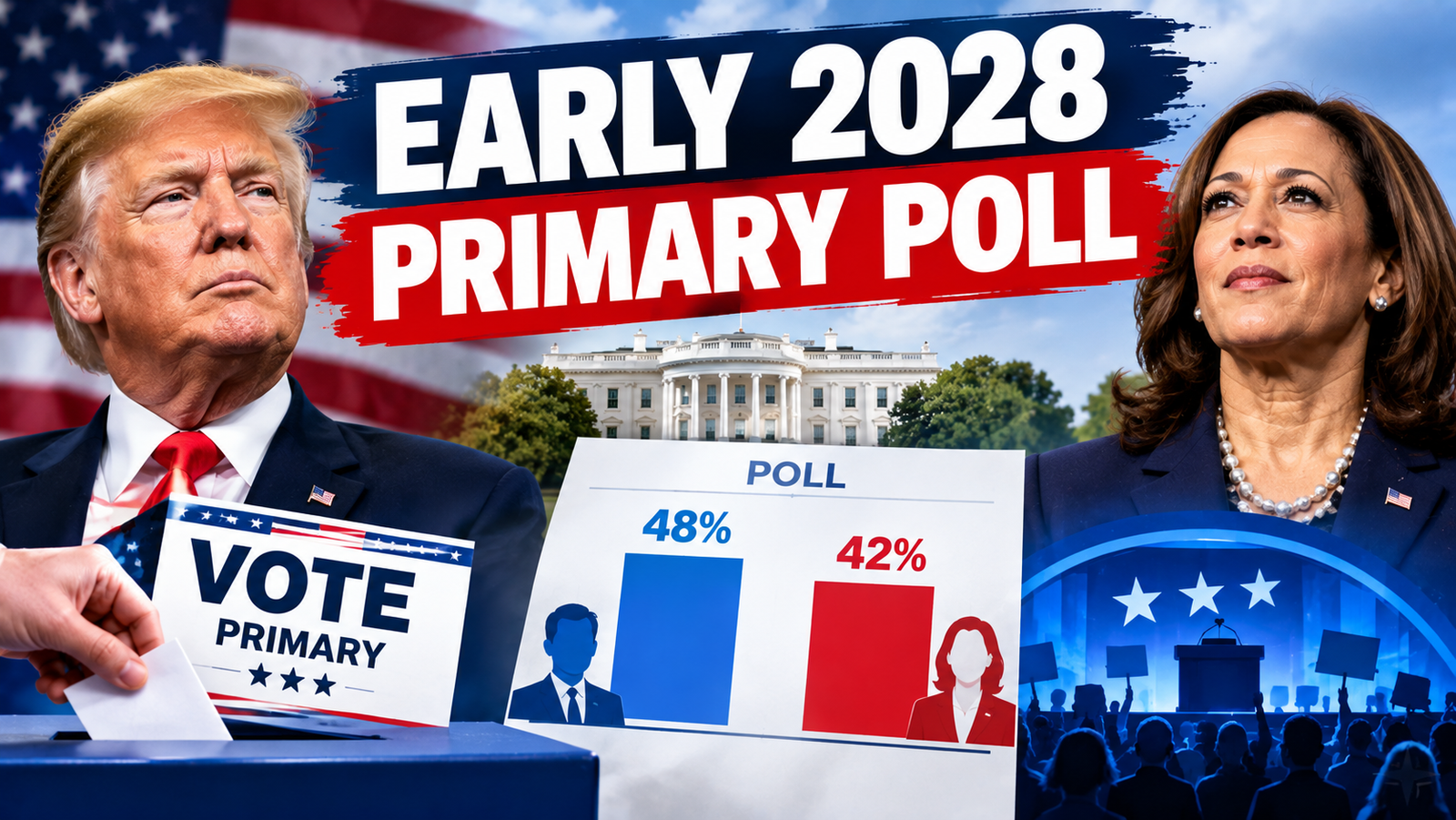
Recent polling averages show Kamala Harris leading the Democratic field and Vice President JD Vance leading the Republican field as potential 2028 presidential contenders. However, the early numbers should be viewed as an indication of current name recognition and voter preferences rather than a prediction of who will ultimately win either party’s nomination.
No major candidate has officially declared a 2028 presidential campaign at this stage. Several potential contenders are still considering whether to run, while others have not publicly ruled out a campaign.
According to RealClearPolling’s current average of national 2028 Democratic primary surveys, Harris is at 24.9%, followed by California Gov. Gavin Newsom at 14.0%, Pete Buttigieg at 12.8%, Rep. Alexandria Ocasio-Cortez at 10.7%, and Sen. Jon Ossoff at 9.1%.
On the Republican side, Vance holds a larger lead in the current polling average. RealClearPolling puts him at 39.8%, followed by Sen. Marco Rubio at 24.3%, Donald Trump Jr. at 9.0%, Florida Gov. Ron DeSantis at 7.3%, and Robert F. Kennedy Jr. at 4.0%.
The numbers make Harris and Vance the leading names in current national polling, but the 2028 primary races remain highly unsettled.
Kamala Harris Leads the Democratic Field
Former Vice President Kamala Harris currently occupies the top position in several national Democratic primary polling averages.
Real Clear Polling’s average of surveys conducted between July 19 and Sept. 21 gives Harris 24.9% support among Democratic primary voters. Newsom follows at 14.0%, Buttigieg at 12.8%, Ocasio-Cortez at 10.7%, and Ossoff at 9.1%.
Another 2028 polling tracker, which aggregates recent national surveys, places Harris at approximately 26% across the five most recent polls. Newsom averages about 16%, while Buttigieg is around 12%.
The most recent Big Data Poll cited by the tracker, conducted Sept. 13-15, gave Harris 27%, followed by Newsom at 16% and Buttigieg at 10%.
Those figures suggest that Harris currently has the strongest level of support among the names tested nationally.
But the Democratic field is much more open than a conventional primary contest would be at this stage.
The 2028 election is still distant, and potential candidates have not yet gone through the process of organizing presidential campaigns, building state operations, raising campaign money at the presidential level or participating in the eventual debate and primary calendar.
Gavin Newsom Remains a Major Democratic Contender
California Gov. Gavin Newsom is currently one of the strongest alternatives to Harris in national Democratic polling.
Real Clear Polling places Newsom at 14.0%, while other polling averages have him in the mid-teens.
Newsom’s position reflects his national profile after serving as California governor and becoming increasingly active in national political debates.
His name has appeared consistently in early Democratic presidential polling.
The September Big Data Poll put Newsom at 16%, behind Harris but ahead of several other potential candidates.
However, early polling does not establish whether Newsom will eventually run.
A presidential campaign would require a significant national political operation and would involve decisions about fundraising, messaging, endorsements, travel and early-state organization.
For now, the polling shows that Democratic voters recognize Newsom as one of the leading potential alternatives in the field.
Pete Buttigieg Remains Near the Top
Former Transportation Secretary Pete Buttigieg is another prominent name in early Democratic polling.
Real Clear Polling’s latest average gives Buttigieg 12.8%, placing him behind Harris and Newsom.
Buttigieg has remained a recognizable figure among Democratic voters since his 2020 presidential campaign.
His early 2028 polling numbers demonstrate that he retains a national base of support, although the size of that support varies considerably from survey to survey.
For example, a Quantus Insights poll conducted Aug. 26-28 placed Buttigieg at 26%, with Harris at 8% and Newsom at 7%. The result was an outlier compared with several other national surveys, illustrating the considerable volatility of early 2028 polling.
That variation is one reason analysts caution against treating a single survey as evidence of a settled primary race.
Alexandria Ocasio-Cortez Draws Significant Early Support
Rep. Alexandria Ocasio-Cortez has also emerged as one of the more prominent names in Democratic polling.
Real Clear Polling’s current average puts her at 10.7%, placing her fourth nationally behind Harris, Newsom and Buttigieg.
Her support is particularly notable because she represents a different ideological lane within the Democratic Party from some of the other leading potential candidates.
Ocasio-Cortez has developed a large national following during her time in Congress and has become a prominent voice among progressive Democrats.
However, her position in early polling should not be interpreted as confirmation that she will run.
Like other potential contenders, she has not officially launched a 2028 presidential campaign.
The Democratic primary field could change significantly if additional governors, senators or members of Congress enter the race.
Jon Ossoff and Other Democrats Remain in the Conversation
Sen. Jon Ossoff of Georgia is another name appearing near the top of early Democratic surveys.
Real Clear Polling gives Ossoff 9.1% in its current average, putting him within several points of Ocasio-Cortez and Buttigieg.
Other potential Democratic candidates include Pennsylvania Gov. Josh Shapiro, Michigan Gov. Gretchen Whitmer, Kentucky Gov. Andy Beshear, Illinois Gov. JB Pritzker and several other nationally recognized politicians.
The current polling indicates that the Democratic field is not limited to one or two possible candidates.
Instead, voters are already identifying several names as potential presidential contenders.
This broad field could become particularly important if leading candidates decide not to run.
JD Vance Leads the Republican Field
On the Republican side, Vice President JD Vance has established a substantial lead in current national primary polling.
Real Clear Polling’s average from July 19 through Sept. 21 shows Vance at 39.8%, more than 15 points ahead of Rubio at 24.3%.
Another polling tracker places Vance at approximately 40% across its latest five national Republican primary polls.
The latest Big Data Poll conducted Sept. 13-15 gave Vance 38%, followed by Rubio at 16% and DeSantis at 8%.
Vance’s position is notable because he is already serving as vice president, giving him a national platform and a prominent role in the Trump administration.
The polling advantage does not mean he has secured the Republican nomination.
It only reflects the current preferences expressed in early surveys.
Marco Rubio Is Vance’s Closest Republican Rival in Polling
Sen. Marco Rubio is currently the second-highest Republican in most national primary polling averages.
Real Clear Polling places Rubio at 24.3%, while another current tracker shows him around 20%.
Rubio has previously sought the Republican presidential nomination, running in the 2016 Republican primary.
His national profile increased further through his service in the Senate and his role in the Trump administration.
The current polling suggests Rubio remains a significant name among Republican primary voters.
However, the gap between Vance and Rubio is substantially larger in several recent polls than it was in some earlier surveys.
For example, an Emerson College survey from July showed Vance and Rubio much closer, with Vance at 39% and Rubio at 38%.
More recent surveys have generally shown Vance ahead by a larger margin.
Donald Trump Jr. and Ron DeSantis Remain Potential Factors
Donald Trump Jr. also appears in early Republican polling, although his numbers are considerably below Vance and Rubio in most recent surveys.
RealClearPolling’s average gives Trump Jr. 9.0%, while Ron DeSantis is at 7.3%.
The polling field also includes names such as Robert F. Kennedy Jr., Nikki Haley, Ted Cruz and others.
Because the 2028 field has not been formally established, the current list of names should not be considered a final candidate lineup.
Potential candidates can enter or leave the race at any time before the official primary contests begin.
Why Early Primary Polls Should Be Treated Carefully
Early presidential polling can attract considerable attention, but it has important limitations.
The first is timing.
The 2028 presidential election is still more than two years away.
The second is candidate familiarity.
Voters are much more likely to recognize politicians who currently hold national office or have previously run for president.
That can give established political figures an advantage in early surveys.
A candidate who is relatively unknown today could become much more competitive after launching a campaign.
The third issue is that many respondents may not yet have made a firm decision.
Early primary voters may name a candidate because they recognize the person’s name or have a favorable impression, rather than because they have studied a detailed presidential platform.
The 2028 Tracker explicitly cautions that early national polling mostly reflects name recognition at this stage rather than the eventual primary result.
No Major 2028 Candidate Has Officially Declared
One of the most important facts surrounding the current polling is that the major presidential field has not yet officially taken shape.
A current 2028 candidate tracker says that no major candidate has officially declared a campaign and identifies Harris and Vance as the current polling leaders in their respective parties.
That means the current numbers are better understood as an early measurement of potential candidates.
The situation could change significantly once politicians begin formally organizing campaigns.
Campaign announcements can alter media coverage, fundraising, endorsements and voter awareness.
Candidates who currently poll in single digits could gain support after becoming more visible.
Harris Has Not Yet Confirmed a 2028 Campaign
Harris’s position is particularly interesting because she has not formally announced that she will seek the Democratic nomination again.
Recent reporting indicates that she is still weighing the possibility.
Axios reported that several former Harris aides and advisers were skeptical that she would ultimately run, while others believed the possibility remained open. The report also said Harris has increased outreach to Democratic officials and activists.
The Associated Press similarly reported that Harris has been active in the 2026 midterm campaign while considering her 2028 options.
That creates an unusual situation in which the leading candidate in national Democratic polling has not yet decided whether to enter the race.
If Harris ultimately chooses not to run, the Democratic field could change substantially.
Vance’s Position Is Different
Vance is already vice president, giving him a different political position from many of the potential Democratic candidates.
His current role gives him regular national exposure and a prominent place within the Republican administration.
That visibility is reflected in early Republican polling.
The current polling average shows Vance with a lead of more than 15 points over Rubio.
However, his position will also be affected by developments during the remainder of the Trump administration.
Economic conditions, foreign policy, congressional elections and the administration’s approval ratings could all influence Republican voters’ preferences before 2028.
The 2026 Midterms Could Affect the 2028 Field
The 2026 midterm elections could become an important turning point for the eventual 2028 presidential race.
Candidates who perform strongly in the midterms could gain greater national visibility.
Governors and senators may use their campaign performances to build political networks.
Potential presidential candidates could also use the results to demonstrate their ability to mobilize voters.
At the same time, politicians associated with disappointing election results could face additional scrutiny.
The current 2028 polling therefore exists within a broader political environment that is still changing.
Trump’s Role in the Republican Primary
Donald Trump’s influence remains an important factor in the Republican Party.
Although the U.S. Constitution’s 22nd Amendment limits presidents to two elected terms, Trump cannot seek a third elected presidential term in 2028.
That creates an open Republican presidential nomination contest for the first time since before his return to the White House.
The question of who inherits Trump’s political coalition is therefore central to the early Republican primary discussion.
Vance’s position in early polling is significant in that context.
The vice president has a close political association with the current administration and is already nationally known.
But other Republicans, including Rubio, DeSantis and Trump Jr., could compete for different segments of Republican primary voters.
The Democratic Party Faces a Different Question
Democrats face a different strategic question heading into 2028.
The party will have to decide whether voters want continuity with the leadership associated with the 2024 election cycle or a new generation of candidates.
Harris’s early polling lead demonstrates that she retains substantial recognition among Democratic voters.
At the same time, Newsom, Buttigieg, Ocasio-Cortez, Ossoff and other potential candidates show that there is considerable interest in alternatives.
The eventual primary could therefore involve debates about age, ideology, governing experience, geography and the direction of the Democratic Party.
Early Numbers Show a Wide Democratic Field
The Democratic polling numbers demonstrate just how many potential contenders could remain relevant.
The current RealClearPolling average has Harris at 24.9%, Newsom at 14.0%, Buttigieg at 12.8%, Ocasio-Cortez at 10.7%, Ossoff at 9.1%, Mark Kelly at 6.8%, Shapiro at 5.8% and Beshear at 4.0%.
That distribution means a large percentage of Democratic voters are not currently committed to the leading candidate.
If several contenders officially enter the race, their campaigns could compete for the same voters and endorsements.
If some decide not to run, their supporters could shift to other candidates.
That makes the current Democratic field particularly fluid.
Republican Polling Is More Concentrated
Republican polling is currently more concentrated around the top two names.
RealClearPolling’s average gives Vance 39.8% and Rubio 24.3%, while all other tested candidates are in single digits.
The five most recent polls tracked by 2028 Tracker similarly show Vance around 40%, Rubio around 20% and Trump Jr. around 11%.
This creates a larger gap between the top two Republicans and the rest of the field than currently exists among Democrats.
But the field remains unofficial.
Candidate decisions, endorsements and political developments over the next two years could change those numbers.
Polling Does Not Predict the General Election
Another important distinction is the difference between primary polling and general-election polling.
A primary poll asks voters who they prefer within their own party.
It does not determine who would win a general election against the opposing party’s eventual nominee.
At this point, neither party has selected a 2028 nominee.
Some organizations have conducted hypothetical general-election matchups, but those surveys should be interpreted separately from primary polling.
The current primary numbers simply show which potential candidates are receiving the most support among their respective party voters.
What Could Change the 2028 Race?
Several factors could reshape the race before the first primary votes are cast.
Candidate Decisions
The biggest factor is whether the current polling leaders actually run.
If Harris does not enter the Democratic contest, the race could become considerably more competitive.
Similarly, Republican polling could change if Vance decides not to run or if additional high-profile candidates enter.
Political Developments
Events during the final years of the Trump administration could change voter preferences.
Economic conditions, foreign policy, inflation and domestic political disputes can influence how voters evaluate potential successors.
Endorsements
Endorsements from governors, senators, members of Congress and party organizations can affect early primary campaigns.
High-profile endorsements can help candidates build fundraising networks and organizational support.
Fundraising
Presidential campaigns require enormous financial resources.
Candidates who demonstrate an ability to raise money early can gain greater visibility and build larger campaign organizations.
Early-State Campaigning
The first primary and caucus states can have an outsized influence on the nomination process.
Candidates who perform better than expected in early contests can gain momentum, while candidates who struggle may face pressure to withdraw.
Why 2028 Polling Is Already Receiving Attention
Despite its limitations, early polling is useful for identifying the politicians who currently have the strongest national profiles.
The numbers also provide insight into how voters view the potential succession battles inside both parties.
For Democrats, Harris’s lead shows that she remains a significant figure even while her decision about another presidential campaign remains unresolved.
For Republicans, Vance’s lead indicates that the vice president currently has substantial support among Republican primary voters.
Neither position guarantees a nomination.
The actual primary process will involve candidate decisions, debates, fundraising, endorsements, organization and eventually voting.
Current Polling Snapshot
Based on the latest Real Clear Polling national averages available as of Sept. 25, 2026:
| Party | Candidate | Polling Average |
|---|---|---|
| Democratic | Kamala Harris | 24.9% |
| Democratic | Gavin Newsom | 14.0% |
| Democratic | Pete Buttigieg | 12.8% |
| Democratic | Alexandria Ocasio-Cortez | 10.7% |
| Democratic | Jon Ossoff | 9.1% |
| Republican | JD Vance | 39.8% |
| Republican | Marco Rubio | 24.3% |
| Republican | Donald Trump Jr. | 9.0% |
| Republican | Ron DeSantis | 7.3% |
| Republican | Robert F. Kennedy Jr. | 4.0% |
These figures represent polling averages rather than election forecasts.
What the Numbers Mean Right Now
The current polling provides a snapshot of the 2028 presidential landscape, but it does not establish the eventual nominees.
Harris has a measurable lead in the Democratic field, while Vance has a larger lead among potential Republican candidates.
The gap between the leading candidates and the rest of their respective fields is also different.
On the Democratic side, several candidates remain within striking distance of one another in early polling.
On the Republican side, Vance and Rubio currently occupy the top two positions, with the remaining candidates significantly further behind in national averages.
Those differences could influence how potential campaigns approach the next stage of the political cycle.
The Importance of Name Recognition
Name recognition is especially important in early presidential polling.
Harris has previously served as vice president and was the Democratic presidential nominee in 2024.
Vance is currently vice president.
Newsom is the governor of California, Buttigieg has run for president before and served in the Biden administration, and Rubio is a nationally known senator and former presidential candidate.
By comparison, lesser-known potential candidates may have much lower polling numbers simply because voters have not yet become familiar with them.
This is one reason early polling can change rapidly once the campaign becomes official.
Potential Campaigns Could Reshape the Field
The 2028 race will likely become much clearer after major candidates make formal decisions.
Presidential campaigns typically involve extensive travel, fundraising, advertising and direct voter outreach.
That process can significantly change perceptions.
A candidate who is currently polling at 5% could rise after a successful campaign launch, while a current leader could lose support if voters become more familiar with their record or proposals.
Therefore, current polling should be treated as a baseline rather than a final assessment.
No Nominee Has Been Chosen
Perhaps the most important point for voters following the 2028 race is that the nomination process has not begun.
The Republican and Democratic parties have not selected their nominees.
The current polling measures hypothetical preferences among potential candidates.
The actual nomination process will occur through state contests, delegates and party rules.
The eventual nominees could be among the current polling leaders, but the field remains open.
Looking Ahead to the 2028 Primary Season
As the 2026 midterm elections conclude and the country moves toward 2027, attention is likely to shift increasingly toward the presidential race.
Potential candidates will have to decide whether to enter.
Political organizations will begin building presidential operations.
Donors and activists will start choosing which campaigns to support.
Early primary states will become increasingly important.
By that point, polling may become more predictive because voters will have had more opportunities to hear from the candidates and compare their records and policies.
For now, however, the polling mainly tells us which names are attracting attention.
Conclusion
Early polling for the 2028 presidential primaries shows two clear leaders in the current national numbers: Kamala Harris among potential Democratic candidates and JD Vance among potential Republican candidates.
Real Clear Polling’s latest average gives Harris 24.9% among Democratic primary voters, followed by Gavin Newsom at 14.0%, Pete Buttigieg at 12.8% and Alexandria Ocasio-Cortez at 10.7%. On the Republican side, Vance leads with 39.8%, followed by Marco Rubio at 24.3%, Donald Trump Jr. at 9.0% and Ron DeSantis at 7.3%.
Other recent polling trackers show broadly similar patterns, with Harris leading most recent Democratic surveys and Vance consistently near the top of Republican polling.
But the 2028 race remains at a very early stage.
No major candidate has officially declared a presidential campaign, and several potential contenders have not yet decided whether they will run.
Harris’s own plans remain uncertain, with recent reporting indicating that she is weighing whether to launch another presidential campaign.
The current numbers therefore should not be interpreted as a prediction of the eventual nominees.
Instead, they provide an early snapshot of where the potential fields stand in September 2026.
The Democratic contest currently features several nationally recognized potential candidates, while Republican polling is more concentrated around Vance and Rubio.
The coming months could change the picture substantially as politicians make decisions about running, campaigns begin taking shape and voters become more familiar with the possible candidates.
For now, the clearest fact from the available national polling is that Harris leads the Democratic field and Vance leads the Republican field, while the 2028 nomination contests remain wide open and formally undecided.