
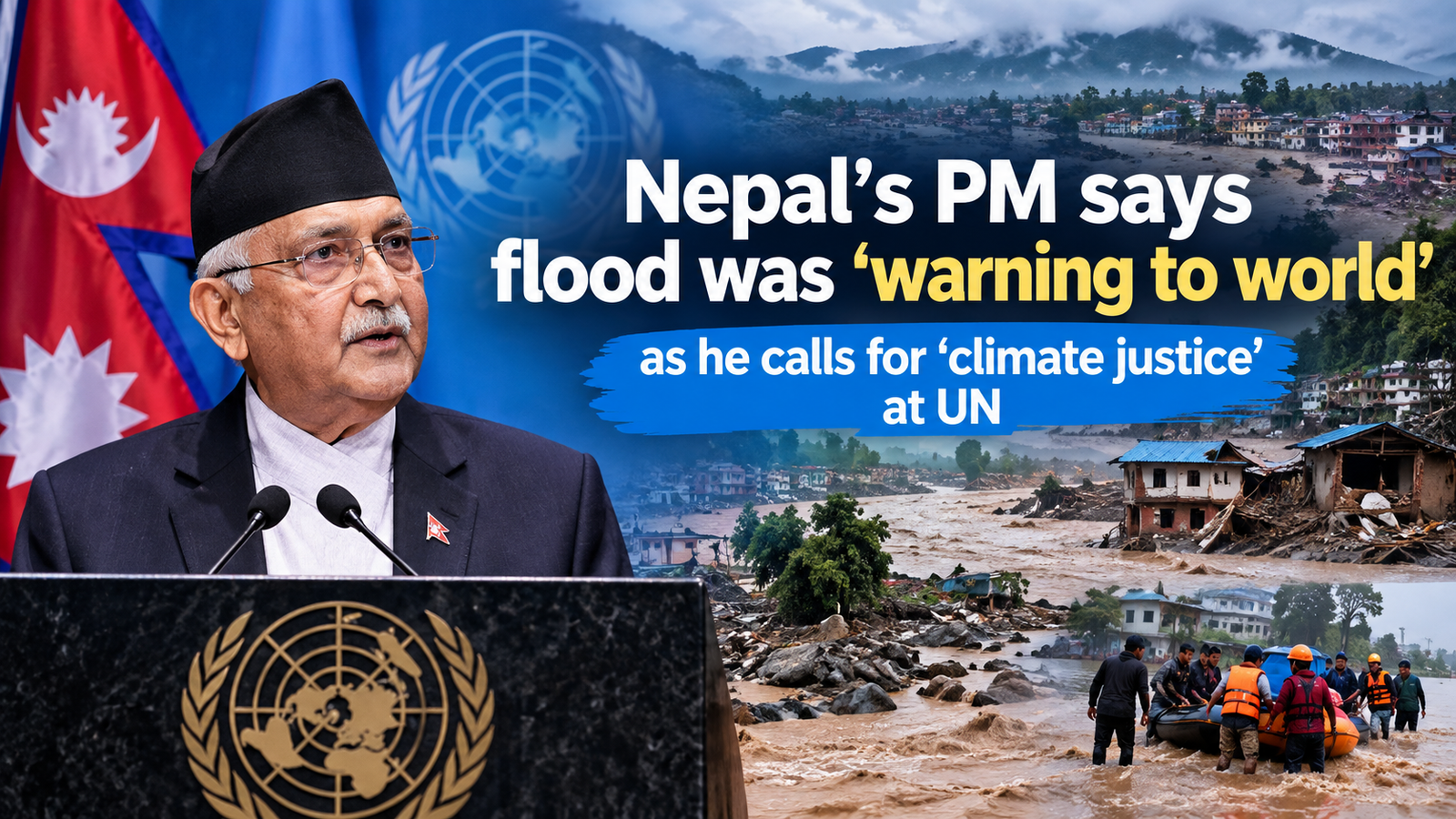
Nepal Floods Spark Climate Justice Call as PM Warns the World at UN
Nepal Floods Spark Climate Justice Call as PM Warns the World at UN
NEW YORK — September 25, 2026 — Nepal Prime Minister Balendra Shah used his first address to the United Nations General Assembly to highlight the devastating floods that struck the Himalayan nation last month, calling the disaster a “warning to the world” about the growing risks associated with climate change. Nepal Floods Spark Climate Justice Call as PM Warns the World at UN
Speaking at the 81st session of the UN General Assembly in New York on September 24, Shah urged world leaders to strengthen international climate action and provide vulnerable countries with greater financial support for disaster recovery and resilience. Nepal Floods Spark Climate Justice Call as PM Warns the World at UN
The prime minister said Nepal had contributed only a small share of global greenhouse-gas emissions while facing severe consequences from a changing climate. He argued that climate-vulnerable countries should not be forced to take on additional debt to rebuild infrastructure destroyed by climate-related disasters. Nepal Floods Spark Climate Justice Call as PM Warns the World at UN
Nepal’s Floods Became the Center of Shah’s UN Address
Shah’s speech focused heavily on the catastrophic Bhotekoshi-Trishuli flooding that affected communities in Nepal’s mountainous regions.
The disaster swept through communities, damaging roads, bridges, schools, homes and livelihoods. Nepal’s government has described the event as one of the country’s most serious recent disasters.
In his address, Shah said the flood was not simply a national tragedy but a warning about risks facing other vulnerable regions. “The Bhotekoshi-Trishuli disaster was not just a local tragedy, it was a warning to the world.”
He then challenged international leaders to consider whether the warning had been adequately heard. Nepal’s Ministry of Foreign Affairs published the remarks as part of the prime minister’s official UN address.
The United Nations has separately reported that the August floods caused extensive damage in northern Nepal, affecting tens of thousands of people and critical infrastructure. An earlier UN assessment reported 1,367 confirmed deaths and thousands of people still missing as search-and-rescue operations continued.
Shah Links Himalayan Risks to Climate Change
A major theme of Shah’s speech was the vulnerability of the Himalayan environment.
According to the prime minister, warming conditions are contributing to changes in the region’s fragile mountain environment, increasing risks associated with glacier-related hazards, floods and landslides.
He said the consequences extend beyond Nepal because Himalayan water systems and mountain ecosystems affect neighboring countries.
Nepal’s official account of the speech emphasized that climate-related hazards do not respect national borders. The country shares borders with China and India, while rivers originating in the Himalayas flow across the wider region.
The UN has also described the recent disaster as an illustration of the losses and damages being experienced by climate-vulnerable countries.
‘Climate Justice’ at the Heart of Nepal’s Appeal
Shah used his UN platform to make a broader argument about climate justice.
Nepal argues that countries with relatively low historical contributions to global emissions can nevertheless face severe economic and humanitarian consequences from climate-related disasters.
In his speech, Shah said Nepal did not create the climate crisis but was paying a significant price for its consequences.
He called for the principle of shared responsibility to be reflected in international climate financing, particularly for countries with limited resources.
The prime minister also argued that climate justice should not be limited to discussions about money. In his view, it involves questions about who bears the costs of climate-related damage and which countries and communities have a meaningful voice in international decision-making.
Nepal Wants More Grant-Based Support
One of Shah’s major requests was for international assistance that does not simply increase the debt burden of disaster-affected countries.
He argued that when climate-related disasters destroy infrastructure in poorer nations, reconstruction should not depend primarily on additional loans.
The Guardian reported that Nepal estimates its recovery and reconstruction needs following the flood at roughly 10% of its gross domestic product. Shah called for adequate grant-based international support instead of relying mainly on large loans or fragmented assistance.
The World Bank has also made emergency financing available to Nepal following the disaster, while the United States announced additional assistance for flood recovery, according to reporting cited by the Guardian.
The debate reflects a larger international discussion over how countries affected by climate-related disasters should receive financial assistance for loss and damage.
Nepal Says It Contributes Little to Global Emissions
Nepal’s climate argument is partly based on the contrast between its emissions and the scale of climate-related risks it faces.
During his UN speech, Shah said Nepal contributes less than 0.1% of global greenhouse-gas emissions while experiencing serious impacts in its mountainous regions.
The prime minister used this contrast to call for greater international solidarity.
The issue is part of a broader debate under international climate negotiations about the principle of common but differentiated responsibilities and respective capabilities, which recognizes that countries have different historical contributions and different capacities to respond to climate change.
Shah argued that countries with greater historical contributions and greater financial capacity should do more to address climate-related challenges. Nepal Floods Spark Climate Justice Call as PM Warns the World at UN
Proposed Himalayan Climate Resilience Mechanism
Nepal also presented a regional proposal during Shah’s address.
The prime minister called for the creation of a Himalayan Climate Resilience Mechanism involving Nepal, India and China.
The proposed framework would focus on practical cooperation, including satellite data sharing, glacier monitoring, early-warning systems and coordinated disaster response.
The proposal reflects Nepal’s argument that climate risks in the Himalayas cannot be addressed by one country acting alone. The region’s mountains, glaciers and river systems connect communities across national boundaries.
Such cooperation could potentially improve the ability of governments to identify emerging hazards and communicate warnings to vulnerable communities.
Thousands Remain Missing After the Disaster
The scale of the recent disaster remains a major concern.
Different reports have provided evolving casualty and missing-person figures as search and recovery operations continued.
The UN reported earlier this month that 1,367 people had been confirmed dead and 5,132 remained missing after the August floods.
More recent reporting surrounding Shah’s UN address has put the death toll at more than 1,400, while the number of missing people has remained above 6,000 in some accounts.
The changing figures reflect the continuing search and recovery process in difficult mountainous terrain.
For affected families, however, the numbers represent an ongoing humanitarian crisis rather than simply a statistical measure of the disaster.
Damage Extends Beyond Homes
The flood damage has also affected Nepal’s development infrastructure.
Shah said the disaster destroyed or damaged roads, bridges, schools, homes, farms and livelihoods.
Such losses can have effects well beyond the immediate emergency. Damaged transportation networks can restrict access to markets and medical services, while destroyed schools and public infrastructure can disrupt communities for months or years.
The prime minister argued that disasters of this scale can erase years of development progress, particularly in countries with limited financial resources.
He described climate catastrophe as both a humanitarian crisis and a development emergency for Nepal.
Climate Change and the Himalayan Region
Nepal’s position at the center of the Himalayas makes climate change a particularly important issue for the country.
The region contains extensive glaciers and provides water resources for large populations across South Asia.
Scientists and international organizations have increasingly focused attention on the effects of warming temperatures on glaciers, mountain ecosystems and communities living in high-risk areas.
Nepal has also highlighted the importance of early-warning systems and better monitoring as governments attempt to reduce the human cost of extreme events.
The recent floods have added urgency to those discussions.
A Broader Call for International Cooperation
Although climate change dominated Shah’s remarks, his speech also addressed the broader international economic and political system.
He argued that developing countries face multiple pressures, including climate disasters, supply-chain disruptions and limited access to resources needed for development.
His message was that international cooperation should extend beyond emergency relief and focus on long-term resilience.
That includes strengthening infrastructure, improving disaster preparedness, expanding climate financing and ensuring that vulnerable countries have greater participation in global decision-making. Nepal Floods Spark Climate Justice Call as PM Warns the World at UN
Why Nepal’s UN Message Matters
Nepal’s appeal comes at a time when climate-related loss and damage remains one of the most contested issues in international climate diplomacy.
Developing and climate-vulnerable countries have repeatedly called for more accessible financing after disasters, while wealthier nations have faced questions over how such funding should be structured and delivered.
Nepal’s recent disaster provides a concrete example of the challenge.
The country is seeking support not only for immediate humanitarian recovery but also for rebuilding infrastructure and improving resilience against future disasters.
The UN has previously highlighted Nepal’s call for financial compensation and described the floods as a stark example of the challenges confronting countries that contribute relatively little to climate change but face severe consequences.
Looking Ahead
Shah’s speech places Nepal’s flood disaster within a much larger international discussion about climate responsibility, disaster financing and Himalayan resilience.
The prime minister did not frame the issue simply as a request for emergency assistance. Instead, he called for a longer-term approach that combines financial support, regional cooperation, disaster preparedness and climate action.
Nepal’s proposed Himalayan Climate Resilience Mechanism could become part of that regional discussion if India and China engage with the proposal.
For Nepal, however, the immediate priority remains recovery from the devastating floods.
The country’s message at the United Nations was clear: climate-related disasters can have consequences far beyond the communities where they begin, and vulnerable nations are seeking stronger international mechanisms to prepare for, respond to and recover from those events.
As Shah told the General Assembly, Nepal’s recent experience was intended to serve as a warning. The challenge now is whether governments can translate that warning into concrete measures on climate resilience, financing and disaster preparedness.
Key Takeaways
- Nepal Prime Minister Balendra Shah addressed the 81st UN General Assembly in New York on September 24, 2026.
- He described the recent Bhotekoshi-Trishuli disaster as a “warning to the world.”
- Shah called for stronger international action on climate change and greater support for vulnerable countries.
- Nepal is seeking grant-based assistance for recovery rather than relying primarily on additional debt.
- Shah proposed a Himalayan Climate Resilience Mechanism involving Nepal, India and China.
- The UN has reported extensive loss of life, displacement and infrastructure damage following the August floods.
- Nepal’s appeal places climate justice, loss and damage, and Himalayan cooperation at the center of its international climate diplomacy.