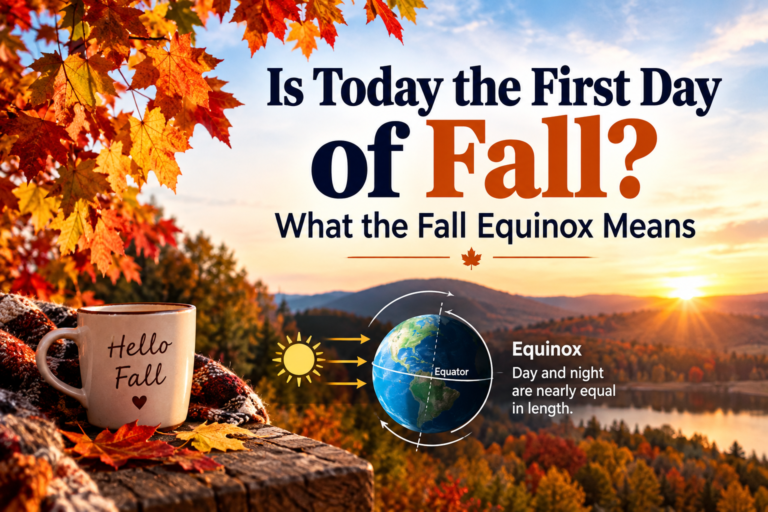
Is Today the First Day of Fall? What the Fall Equinox Means in 2026
Is Today the First Day of Fall? What the Fall Equinox Means in 2026
If you are wondering, “Is today the first day of fall?”, the answer depends on which definition of fall you use.
For people who follow the astronomical seasons, fall begins with the autumnal equinox, also called the fall equinox. In the Northern Hemisphere, the fall equinox occurs in September and marks the transition from summer to autumn.
In 2026, the September equinox occurs on September 22. That makes September 22 the astronomical beginning of fall in the Northern Hemisphere.
But there is another definition of the season. Meteorologists use a fixed calendar system, meaning meteorological fall begins on September 1 and continues through November 30.
So, depending on the system you are using, fall may have already started earlier this month—or it begins with the September equinox.
The difference comes down to how scientists and calendars define the changing seasons.
When Is the Fall Equinox in 2026?
The 2026 fall equinox occurs on September 22.
An equinox happens when the Sun crosses the celestial equator as it appears to move from north to south. This marks an important point in Earth’s yearly journey around the Sun.
For the Northern Hemisphere, the September equinox signals the beginning of astronomical autumn. At approximately the same time, the Southern Hemisphere enters spring.
The exact moment of the equinox occurs at a specific instant worldwide, but the local calendar date can vary depending on your time zone.
This is why people in different parts of the world can sometimes see different dates listed for the same astronomical event.
For most people in the United States and other locations in the Northern Hemisphere, however, September 22, 2026, is the key date for the astronomical beginning of fall.
What Is the Fall Equinox?
The word equinox comes from Latin roots associated with “equal night.”
The fall equinox is one of two equinoxes that occur every year. The other is the spring or vernal equinox, which takes place around March.
During an equinox, Earth’s axis and its position around the Sun create a situation in which neither hemisphere is tilted strongly toward or away from the Sun.
This produces a relatively balanced distribution of daylight between the Northern and Southern Hemispheres.
However, the common idea that an equinox produces exactly 12 hours of daylight and 12 hours of darkness everywhere on Earth is not quite accurate.
Several factors, including atmospheric refraction and the apparent size of the Sun, mean that the actual length of daylight is generally a little longer than 12 hours in many locations.
Still, the equinox represents an important astronomical midpoint in the seasonal cycle.
Why Does the Fall Equinox Happen?
To understand the fall equinox, it helps to understand Earth’s movement through space.
Earth rotates on its axis once approximately every 24 hours. At the same time, it travels around the Sun once every year.
The important detail is that Earth’s rotational axis is tilted by about 23.5 degrees relative to the plane of its orbit around the Sun.
That tilt is responsible for the seasons.
When the Northern Hemisphere is tilted toward the Sun, it receives more direct sunlight and experiences longer days. This corresponds to summer.
Several months later, Earth’s position in its orbit changes. The Northern Hemisphere becomes increasingly tilted away from the Sun, producing shorter days and cooler conditions.
The fall equinox occurs during this transition.
After the September equinox, the Northern Hemisphere continues moving toward its winter orientation, while the Southern Hemisphere moves toward summer.
Is September 22 Always the First Day of Fall?
No.
The astronomical beginning of fall does not always occur on exactly the same calendar date.
The September equinox can occur on September 22, 23, or occasionally September 21, depending on the year and the time zone.
This happens because Earth’s orbit around the Sun does not take exactly 365 days.
A tropical year is approximately 365.24 days long. Our calendar compensates for that difference by adding leap years.
As a result, the exact timing of astronomical events shifts slightly from year to year.
The fall equinox is therefore determined by Earth’s actual position relative to the Sun rather than by a fixed calendar date.
Why Do Meteorologists Say Fall Starts on September 1?
Meteorologists use a different system for defining seasons.
Instead of relying on astronomical events, meteorological seasons are based on groups of three complete calendar months.
In the Northern Hemisphere:
- Spring: March 1 through May 31
- Summer: June 1 through August 31
- Fall: September 1 through November 30
- Winter: December 1 through February 28 or 29
This system makes it easier for meteorologists and climate researchers to compare seasonal weather patterns from year to year.
For example, every meteorological fall contains the same three calendar months: September, October and November.
Astronomical seasons, by comparison, vary slightly in length because they are based on Earth’s position in its orbit.
So if someone asks, “When does fall start?”, both September 1 and the September equinox can be correct depending on the definition being used.
What Happens to Daylight After the Fall Equinox?
One of the most noticeable changes after the fall equinox is the gradual reduction in daylight across the Northern Hemisphere.
After the September equinox, the days generally become shorter and the nights become longer.
The change is particularly noticeable at higher latitudes.
For example, locations closer to the Arctic Circle experience much more dramatic changes in daylight than locations closer to the equator.
In the weeks following the equinox, sunrise generally occurs later and sunset occurs earlier.
This continues until the winter solstice, which occurs in December.
The winter solstice marks the shortest day and longest night of the year in the Northern Hemisphere.
After that point, daylight begins increasing again.
Are Day and Night Exactly Equal on the Equinox?
Despite its name, the equinox does not necessarily produce exactly equal periods of daylight and darkness.
There are several reasons.
First, the Sun is not simply a point in the sky. It has an apparent disk.
Second, Earth’s atmosphere bends sunlight. This phenomenon, known as atmospheric refraction, allows people to see the Sun even when its geometric position is slightly below the horizon.
Because of these effects, the date when a location experiences approximately 12 hours of daylight and 12 hours of night may occur a few days away from the equinox.
The exact timing varies with latitude.
Therefore, “equinox” should be understood primarily as an astronomical event rather than a guarantee of precisely equal daylight and darkness everywhere.
What Does the Fall Equinox Mean for the Northern Hemisphere?
For the Northern Hemisphere, the September equinox represents a major seasonal transition.
It means:
- Astronomical fall begins.
- The Sun crosses the celestial equator moving southward.
- Daylight begins decreasing overall.
- Nights gradually become longer.
- Temperatures often begin trending cooler, although local weather varies considerably.
- The Northern Hemisphere moves toward the winter solstice.
The equinox itself does not cause temperatures to suddenly drop.
Instead, it marks a point in the larger seasonal cycle.
Weather changes usually occur gradually, and the timing differs from one region to another.
What Does the September Equinox Mean for the Southern Hemisphere?
The same astronomical event has the opposite seasonal meaning south of the equator.
While the Northern Hemisphere enters fall, the Southern Hemisphere enters spring.
That means daylight generally increases in the Southern Hemisphere after the September equinox.
Spring begins astronomically, while meteorological spring has already started on September 1.
This opposite seasonal pattern exists because Earth’s axis is tilted: when one hemisphere is oriented more toward the Sun, the other is oriented more away from it.
Why Does Fall Feel Different From Summer?
The changing amount of sunlight is one of the main reasons seasonal conditions change.
During summer in the Northern Hemisphere, the Sun appears higher in the sky and remains above the horizon for more hours.
That allows a location to receive more solar energy over the course of a day.
After the fall equinox, the Sun’s apparent path shifts farther south. Days become shorter, and the Sun generally reaches a lower position in the sky.
Over time, this contributes to cooler conditions.
However, temperatures do not necessarily reach their seasonal minimum immediately after the equinox.
Land and oceans absorb and release heat gradually. This phenomenon helps explain why the coldest part of winter usually occurs weeks after the shortest day of the year, rather than exactly on the winter solstice.
Does the Fall Equinox Affect Leaves Changing Color?
The fall equinox is associated with autumn, but it is not the direct switch that causes leaves to change color.
Leaf color depends on several environmental factors, including:
- Day length
- Temperature
- Tree species
- Moisture
- Local weather conditions
As days become shorter, trees receive signals that prepare them for winter.
Chlorophyll, the pigment responsible for much of the green color in leaves, gradually breaks down.
As the green pigment fades, other pigments become more visible.
Yellow and orange colors come from pigments such as carotenoids, while red and purple colors can be produced by anthocyanins in some species.
The timing of peak fall foliage varies considerably by location and weather conditions.
Therefore, the arrival of the fall equinox does not mean every tree will immediately begin changing color.
What Is the Difference Between the Fall Equinox and the Autumnal Equinox?
There is no meaningful difference.
Fall equinox and autumnal equinox describe the same astronomical event.
“Fall” is especially common in American English, while “autumn” is widely used in British English and many other varieties of English.
You may also see the event called the September equinox.
That term is useful because it describes the event without tying it specifically to a season in one hemisphere.
In the Northern Hemisphere, the September equinox begins autumn.
In the Southern Hemisphere, it begins spring.
Why Is the Fall Equinox Important?
The equinox has been important to human societies for thousands of years.
Before modern calendars and precise astronomical instruments, observing the changing position of the Sun helped people understand the passage of the year.
Seasonal changes influenced:
- Agriculture
- Harvest schedules
- Animal migration
- Food storage
- Religious ceremonies
- Cultural traditions
- Calendars
Many cultures developed festivals and celebrations around seasonal transitions.
The modern scientific understanding of the equinox is much more precise, but the event remains culturally significant.
It is also an important reminder that Earth’s seasons are connected to the planet’s position and axial tilt rather than changes in Earth’s distance from the Sun alone.
Does Earth Get Farther From the Sun in Fall?
This is a common misconception.
Earth’s seasons are not primarily caused by Earth being closer to or farther from the Sun.
In fact, Earth reaches its closest point to the Sun, called perihelion, during the Northern Hemisphere’s winter.
It reaches its farthest point, called aphelion, during Northern Hemisphere summer.
The primary reason for the seasons is Earth’s axial tilt.
When the Northern Hemisphere tilts toward the Sun, sunlight strikes it more directly and days are longer.
When the Northern Hemisphere tilts away from the Sun, sunlight arrives at a lower angle and days are shorter.
That difference in solar energy is what produces the seasonal cycle.
When Is the Next Solstice After the Fall Equinox?
After the September equinox, the next major astronomical milestone for the Northern Hemisphere is the winter solstice in December.
The winter solstice marks the shortest day and longest night of the year in the Northern Hemisphere.
Following the winter solstice, daylight begins increasing again.
The annual cycle can therefore be summarized as:
Spring equinox → Summer solstice → Fall equinox → Winter solstice
Each event represents a different point in Earth’s yearly journey around the Sun.
Fall Equinox 2026: What Should You Expect?
If you are in the Northern Hemisphere, the 2026 fall equinox on September 22 marks the astronomical beginning of autumn.
You may notice several seasonal changes in the weeks that follow.
Sunsets will gradually occur earlier, while sunrises will generally occur later. The amount of daylight will decrease, and many regions will begin experiencing cooler temperatures.
In northern areas, trees may begin displaying stronger fall colors.
However, exactly when these changes happen depends on where you live.
Someone in northern Canada, for example, can experience dramatically different autumn conditions from someone in Florida or southern Texas.
The equinox is therefore a global astronomical event, but its visible effects are highly local.
How Can You Observe the Fall Equinox?
You do not need special equipment to appreciate the equinox.
One simple approach is to pay attention to the position of the Sun.
You can also record sunrise and sunset times around the equinox and compare them with times later in the fall.
Another option is to spend time outdoors around sunrise or sunset.
The changing angle of sunlight becomes increasingly noticeable as autumn progresses.
If you are interested in astronomy, the equinox is also an excellent opportunity to learn about Earth’s axial tilt, orbital motion and the celestial equator.
Fall Equinox Traditions and Celebrations
Seasonal transitions have inspired celebrations across cultures.
In some traditions, autumn is associated with harvest, gratitude and preparation for winter.
The equinox itself has also been connected with various cultural and spiritual observances.
Modern celebrations can be as simple as enjoying fall food, visiting a pumpkin patch, watching the leaves change or spending time outdoors.
While these traditions vary greatly, many share a common theme: recognizing a major transition in the natural year.
Frequently Asked Questions About the Fall Equinox
Is today the first day of fall?
If you are in the Northern Hemisphere and today is September 22, 2026, then yes, today is the astronomical first day of fall because the September equinox occurs on this date. Meteorologically, fall began on September 1.
When is the first day of fall in 2026?
Astronomical fall begins with the September equinox on September 22, 2026, in the Northern Hemisphere.
What time does fall officially begin?
The equinox occurs at a precise moment rather than lasting an entire day. The exact local clock time depends on your location and time zone.
Why does the date of the fall equinox change?
Earth takes approximately 365.24 days to orbit the Sun rather than exactly 365 days. Leap years and calendar adjustments cause the equinox to fall on slightly different dates.
Is the fall equinox the same as the autumnal equinox?
Yes. “Fall equinox” and “autumnal equinox” refer to the same astronomical event.
Does the equinox mean 12 hours of daylight and 12 hours of darkness?
Not exactly. Atmospheric refraction and the apparent size of the Sun mean that many locations experience slightly more than 12 hours of daylight around the equinox.
Does the equinox cause cooler weather?
The equinox marks an astronomical transition, but it does not instantly make temperatures colder. Weather changes depend on location, atmospheric conditions, oceans, land and other factors.
When does meteorological fall begin?
Meteorological fall begins on September 1 and ends on November 30 in the Northern Hemisphere.
When does astronomical fall end?
Astronomical fall ends with the December or winter solstice, when astronomical winter begins in the Northern Hemisphere.
Final Thoughts: Is Today the First Day of Fall?
So, is today the first day of fall?
If you are asking about the astronomical season in the Northern Hemisphere, September 22, 2026, marks the beginning of fall with the September equinox.
If you are using the meteorological definition, however, fall began on September 1.
Both definitions are legitimate. They simply serve different purposes.
The astronomical system connects the seasons to Earth’s position relative to the Sun, while the meteorological system divides the year into consistent three-month periods that are useful for climate and weather analysis.
The fall equinox itself is more than just a date on the calendar. It marks a major turning point in Earth’s annual cycle. From this point forward, Northern Hemisphere days gradually become shorter, nights become longer, and the planet moves toward the winter solstice.
For many people, it also signals the arrival of familiar signs of autumn—from changing leaves and cooler evenings to fall traditions and seasonal foods.
Whether you call it fall, autumn or the September equinox, September 22, 2026, is an important date in the astronomical calendar and the beginning of a new season in the Northern Hemisphere.