
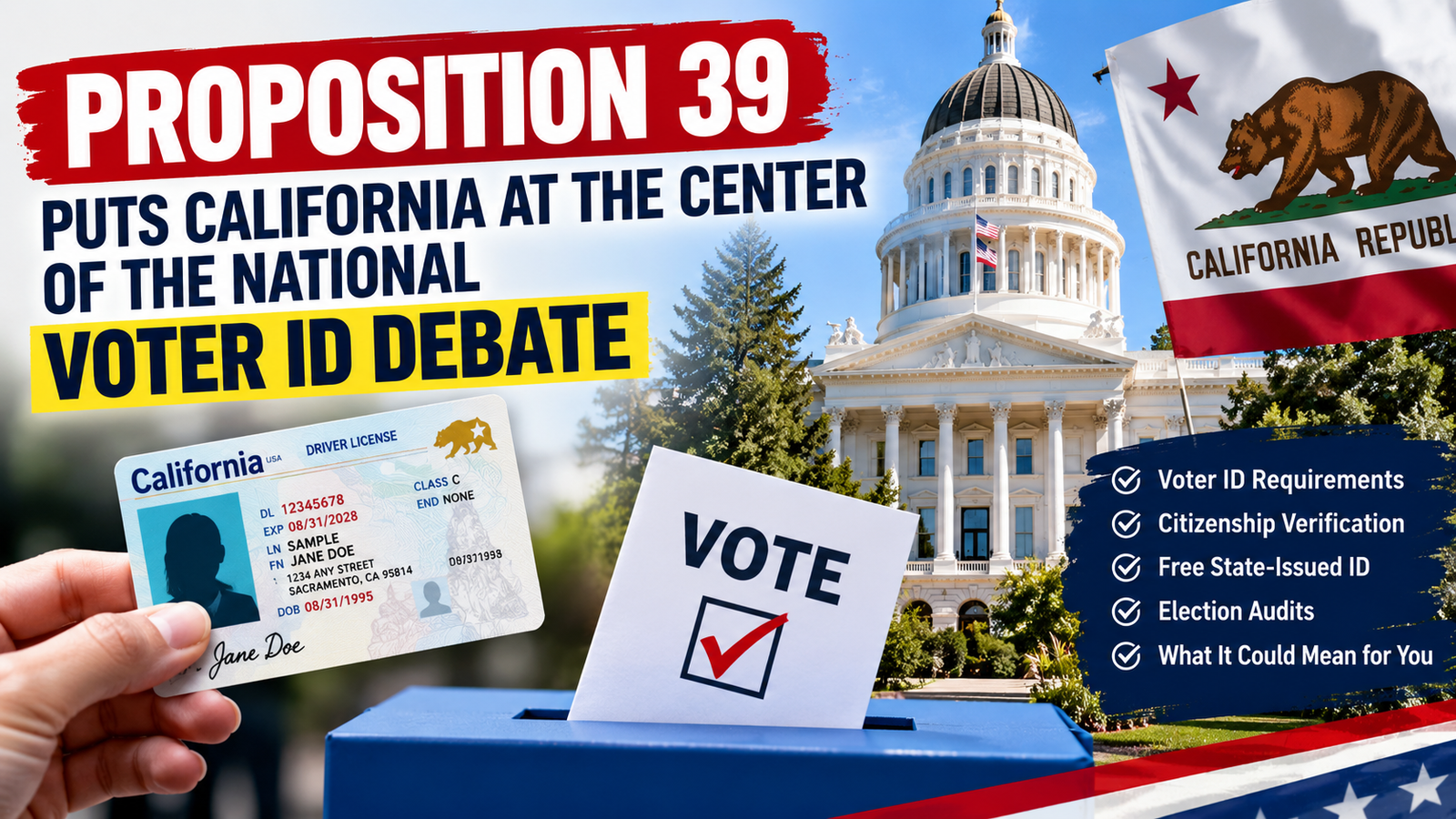
Proposition 39: California Voter ID Debate Explained
Proposition 39: California Voter ID Debate Explained
California voters are preparing to decide a major election-policy question this November as Proposition 39 appears on the state’s November 3, 2026, general election ballot.
The initiative constitutional amendment would establish new voter identification and citizenship-verification requirements in California. If approved, voters casting ballots in person would generally be required to present government-issued identification, while voters using mail ballots would have to provide the last four digits of a government-issued identification number selected during voter registration.
The proposal would also require state and local election officials to make best efforts to verify the U.S. citizenship status of registered voters using government data. Counties would have to report annually the percentage of registered voters whose citizenship status had been verified. The measure would further create a free state-issued voter identification card for voters who request one and require regular audits of compliance.
The measure has placed California in the broader national discussion over voter identification, election administration, election security and voting access.
Supporters describe Proposition 39 as a way to strengthen voter confidence and establish a standardized identification system. Opponents argue that the measure could create additional barriers for eligible voters and impose substantial administrative costs.
The official California voter guide presents both sides’ arguments but notes that ballot arguments are statements by their authors and are not independently verified by state election officials.
Table of Contents
- What Is Proposition 39?
- When Will California Voters Decide Proposition 39?
- What Would Proposition 39 Change?
- Current California Voting Requirements
- Voter ID Requirements Under Proposition 39
- How Mail Voting Would Change
- Citizenship Verification Provisions
- The Proposed Free Voter ID Card
- Election Audits and Oversight
- The Cost of Proposition 39
- Arguments From Proposition 39 Supporters
- Arguments From Proposition 39 Opponents
- Why Voter ID Has Become a National Issue
- California’s Existing Election System
- Legal and Implementation Questions
- What Happens if Proposition 39 Passes?
- What Happens if Proposition 39 Fails?
- Why the Measure Matters Beyond California
- Key Facts About Proposition 39
- Final Takeaways
What Is Proposition 39?
Proposition 39 is an initiative constitutional amendment that would add new voter identification and citizenship-verification requirements to California’s election system.
The measure qualified for the November 3, 2026, statewide ballot after gathering enough petition signatures. California Secretary of State Shirley N. Weber assigned Proposition 39 its ballot number as part of the state’s process for preparing the November election.
The official ballot title describes the proposal as:
“Prohibits Citizens From Voting Unless They Present Government-Issued Identification.”
The measure would affect both in-person and mail voting, although the identification procedures would be different depending on how a voter casts a ballot.
In addition to voter identification, Proposition 39 contains provisions dealing with citizenship verification, state-issued voter identification cards, reporting requirements and audits.
That makes the proposal broader than a traditional polling-place ID requirement.
When Will California Voters Decide Proposition 39?
California voters will decide Proposition 39 during the state’s November 3, 2026, General Election.
The proposition is one of the statewide measures scheduled to appear on the November ballot. The California Secretary of State lists Proposition 39 among the qualified statewide ballot measures for that election.
The result will determine whether California’s Constitution is amended to include the proposed identification and verification requirements.
Because California has millions of registered voters and conducts elections across 58 counties, implementation would involve state election officials as well as county election departments.
The exact administrative procedures would also depend on legislation and regulations adopted after passage.
What Would Proposition 39 Change?
Proposition 39 would make several significant changes to California’s election procedures.
According to the Legislative Analyst’s Office, the proposal would:
- Require voters to provide additional identifying information each time they vote.
- Require government-issued identification for in-person voting.
- Require mail voters to provide the last four digits of a selected government-issued identification number.
- Require election officials to verify the identifying information before counting ballots.
- Require state and local officials to make best efforts to verify voters’ U.S. citizenship using government data.
- Require annual reporting on citizenship verification.
- Create a free state-issued voter identification card for voters who request one.
- Require regular state audits of election officials’ compliance.
- Require additional legislation to fully implement certain provisions.
The measure therefore would affect voter registration, ballot casting, election administration and oversight.
Current California Voting Requirements
Under California’s current system, voters do not generally have to show identification when casting a ballot in person.
When registering to vote, Californians must declare under penalty of perjury that they are U.S. citizens and provide information used to verify their identity, such as a driver’s license number, state identification information or Social Security number.
For vote-by-mail ballots, election officials compare the voter’s signature on the ballot envelope with the signature associated with the voter’s registration record.
The current system therefore uses voter registration information and signature verification rather than requiring every in-person voter to present government-issued identification at the polling location.
Proposition 39 would add another layer of identification requirements.
Voter ID Requirements Under Proposition 39
The most visible change would involve voting in person.
Under Proposition 39, voters would be required to present government-issued identification before voting.
The measure does not simply establish one specific type of identification document. Instead, the Legislature would need to clarify some of the implementation details, including which forms of government identification would qualify.
The proposal also provides for a state-issued voter identification card.
That card would be available without charge to voters who request one.
The purpose of the free card would be to provide an identification option for voters who otherwise might not have another qualifying government-issued ID.
The exact design and distribution system would be determined through the implementation process.
How Mail Voting Would Change
California is known for widespread vote-by-mail participation, and Proposition 39 would establish a different identification procedure for those voters.
Instead of physically presenting an identification document, voters would select a government-issued identification number when registering.
When returning a mail ballot, the voter would provide the last four digits of that selected identification number on the ballot envelope. Election officials would then compare the information with the number recorded in the voter registration system.
The official state analysis gives an example of why the matching requirement matters.
If a voter designated one government-issued identification number during registration but later provided the last four digits of a different identification number on the ballot envelope, the ballot would not satisfy the proposed requirement.
That provision could make administrative accuracy particularly important for mail voters.
Citizenship Verification Provisions
Proposition 39 also goes beyond identification at the time of voting.
The measure would require state and local election officials to make best efforts to verify the U.S. citizenship status of registered voters using government data.
Officials would then have to report annually the percentage of registered voters in each county whose citizenship status had been verified.
Current California law already requires U.S. citizenship for voting in federal, state and almost all local elections.
The Legislative Analyst’s Office notes that noncitizens who vote in a state or federal election can face criminal penalties.
There are limited local exceptions in California, including special rules in San Francisco and Oakland allowing certain noncitizens who are parents, guardians or legally recognized caregivers of students to vote in school board elections.
Proposition 39 would therefore add a new verification process to the existing legal requirement.
The Proposed Free Voter ID Card
One of the measure’s provisions would require California to provide a voter identification card at no cost to voters who request one.
The card could be used as the government-issued identification needed for voting.
Supporters point to the free card as part of their argument that the proposal would maintain access for voters who do not already have another qualifying form of identification.
Opponents, however, focus on the broader requirement itself and argue that obtaining and maintaining qualifying identification can still create practical difficulties for some voters.
The effectiveness of the free-card system would depend partly on how California designs the application, distribution and replacement process.
Election Audits and Oversight
Proposition 39 would also create additional oversight requirements.
Under the measure, the California State Auditor would conduct regular audits of state and county compliance.
The audits would take place in every odd-numbered year and would evaluate how well state and county officials were implementing the measure. The auditor would also be required to make recommendations for improvement.
Supporters describe auditing as an additional layer of accountability.
Opponents question whether the additional bureaucracy and cost would produce meaningful benefits compared with California’s existing election safeguards.
The measure’s fiscal analysis estimates that the new requirements would increase state and local government costs.
The Cost of Proposition 39
The Legislative Analyst’s Office estimates that Proposition 39 would result in tens of millions of dollars to low hundreds of millions of dollars in additional state and local government costs each year.
The exact amount would depend on decisions made by the Legislature, state agencies, counties and voters during implementation.
Potential costs could include:
- Producing and distributing voter identification cards
- Updating election databases
- Developing new verification systems
- Training election workers
- Updating voter registration procedures
- Processing identification information
- Conducting audits
- Developing new administrative systems
- Educating voters about the new requirements
The Legislative Analyst’s Office says these costs would amount to less than one-quarter of 1% of California’s total General Fund budget.
The analysis also identifies potential savings from having fewer people registered to vote, such as through the removal of ineligible voters or voters who lack required identification. However, the office says those savings likely would not exceed the costs of the measure.
Arguments From Proposition 39 Supporters
Supporters of Proposition 39 argue that voter identification could increase public confidence in elections.
The official voter guide’s argument in favor says supporters view voter ID as a bipartisan election reform and contend that the measure would strengthen trust while keeping existing voting options such as mail ballots and extended polling hours.
Supporters also argue that identification requirements could improve election administration and provide another method of confirming voter identity.
They point to the proposed free voter identification card as a way to provide an identification option for eligible voters who need one.
Supporters further say the citizenship verification and auditing provisions would improve oversight of voter registration records.
These are arguments made by the measure’s supporters and should be distinguished from the state’s official description of what the measure would legally do.
Arguments From Proposition 39 Opponents
Opponents of Proposition 39 argue that the measure could create additional barriers for eligible voters.
The official voter guide lists the ACLU California Action, Common Cause and the League of Women Voters of California among the organizations opposing the measure.
Opponents argue that California already has procedures for verifying voter identity and processing ballots.
They also raise concerns about the potential administrative costs and the possibility that eligible voters could encounter difficulties if their identification information does not match election records.
Privacy is another issue raised by opponents, particularly regarding the collection and use of additional identifying information.
These arguments represent the position of the opposition campaign and organizations involved in the debate.
Why Voter ID Has Become a National Issue
Voter identification has become one of the most debated election-policy subjects in the United States.
Different states have adopted different approaches to voter identification.
Some require voters to present identification at polling places, while others use alternative methods such as signature verification, voter registration databases or other identification procedures.
The national debate involves two recurring questions.
The first concerns election security and public confidence.
Supporters of voter ID policies generally argue that identification requirements can provide an additional safeguard and reassure voters that ballots are being cast by eligible individuals.
The second concerns voter access.
Opponents of stricter ID requirements generally argue that eligible voters may have difficulty obtaining qualifying documents or complying with additional requirements.
California’s Proposition 39 brings those broader national questions into the state’s own election system.
California’s Existing Election System
California currently relies on several layers of election administration.
County election officials administer most elections. They process voter registration, distribute ballots, conduct voting and count ballots.
The Secretary of State oversees statewide election administration and provides guidance and election information.
For vote-by-mail ballots, election officials verify signatures before counting ballots.
The Legislative Analyst’s Office notes that signatures from in-person voters generally are not verified before ballots are counted in the same way that vote-by-mail signatures are.
Proposition 39 would add identification requirements to this system rather than replacing the entire election structure.
Legal and Implementation Questions
One important feature of Proposition 39 is that some details would have to be worked out after passage.
The Legislative Analyst’s Office says the Legislature would need to enact additional laws to implement the measure fully.
Those laws would clarify issues such as which forms of identification qualify and what steps election officials would have to take to satisfy the requirement to make best efforts to verify citizenship.
This means that the exact practical operation of Proposition 39 would not be determined solely by the ballot text.
Administrative rules, legislation and election procedures would play a significant role.
There have also already been legal disputes over the language used to describe the measure.
In August, a Sacramento County Superior Court judge rejected a challenge to the attorney general’s official title and summary, finding that the description accurately characterized the measure’s effects.
That legal dispute illustrates how wording has become part of the political debate surrounding Proposition 39.
What Happens if Proposition 39 Passes?
If California voters approve Proposition 39, the state would begin implementing the new requirements.
The Legislature would need to address several implementation details.
State and county election agencies would need to update systems, train personnel and inform voters about the new procedures.
California would also need to establish the process for issuing free voter identification cards.
Election officials would have to develop systems for recording the government-issued identification number selected by voters and matching the required information on mail ballots.
The citizenship-verification process would also need to be established.
Because California’s elections are administered at the county level, implementation would involve coordination between state officials and local election departments.
The exact timeline for individual changes would depend on the measure’s legal requirements and subsequent legislation.
What Happens if Proposition 39 Fails?
If voters reject Proposition 39, California’s existing voter-identification procedures would remain in place.
In-person voters would continue to use the current identification process rather than being required to present government-issued ID under Proposition 39.
Vote-by-mail voters would continue using the existing signature-verification system rather than the proposed government-ID number procedure.
The additional citizenship-verification and audit requirements contained in Proposition 39 would also not take effect.
That would not prevent the Legislature or voters from considering other election reforms in the future.
Why the Measure Matters Beyond California
California is one of the largest states in the United States, both by population and by number of registered voters.
As a result, changes to California election procedures can attract national attention.
Proposition 39 also arrives at a time when voter identification, election security and voting access remain subjects of debate across the country.
A California voter ID requirement would therefore provide another major example of how a state can approach election administration.
The measure is also notable because it combines several election policies in one constitutional amendment.
Rather than addressing only identification at polling places, Proposition 39 includes mail-ballot identification, citizenship verification, voter ID cards and state audits.
That broader structure is one reason the proposition has become a significant issue in the 2026 California election.
Proposition 39 Campaign Spending
Campaign-finance records provide another indication of the level of interest surrounding the proposition.
According to California Secretary of State records, the committee supporting Proposition 39, Californians for Voter ID, Yes on 39, had reported approximately $15.17 million in contributions through August 2, 2026.
Opposition committees had reported approximately $524,847 in contributions by the same date.
Campaign-finance totals can change as additional contributions and expenditures are reported.
They also do not, by themselves, establish whether voters support or oppose the measure.
The spending reflects campaign activity surrounding the proposition rather than an official assessment of its effects.
The Broader Debate Over Election Confidence
At the center of the Proposition 39 discussion is a broader question about how election systems establish public confidence.
Supporters argue that additional identification and verification can give voters another reason to trust the process.
Opponents argue that confidence can also depend on whether election procedures are accessible, understandable and efficiently administered.
California’s existing system already contains multiple procedures for voter registration and ballot verification.
The debate over Proposition 39 therefore involves competing views about what additional safeguards are necessary and what administrative costs are justified.
Those questions are not unique to California.
Across the United States, policymakers and voters have continued to debate the balance between election security measures and ease of access to the ballot.
Key Facts About Proposition 39
Here are the main facts voters should know about the 2026 California proposition:
Election date: November 3, 2026.
Type: Initiative constitutional amendment.
Main issue: Additional voter identification and citizenship-verification requirements.
In-person voting: Government-issued identification would generally be required.
Mail voting: Voters would provide the last four digits of a selected government-issued identification number.
Citizenship verification: Election officials would make best efforts to verify U.S. citizenship using government data.
Annual reporting: Counties would report the percentage of registered voters whose citizenship status had been verified.
Free voter ID: California would provide a voter identification card at no cost to voters who request one.
Audits: The State Auditor would conduct regular compliance audits.
Implementation: Additional legislation would be required to clarify several provisions.
Estimated cost: Tens of millions to low hundreds of millions of dollars annually for state and local governments, according to the Legislative Analyst’s Office.
Current system: California generally relies on voter registration information and signature verification rather than requiring government ID at the polls.
What Voters Will Be Deciding
Ultimately, California voters will decide whether the state’s Constitution should be amended to establish the proposed voter identification and citizenship-verification requirements.
A vote in favor would put the new identification, verification, reporting and auditing provisions into effect subject to the measure’s implementation process.
A vote against would leave the current system in place unless future legislation or another ballot measure changes it.
The official voter guide summarizes the distinction this way: a yes vote would require voters to provide additional identifying information each time they vote, while a no vote would leave voter identity established through the existing signature-based system.
The choice also comes with different policy considerations.
Supporters emphasize identification, citizenship verification, auditing and public confidence.
Opponents emphasize access, privacy, administrative complexity and cost.
The official state analysis provides the factual framework voters can use to examine those competing arguments.
Final Takeaways
Proposition 39 has made voter identification a major issue in California’s 2026 election.
The measure would represent a significant change from California’s current approach by requiring government-issued identification for in-person voting and additional identification information for mail voting.
It would also establish new citizenship-verification procedures, create a free state-issued voter identification card and require regular audits of election administration.
The proposal has attracted support from organizations and campaign groups that say stronger identification requirements could improve public confidence and election administration.
Opponents argue that the new requirements could create additional obstacles for eligible voters and impose substantial costs.
California’s official fiscal analysis estimates that implementing the measure could cost state and local governments tens of millions to low hundreds of millions of dollars annually, although the precise amount would depend on future implementation decisions.
The measure also raises practical questions that would have to be resolved if voters approve it, including which forms of identification would qualify, how free voter ID cards would be distributed, how citizenship verification would work and how counties would manage the new requirements.
With the November 3 election approaching, Proposition 39 will remain part of the wider national discussion over election security, voter identification and access to the ballot.
The final decision will be made by California voters on Election Day, with the outcome determining whether the state moves toward the proposed identification and verification framework or retains its existing system.
For voters seeking authoritative information, California’s Secretary of State and Legislative Analyst’s Office provide the official measure text, analysis, fiscal information and voter-guide materials.