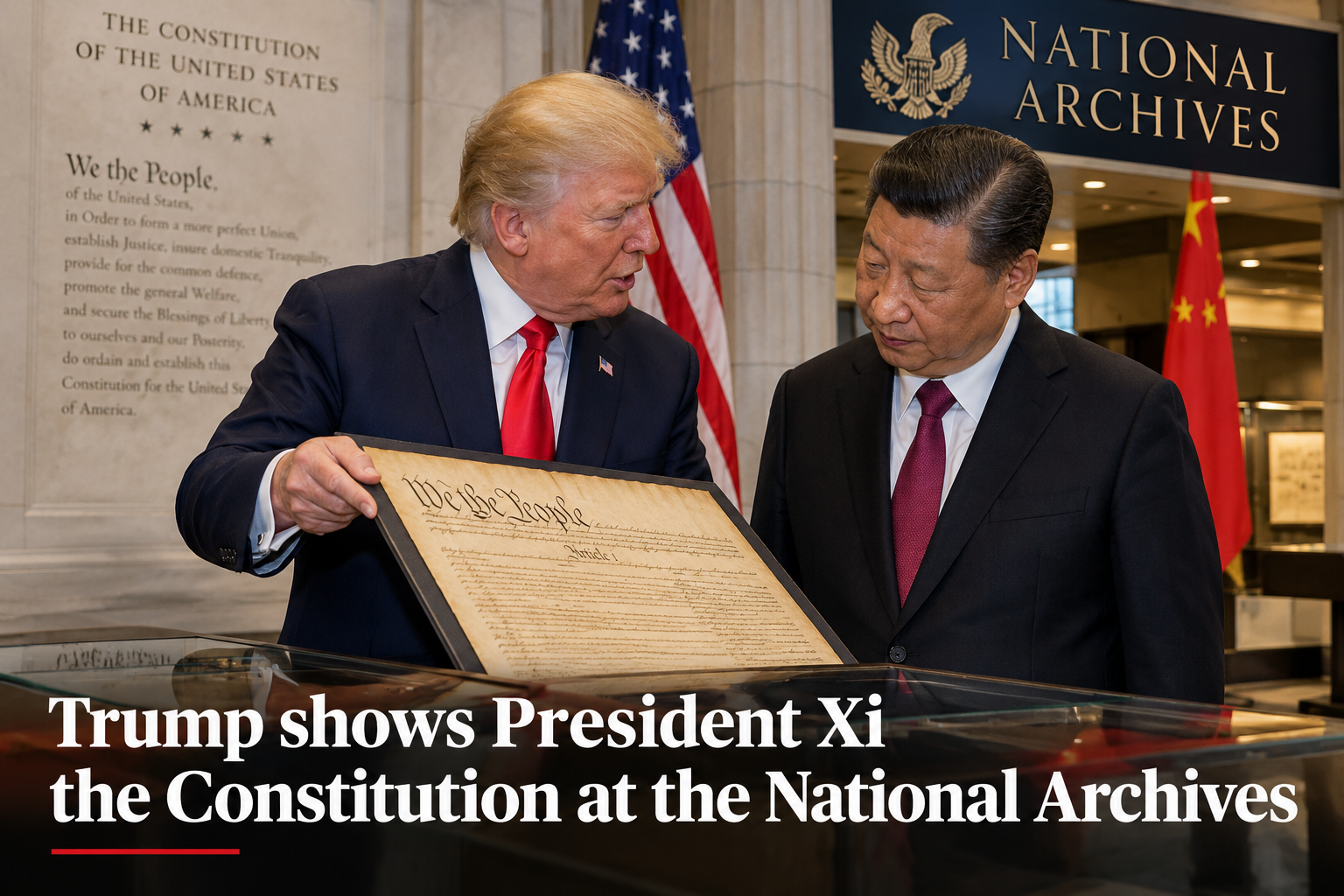
Trump Shows President Xi the Constitution at the National Archives
Trump Shows President Xi the Constitution at the National Archives
President Donald Trump and Chinese President Xi Jinping ended Xi’s three-day state visit to Washington on Friday with a highly symbolic tour of the National Archives, where they viewed some of the United States’ most important founding documents.
The visit brought the two leaders face-to-face with the U.S. Constitution, Declaration of Independence and Bill of Rights, documents preserved inside the National Archives in Washington, D.C.
Trump personally accompanied Xi through the nation’s vault of historical records. The tour came after several days of meetings, a formal state ceremony, a White House dinner and private discussions covering major international and economic issues.
The National Archives visit also took place as the United States celebrates the 250th anniversary of its founding, adding historical significance to the leaders’ appearance at the institution that safeguards some of the country’s most important founding records.
The scene was notable not only because of the documents on display but also because of the broader relationship between Washington and Beijing. The United States and China remain the world’s two largest economies, with disagreements involving trade, technology, Taiwan and other international issues.
Against that backdrop, Trump’s decision to show Xi the foundational documents of American government created a striking visual moment at the end of the Chinese president’s visit.
Xi Jinping Visits the National Archives With Trump
Xi arrived at the National Archives with Trump and their wives, first lady Melania Trump and China’s first lady Peng Liyuan.
Inside the Archives, the group viewed historic documents protected behind glass.
The Constitution was among the central documents shown to the Chinese president.
The National Archives houses the original parchment copies of the Declaration of Independence, Constitution and Bill of Rights, collectively known as the Charters of Freedom.
For visitors, the documents provide a direct connection to the early history of the United States.
For the Trump-Xi meeting, the setting provided a backdrop focused on American history rather than contemporary political negotiations.
Trump had already shown Xi a copy of the Declaration of Independence on Thursday. That document was a wall-mounted copy displayed in the Oval Office.
On Friday, the two leaders went to the National Archives itself to view the original historical documents preserved there.
Trump Compares the Histories of the United States and China
After viewing the Constitution, Trump spoke briefly with reporters about the two countries’ histories.
Trump noted that the United States was celebrating 250 years while China has a history stretching back thousands of years.
“We’re just comparing,” Trump said, according to the Associated Press.
He contrasted America’s 250-year history with China’s much longer historical record while emphasizing his pride in the United States’ anniversary.
The comments came during a tour that was deliberately focused on history and the relationship between the two countries.
The United States is marking its 250th anniversary in 2026, making historical symbolism an important part of public events this year.
The National Archives has also mounted a special exhibition connected with the anniversary.
The American Story Exhibition
The National Archives’ anniversary exhibition is titled “The American Story.”
The exhibit explores the country’s development and achievements while also presenting difficult and complicated chapters of American history.
That broader historical setting made the Trump-Xi visit particularly relevant.
Rather than simply viewing one document, the leaders were visiting an institution designed to preserve records that tell the story of the United States.
Trump had said that he wanted Xi to see some of the greatest treasures of American history.
The tour therefore served both a diplomatic and cultural purpose.
It provided the Chinese president with an opportunity to see documents that are central to America’s national identity.
At the same time, the visit gave the Trump administration an opportunity to highlight American history during a major anniversary year.
Why the Constitution Was Significant
The U.S. Constitution is the foundational document establishing the framework of the federal government.
It was drafted in 1787 and later ratified by the states.
The document established the structure of the federal government, including the legislative, executive and judicial branches.
For an international visitor, viewing the original Constitution offers a direct connection to the political history of the United States.
The Constitution is also one of the most recognizable documents preserved by the National Archives.
Trump’s decision to show Xi the document therefore had a straightforward historical meaning: it was an opportunity to introduce the Chinese leader to one of the central documents of American political history.
The visit did not itself change U.S. constitutional policy or establish a new agreement between Washington and Beijing.
Instead, it functioned primarily as part of the ceremonial and diplomatic program surrounding Xi’s state visit.
The Declaration of Independence Was Also on Display
The Constitution was not the only major founding document viewed during the visit.
The National Archives also holds the original Declaration of Independence.
The document was adopted by the Continental Congress on July 4, 1776.
It announced the American colonies’ decision to separate from British rule and became one of the most important documents in U.S. history.
Trump had highlighted the Declaration during Xi’s visit to the White House.
According to reporting from the Associated Press, Trump showed Xi a copy of the Declaration of Independence displayed in the Oval Office on Thursday.
The National Archives tour the following day provided an opportunity to see the original historical records.
Xi Also Saw the Bill of Rights
The Bill of Rights was another major document included in the National Archives display.
The Bill of Rights consists of the first 10 amendments to the U.S. Constitution.
These amendments address fundamental rights and restrictions on government power.
Together, the Constitution and Bill of Rights form a central part of the documents preserved in the Archives’ Rotunda.
Xi’s visit therefore included several of the most important records associated with the founding and early development of the American constitutional system.
The National Archives as a Diplomatic Setting
The National Archives is not normally associated with international diplomacy in the way the White House or State Department is.
That made Friday’s visit visually distinctive.
The setting placed the Trump-Xi encounter inside a museum and archival environment rather than a traditional diplomatic meeting room.
The choice also allowed the United States to showcase its history to a foreign leader.
Reuters reported that Trump and Xi’s National Archives tour was expected to emphasize the history and direction of relations between the United States and China.
Trump had also spoken about the long historical connections between the two countries.
He referenced earlier generations who crossed oceans for trade, learning and other forms of interaction.
That framing presented the relationship as extending beyond today’s disputes.
Trump and Xi’s Three-Day State Visit
The National Archives tour was the final major public event of Xi’s three-day state visit to Washington.
The visit included formal ceremonies, meetings at the White House and a state dinner.
Trump and Xi also held a private meeting lasting about 90 minutes on Thursday.
According to the Chinese government’s account of the meeting, the two leaders discussed issues including the Middle East, Ukraine and the Korean Peninsula.
Trump later told reporters that Iran was also discussed.
The White House did not immediately provide a detailed public account of the private discussions.
The Archives tour therefore came after several days of diplomacy involving both symbolic events and substantive policy discussions.
A State Dinner at the White House
Before visiting the National Archives, Xi attended a formal state dinner hosted by Trump and first lady Melania Trump.
The event brought together political figures and prominent members of the technology and business communities.
The dinner represented the ceremonial side of the state visit.
State dinners traditionally provide an opportunity for governments to demonstrate hospitality and emphasize the importance of bilateral relationships.
In the Trump-Xi visit, the dinner was particularly significant because of the importance of the U.S.-China relationship.
The two countries have extensive economic ties but also significant disagreements.
The contrast between those tensions and the highly formal reception for Xi was one of the defining features of the visit.
Tea at the White House Before the Archives Tour
On Friday morning, Trump and Melania Trump hosted Xi and Peng Liyuan for tea in the White House’s Red Room.
The gathering took place during China’s Mid-Autumn Festival.
The holiday is traditionally associated with family gatherings, tea and mooncakes.
Xi thanked the Trumps for the reception and described the visit as successful.
Trump also characterized the visit positively.
The tea was followed by the National Archives tour, giving the final day of the state visit a more informal and cultural character than the previous day’s formal summit activities.
What Trump and Xi Discussed During Their Summit
While the National Archives visit focused on history, the broader summit dealt with current international issues.
The two leaders discussed U.S.-China relations and a range of global issues.
Among the subjects reported during the visit were trade, artificial intelligence, Taiwan, Ukraine, the Middle East and Iran.
Trade remained particularly important because Washington and Beijing have spent recent years imposing tariffs and negotiating agreements designed to manage their economic disputes.
Reuters reported that the two countries had made limited progress under a bilateral trade mechanism and that additional details of the trade arrangements were expected to be released later.
The leaders also identified artificial intelligence as an area where the two countries could cooperate.
However, the summit did not resolve all major disagreements between Washington and Beijing.
Trade Remained a Major Issue
Trade has been one of the most important areas of tension between the United States and China.
The two countries have previously imposed tariffs on each other’s products.
During Xi’s 2026 visit, the two governments discussed ways to manage those tensions.
Reuters reported that Washington and Beijing agreed to extend their trade truce by two months, with the existing arrangement having been scheduled to expire later in the year.
The administration also pointed to potential benefits for American farmers and ranchers.
Additional details about specific trade arrangements were expected to emerge after the summit.
The National Archives ceremony did not resolve those economic disputes, but it provided a highly visible ending to a summit centered partly on maintaining stability between the two governments.
Taiwan Remained a Sensitive Issue
Taiwan was another major issue surrounding the Trump-Xi meeting.
China claims Taiwan as part of its territory, while Taiwan operates as a self-governing democracy.
The United States does not have formal diplomatic relations with Taiwan but maintains extensive unofficial relations and provides defense-related support under U.S. law.
According to Reuters, Xi pressed Trump on Taiwan during their discussions and urged Washington to handle the issue with what Beijing described as prudence.
Taiwan therefore remained one of the major strategic issues in the background of the summit.
The National Archives visit did not remove those differences.
Instead, it concluded a meeting in which both governments continued to manage disagreements while emphasizing stability.
Artificial Intelligence Was Another Area of Discussion
Artificial intelligence has become increasingly important in U.S.-China relations.
Both countries are competing in advanced technology, while also discussing potential risks and rules surrounding AI.
Reuters reported that Trump and Xi identified AI as an area for cooperation during the summit.
Technology also featured prominently in the state dinner, which included major figures from the technology industry.
The issue illustrates the broader complexity of the relationship.
The United States and China compete in advanced technologies while simultaneously exploring areas where cooperation may be possible.
The Symbolism of Showing Xi American Founding Documents
The decision to take Xi to the National Archives was inherently symbolic.
The Constitution represents the structure of the U.S. government.
The Declaration of Independence represents the country’s declaration of separation from British rule.
The Bill of Rights represents the first 10 amendments to the Constitution and includes protections related to individual liberties.
Showing these documents to a foreign head of state allowed the Trump administration to emphasize the historical foundations of the United States.
For Xi, the visit offered a view into documents that have shaped American political development.
The symbolism was particularly strong because Xi is the leader of a political system fundamentally different from America’s constitutional system.
However, the event itself was ceremonial rather than a formal negotiation over political systems.
America’s 250th Anniversary Added Context
The timing of Xi’s visit was significant.
The United States is celebrating its 250th anniversary in 2026.
That anniversary has generated exhibitions and public events across the country.
The National Archives has played a major role in those commemorations because of its responsibility for preserving America’s founding records.
The “American Story” exhibition places the founding documents within a broader historical narrative.
Trump’s decision to bring Xi to the Archives therefore connected the diplomatic visit with one of the biggest historical anniversaries in the United States.
Xi’s Comments About Future Meetings
The National Archives tour also came with an indication that Trump’s relationship with Xi is expected to continue through the remainder of 2026.
Xi said he expected to meet Trump two more times before the end of the year.
He invited Trump and Melania Trump to China for the Asia-Pacific Economic Cooperation summit in Shenzhen in November.
The leaders could then meet again at the G20 summit in Miami in December.
Trump indicated that he planned to attend the APEC meeting.
These future meetings would give the two governments additional opportunities to address unresolved issues.
What the National Archives Visit Did — and Did Not — Accomplish
It is important to distinguish between symbolism and policy.
The National Archives tour was an important diplomatic image and cultural event.
However, it did not by itself produce a new treaty or resolve major disputes.
The broader summit included discussions about trade, AI, Taiwan and international conflicts.
Some limited agreements and understandings emerged, while several larger issues remained unresolved.
Reuters described the summit as emphasizing personal diplomacy and stability rather than producing major breakthroughs in economic relations.
That distinction is important when evaluating the significance of the Archives visit.
Its importance was primarily historical, ceremonial and diplomatic.
A Different Kind of Trump-Xi Moment
Trump and Xi have had numerous interactions over the years, but the National Archives setting created a different kind of image.
Instead of standing behind podiums discussing tariffs or security issues, the leaders stood before documents created centuries earlier.
The setting shifted attention from immediate policy disputes to the history of the United States.
It also gave the visit a highly visual ending.
Photographs of Trump, Xi and their spouses viewing the founding documents quickly became part of coverage of the summit.
The Broader U.S.-China Relationship
The National Archives visit should also be understood within the much larger U.S.-China relationship.
The two nations have extensive trade and investment connections.
They are major competitors in technology.
They have different positions on Taiwan and several international issues.
At the same time, their economies are deeply connected, creating incentives for both governments to manage disputes.
This combination of competition and cooperation makes U.S.-China diplomacy particularly complicated.
The 2026 summit demonstrated that dynamic.
The leaders emphasized stability and future engagement while leaving many disagreements unresolved.
Why the Image of Trump and Xi at the Archives Matters
Images can become important diplomatic symbols.
A photograph of two leaders viewing a country’s founding documents can communicate a message even without a formal agreement.
In this case, the image placed the American and Chinese leaders in front of documents that represent the historical identity of the United States.
It also came after a week of highly formal diplomacy.
For the Trump administration, the tour highlighted American history during the nation’s 250th anniversary.
For Xi, it provided a final public stop before departing Washington.
The meaning of the image ultimately depends on how the broader relationship develops after the summit.
Xi Leaves Washington
After the National Archives visit, Xi and Peng Liyuan departed Washington.
The departure marked the end of a three-day state visit that included ceremonial events and high-level discussions.
Trump returned to the White House after the Archives tour.
The two governments are now expected to continue working through the issues discussed during the summit.
Future meetings later in 2026 could provide additional opportunities to evaluate whether the diplomatic engagement produces further agreements.
What Comes Next for Trump and Xi?
The leaders are expected to have additional face-to-face meetings during the year.
The APEC summit in China is scheduled for November, while the G20 summit in Miami is expected in December.
Those meetings could provide opportunities to revisit trade arrangements and other issues discussed in Washington.
The two governments also face continuing questions surrounding Taiwan, technology competition, artificial intelligence and international conflicts.
The National Archives visit therefore represents an endpoint for one summit, not the conclusion of U.S.-China diplomacy.
Final Takeaway
President Donald Trump’s decision to show Chinese President Xi Jinping the U.S. Constitution at the National Archives provided a symbolic conclusion to Xi’s three-day state visit to Washington.
The leaders viewed the Constitution, Declaration of Independence and Bill of Rights inside the National Archives, accompanied by first lady Melania Trump and Peng Liyuan.
The visit took place as the United States celebrates its 250th anniversary and as the National Archives highlights American history through its “American Story” exhibition.
The tour was only one part of a much larger summit.
Trump and Xi discussed trade, artificial intelligence, Taiwan, Iran and other international issues. The governments also indicated that additional meetings are expected later in 2026.
For Trump, the Archives tour offered an opportunity to showcase some of America’s most important historical documents.
For Xi, it provided a final cultural and diplomatic stop before leaving the United States.
The image of the two leaders standing before the Constitution will likely remain one of the most recognizable moments from the 2026 Trump-Xi state visit — a moment where modern diplomacy met the history preserved inside America’s National Archives.
Key Facts
- Event: Trump and Xi visit the National Archives
- Date: September 25, 2026
- Location: Washington, D.C.
- U.S. President: Donald Trump
- Chinese President: Xi Jinping
- Documents viewed: U.S. Constitution, Declaration of Independence and Bill of Rights
- Occasion: Final day of Xi’s three-day U.S. state visit
- Historical context: U.S. 250th anniversary in 2026
- National Archives exhibition: “The American Story”
- Next expected meetings: APEC in China and G20 in Miami
Sources
This article is based on current reporting from Associated Press and Reuters, published September 25, 2026.