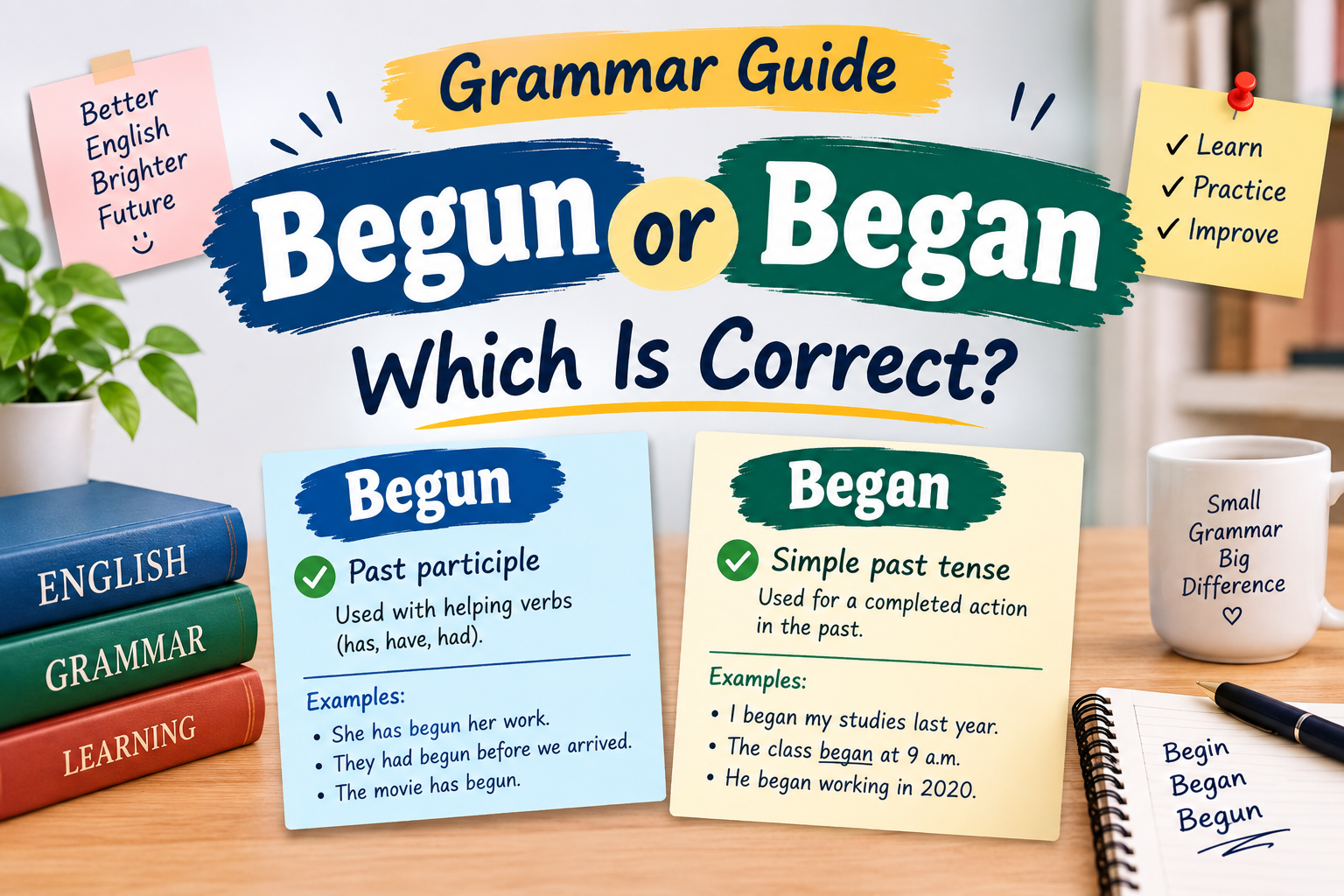
Begun or Began: Which Is Correct?
Begun or Began: Which Is Correct?
Begun or began? Both words are correct, but they are used in different grammatical situations. The main difference is that “began” is the simple past tense of “begin,” while “begun” is the past participle of “begin” and usually needs a helping verb such as “has,” “have,” or “had.”
Understanding when to use began vs. begun can make your English writing clearer and more grammatically accurate. In this guide, we’ll explain the difference between began and begun, show you how to use each word correctly, and provide plenty of easy examples.
Began vs. Begun: The Quick Answer
The verb begin has three important forms:
- Begin — present tense
- Began — simple past tense
- Begun — past participle
Here is a simple comparison:
| Verb Form | Word | Example |
|---|---|---|
| Present | Begin | I begin work at 9 a.m. |
| Simple Past | Began | I began work at 9 a.m. |
| Past Participle | Begun | I have begun my work. |
The easiest rule to remember is:
Use “began” for a completed action in the past.
Use “begun” with a helping verb such as has, have, or had.
What Does “Began” Mean?
Began is the simple past form of the verb begin. It describes something that started at a particular time in the past.
Examples of “Began”
- She began her new job last Monday.
- The movie began at 8 p.m.
- It began to rain yesterday.
- He began learning English five years ago.
- The meeting began after everyone arrived.
-
Begun or Began: Which Is Correct?
In each sentence, began describes an action that happened in the past.
“Began” in a Question
You can also use began in questions about the past.
For example:
- When did the concert begin?
- When did the class begin?
- What time did the meeting begin?
Notice something important: after did, use begin, not began.
Incorrect: When did the movie began?
Correct: When did the movie begin?
This is because did already indicates the past tense.
What Does “Begun” Mean?
Begun is the past participle of “begin.” It is generally not used by itself as the main verb in a standard sentence. Instead, it is used with auxiliary or helping verbs such as:
- has
- have
- had
- has been
- have been
- had been
Examples of “Begun”
- The show has begun.
- They have begun their journey.
- She has begun studying for her exam.
- The rain had begun before we left.
- Construction has begun on the new building.
In these examples, begun works together with a helping verb.
Began vs. Begun: The Main Difference
The biggest difference between began and begun is their grammatical function.
Use “Began” for Simple Past
Use began when talking about an action that started and happened in the past.
Example:
The meeting began at noon.
The sentence tells us that the meeting started at a specific time in the past.
Use “Begun” With a Helping Verb
Use begun when forming perfect tenses.
Example:
The meeting has begun.
Here, has is the helping verb and begun is the past participle.
Another example:
The meeting had begun before I arrived.
The helping verb had is followed by begun.
Easy Trick to Remember Began and Begun
A simple memory trick can help:
Began = past
Begun = has/have/had + past participle
For example:
- Yesterday, the game began.
- The game has begun.
- The game had begun before we arrived.
If you see has, have, or had, you will usually need begun rather than began.
Common Mistakes With Began and Begun
Many English learners confuse these two words. Here are some common mistakes.
Mistake 1: “Has began”
Incorrect: The movie has began.
Correct: The movie has begun.
Why? Because has requires the past participle, which is begun.
Mistake 2: “Had began”
Incorrect: The meeting had began before I arrived.
Correct: The meeting had begun before I arrived.
After had, use the past participle begun.
Mistake 3: “Did began”
Incorrect: When did the show began?
Correct: When did the show begin?
After did, use the base form begin.
Mistake 4: Using “Begun” Alone
Incorrect: The concert begun at 7 p.m.
Correct: The concert began at 7 p.m.
Because this sentence uses simple past tense, began is required.
Began in Example Sentences
Here are several examples showing how to use began correctly:
- The teacher began the lesson at 10 a.m.
- She began writing her book last year.
- The children began playing outside.
- The storm began late at night.
- He began working at the company in 2024.
- The ceremony began shortly after sunset.
- I began learning Spanish when I was a teenager.
- The audience began to applaud.
- The company began producing the product in January.
- The discussion began after lunch.
Begun in Example Sentences
Now let’s look at examples using begun:
- The show has begun.
- She has begun a new project.
- They have begun preparing for the event.
- Construction has begun on the new school.
- He has begun to understand the problem.
- The students have begun their assignments.
- The rain had begun before we reached home.
- The celebration has begun.
- Work has begun on the new bridge.
- The process had begun several hours earlier.
“Has Begun” vs. “Began”
Both expressions can be correct, but they communicate slightly different things.
“Began”
The meeting began at 3 p.m.
This simply tells us when the meeting started in the past.
“Has Begun”
The meeting has begun.
This emphasizes that the meeting has started and is relevant to the present situation.
For example, someone might say:
Hurry up! The movie has begun.
The important information is that the movie has already started.
“Had Begun” vs. “Began”
Had begun is used when talking about an action that happened before another past event.
Example:
The movie had begun before we entered the theater.
There are two past events:
- The movie started.
- We entered the theater.
The movie started first, so had begun is appropriate.
Compare this with:
The movie began at 8 p.m.
Here, there is no need to show a relationship between two past events.
Is “Begun” a Verb?
Yes, begun is a verb form, but more specifically, it is the past participle of “begin.”
The complete verb forms are:
Begin → Began → Begun
For example:
- I begin my work at 9.
- I began my work at 9 yesterday.
- I have begun my work.
Because “begun” is a past participle, it commonly appears with auxiliary verbs.
Began or Begun: Which One Should You Use?
If you are unsure, look at the sentence structure.
Use began when:
- You are describing a completed past event.
- You are using the simple past tense.
- There is no helping verb before the verb.
Example:
The class began at 9 a.m.
Use begun when:
- You are using a perfect tense.
- The sentence contains has, have, or had.
- You need the past participle form.
Example:
The class has begun.
Quick Grammar Test
Try choosing the correct word:
1. The concert ___ at 8 p.m.
Answer: began
2. The concert has ___.
Answer: begun
3. She ___ learning English last year.
Answer: began
4. She has ___ learning English.
Answer: begun
5. The rain had ___ before we left.
Answer: begun
This simple test shows the main difference between the two forms.
Frequently Asked Questions About Began and Begun
Is “began” past tense?
Yes. Began is the simple past tense of begin.
Is “begun” past tense?
Not exactly. Begun is the past participle of begin. It is normally used with a helping verb, such as has, have, or had.
Is “I have began” correct?
No. The correct form is:
I have begun.
Is “I began” correct?
Yes. I began is correct when using the simple past tense.
Is “It has begun” correct?
Yes. It has begun is grammatically correct because begun is used with has.
Which is correct: “The event began” or “The event begun”?
The event began is correct when using simple past tense.
You could also say:
The event has begun.
But “The event begun” is incorrect as a standard complete sentence.
What are the three forms of begin?
The three principal forms are:
Begin – Began – Begun
These correspond to the present/base form, simple past, and past participle.
Final Answer: Begun or Began?
Both began and begun are correct English words, but they cannot always be used interchangeably.
Remember this simple rule:
Begin → present
Began → simple past
Begun → past participle
For example:
I begin work at 9 a.m.
I began work at 9 a.m. yesterday.
I have begun my work.
The easiest way to remember the difference is that “began” can stand alone as the simple past form, while “begun” generally needs a helping verb such as has, have, or had.
Once you understand this pattern, choosing between began and begun becomes much easier and your English writing will be more accurate and natural.