
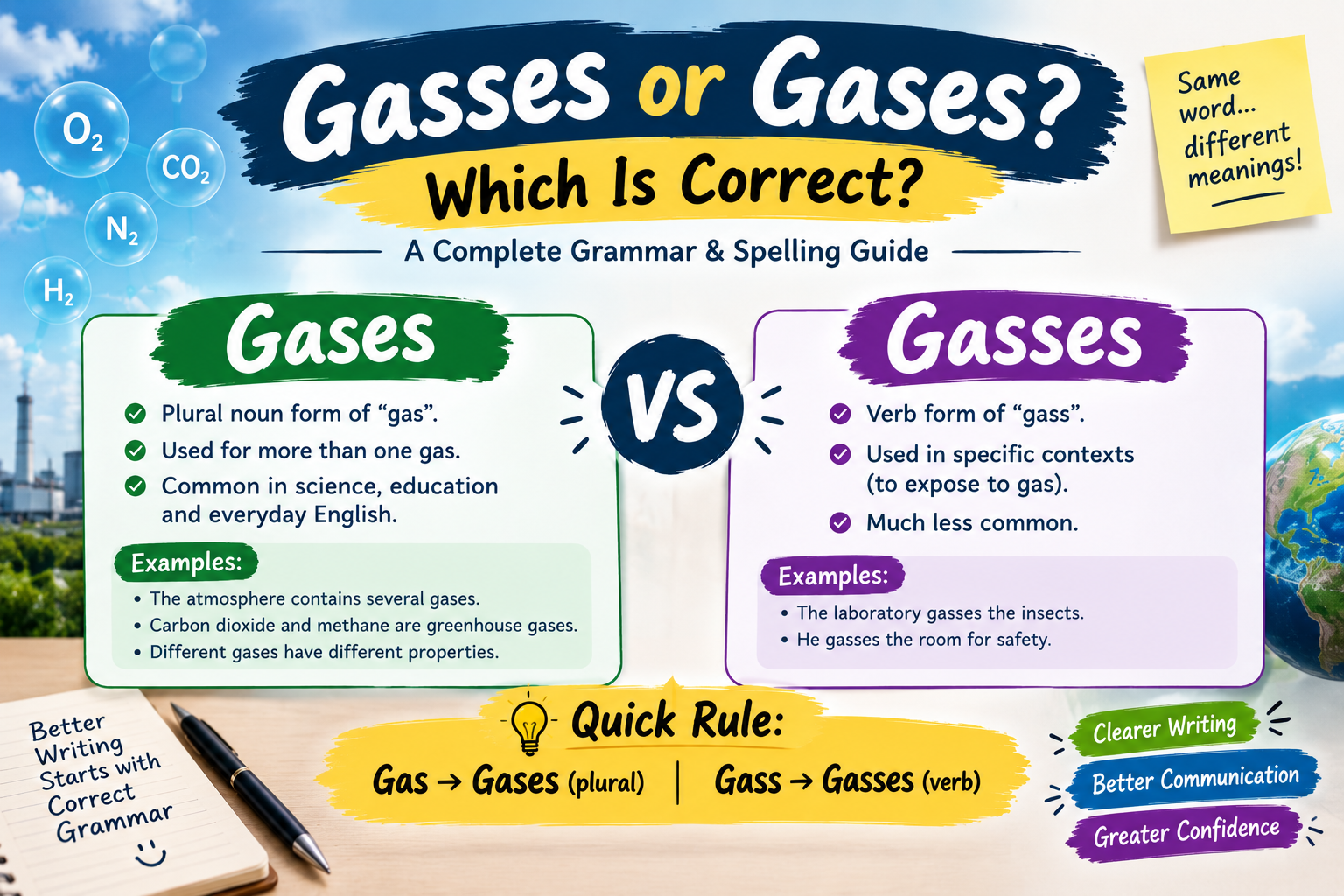
Gasses or Gases: Which Is Correct?
Gasses or Gases: Which Is Correct?
Gasses or gases — which spelling is correct? If you have ever been unsure whether the plural of gas should be written as gasses or gases, you are not alone. Both spellings can appear in English, but they do not have exactly the same usage.
The standard and most widely accepted plural spelling of gas is gases. The word gasses also exists, but it is generally used as the third-person singular form of the verb “gass” in certain contexts, especially when meaning to expose someone or something to gas.
Understanding the difference between gases and gasses can help you avoid spelling and grammar mistakes in academic writing, professional communication, and everyday English.
Gases or Gasses: The Quick Answer
When you mean more than one gas, the preferred plural form is:
Gases
For example:
The atmosphere contains several different gases.
The spelling gasses is different. It can be the verb form of gass, although this verb is less common in everyday English.
For most general writing, science articles, school assignments, and professional content, use gases when referring to multiple gases.
What Does “Gases” Mean?
Gases is the plural form of the noun gas.
A gas is one of the basic states of matter. Unlike solids and liquids, gases do not have a fixed shape or fixed volume. They expand to fill the container available to them.
Examples of gases include:
- Oxygen
- Nitrogen
- Carbon dioxide
- Hydrogen
- Helium
- Water vapor
When talking about more than one type or quantity of gas, we generally use gases.
Examples of “Gases”
Oxygen and nitrogen are important gases in Earth’s atmosphere.
Scientists study different gases in the laboratory.
Greenhouse gases can affect Earth’s climate.
Several gases were detected in the atmosphere.
In all these examples, gases is the correct plural noun
What Does “Gasses” Mean?
Gasses can be a legitimate English word, but its grammatical function is different.
It can be the third-person singular form of the verb gass, meaning to expose someone or something to gas. However, gass is relatively uncommon compared with the noun gas and its plural gases.
For example:
The chemical gasses the laboratory equipment.
Here, gasses functions as a verb rather than a plural noun.
This is why the context of a sentence is important.
If you are talking about multiple types or quantities of gas, use gases.
If you encounter gasses as a verb, its meaning is different.
Gases vs. Gasses: The Main Difference
The simplest way to understand the difference is to identify whether the word is being used as a noun or a verb.
Gases = plural noun
Different gases have different properties.
Here, “gases” means more than one gas.
Gasses = verb
The substance gasses the insects.
Here, “gasses” describes an action.
Therefore:
Gases = more than one gas
Gasses = a verb form of “gass” in specific contexts
Why Is the Plural of Gas “Gases”?
English spelling rules can sometimes be confusing because different words form their plurals in different ways.
The noun gas usually becomes gases in the plural.
Singular:
gas
Plural:
gases
The spelling changes by adding -es, rather than simply adding -s.
Similar examples include:
- bus → buses
- class → classes
- glass → glasses
- gas → gases
This makes gases the standard plural spelling in modern English.
Examples of “Gases” in Sentences
Here are several examples to help you understand how gases is used correctly.
Example 1
The Earth’s atmosphere contains several important gases.
Example 2
Carbon dioxide and methane are greenhouse gases.
Example 3
Some gases are invisible and difficult to detect without special equipment.
Example 4
Scientists analyzed the gases released during the experiment.
Example 5
Different gases react differently under pressure.
In each example, gases is a plural noun.
Common Mistake: Using “Gasses” as the Plural of Gas
A common spelling mistake is writing:
The atmosphere contains many gasses.
For standard English, the preferred form is:
The atmosphere contains many gases.
Similarly:
❌ Greenhouse gasses contribute to climate change.
✅ Greenhouse gases contribute to climate change.
❌ Several toxic gasses were detected.
✅ Several toxic gases were detected.
Although “gasses” may appear in some dictionaries or specialized contexts, gases is the normal plural form of the noun gas.
Is “Gasses” Ever Correct?
Yes, but it is important to understand the context.
Gasses can function as a verb when derived from gass.
For example:
The worker gasses the insects.
Here, the word is not being used to mean “multiple gases.” It describes an action.
However, in ordinary writing, people are far more likely to use gases when referring to multiple gases.
This distinction is especially important in scientific, educational, and professional writing.
Gases in Science and Everyday English
The word gases is extremely common in scientific writing.
For example:
The atmosphere is made up of a mixture of different gases.
Scientists may discuss:
- Noble gases
- Greenhouse gases
- Toxic gases
- Combustible gases
- Atmospheric gases
- Industrial gases
- Inert gases
In all these expressions, gases is the standard plural noun.
For example:
Helium and neon are noble gases.
Carbon dioxide and methane are greenhouse gases.
Laboratories must carefully handle potentially dangerous gases.
Gases vs. Gas: Singular and Plural
It can also help to compare the singular and plural forms.
| Singular | Plural |
|---|---|
| gas | gases |
| a gas | several gases |
| one gas | many gases |
| this gas | these gases |
Examples:
Oxygen is a gas.
Oxygen and nitrogen are gases.
This is the simplest grammatical distinction.
How to Remember “Gases” Correctly
A useful memory trick is:
One gas → many gases
Think of common words ending in -s that add -es in the plural:
- class → classes
- glass → glasses
- bus → buses
- gas → gases
If you are referring to more than one gas, gases should normally be your choice.
Gasses or Gases in Academic Writing
When writing essays, research papers, school assignments, blog posts, or educational articles, gases is generally the appropriate spelling when referring to multiple gases.
For example:
The experiment measured the concentration of several gases.
Using gasses as the plural noun may look like a spelling error to many readers.
Therefore, writers should use gases when discussing chemistry, physics, environmental science, atmospheric science, or other subjects involving multiple gases.
Frequently Asked Questions
Is “gasses” or “gases” correct?
Both forms can exist in English, but they have different uses. Gases is the standard plural noun for gas. Gasses can be a verb form of gass in specific contexts.
What is the plural of gas?
The standard plural of gas is gases.
One gas → two gases.
Is “gasses” a real word?
Yes. Gasses can be a legitimate word when used as a form of the verb gass, but it is not normally the spelling used for the plural noun “gas.”
Is “greenhouse gasses” correct?
The standard spelling is:
Greenhouse gases
“Gasses” is not the normal plural noun form in this expression.
Is “toxic gasses” correct?
In standard usage, write:
Toxic gases
because you are referring to multiple gases.
Why is the plural “gases” instead of “gasses”?
The standard plural spelling of the noun gas is gases. English pluralization often adds -es to words ending in an s-like sound.
Final Verdict: Gasses or Gases?
If you are asking how to spell the plural of gas, the best choice is gases.
Use:
Gas → Gases
For example:
The experiment produced several different gases.
The spelling gasses has a different grammatical use and can function as a verb related to gass. Because this usage is much less common, it should not normally be used as the plural of gas.
The easiest rule to remember:
Gases = plural of gas
Gasses = verb form in specific contexts
So, when writing about chemistry, science, the atmosphere, pollution, or multiple types of gas, choose gases.
SEO Metadata
SEO Title: Gasses or Gases: Which Is Correct? Grammar & Spelling Guide
Meta Description: Gasses or gases—which spelling is correct? Learn the difference between gases and gasses, with examples, grammar rules, common mistakes, and FAQs.
Focus Keyword: gasses or gases
Secondary Keywords:
gases or gasses, gasses vs gases, gases vs gasses, is it gases or gasses, plural of gas, gas plural, correct spelling of gases, greenhouse gases spelling, English spelling guide, grammar guide
URL Slug: gasses-or-gases-which-is-correct
Category: English Grammar / Education
Tags: Gasses or Gases, Gases vs Gasses, English Grammar, Spelling Guide, Grammar Guide, Learn English, English Words, Writing Tips, Correct Spelling
Featured Image Alt Text: Gasses or gases grammar guide explaining the correct spelling and usage
Featured Image Title: Gasses or Gases: Which Is Correct?
Featured Image Caption: A grammar guide explaining the difference between gases and gasses.
Featured Image Description: A professional educational graphic explaining why “gases” is the standard plural of “gas” and when “gasses” can be used as a verb.