Trump Holds Ribbon-Cutting for New White House Helipad
Trump Holds Ribbon-Cutting for New White House Helipad
WASHINGTON, D.C. — September 21, 2026: President Donald Trump officially unveiled a newly constructed helipad on the South Lawn of the White House on Monday, holding a ribbon-cutting ceremony before departing for New York to attend events surrounding the United Nations General Assembly.
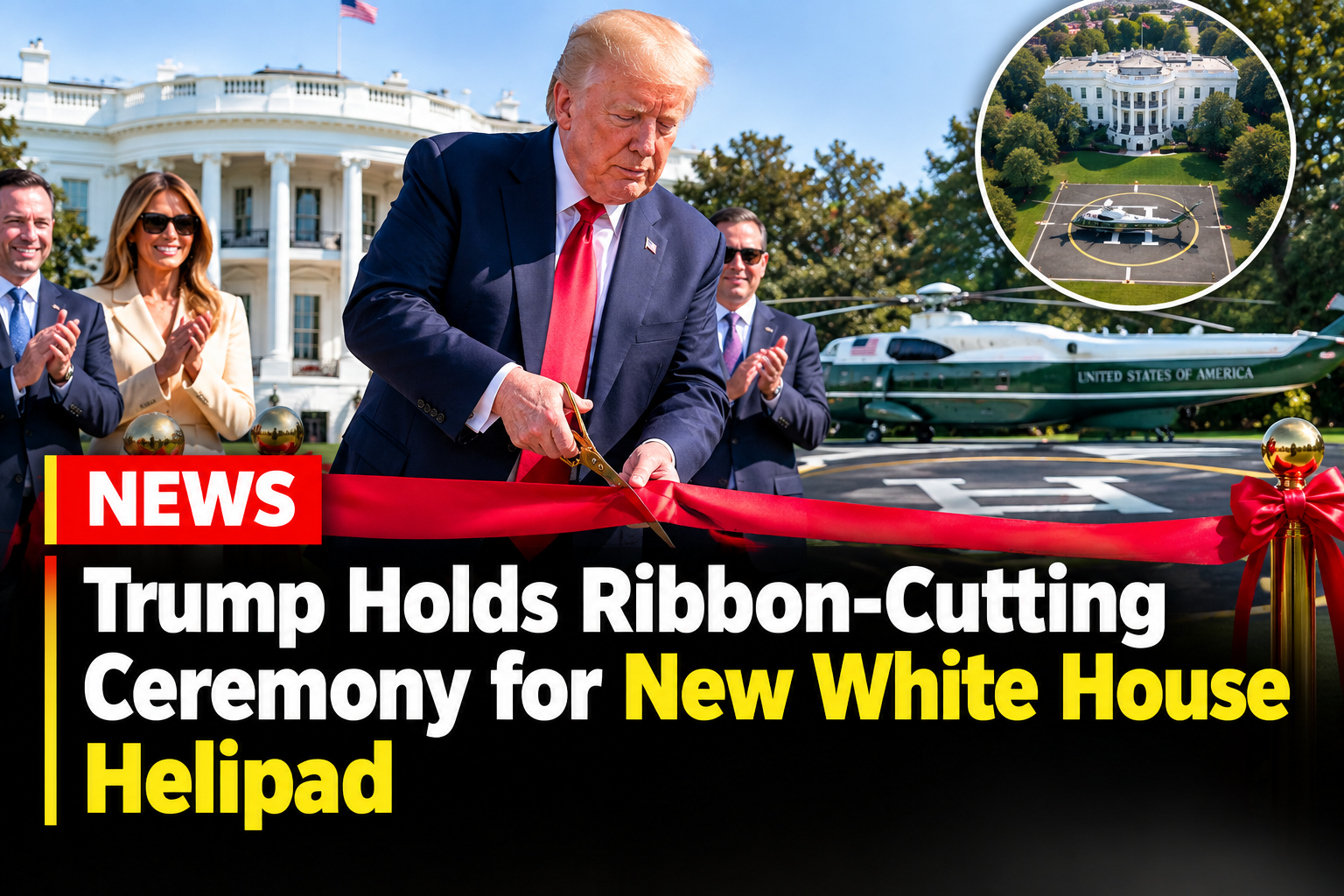
Trump used oversized gold-colored scissors to cut a red, white and blue ribbon marking the completion of the project. Construction workers and officials involved with the project stood nearby as the president showcased the new landing area before boarding Marine One. Reuters images from the event showed Trump participating in the ceremony before departing the White House.
The new White House helipad has attracted significant attention because it represents a major physical change to the historic South Lawn. The project features an extensive granite surface and a large presidential seal incorporated into the design.
The helipad was built to accommodate the newer generation of presidential helicopters and to address operational concerns associated with landing those aircraft directly on the White House lawn.
The newly completed helipad sits on the South Lawn of the White House, near the traditional area used by Marine One.
For decades, presidents have boarded helicopters from the grass of the South Lawn. The image of a president walking across the White House lawn before boarding Marine One has become one of the most recognizable scenes associated with the modern presidency.
The new facility changes that arrangement by providing a permanent, hardened landing surface.
According to reporting about the project, the helipad is constructed largely from granite and includes a large presidential seal. Earlier plans called for a seal measuring approximately 100 feet across.
The project was developed primarily around the operational needs of newer Marine One helicopters.
Why Did the White House Need a New Helipad?
One of the main reasons given for the project involves the newer VH-92A Patriot helicopters used in the presidential helicopter fleet.
The VH-92A was developed to replace older Marine One aircraft. Unlike some of the helicopters used by previous presidents, the newer aircraft have exhaust systems that direct substantial heat downward.
That created a practical problem when the helicopters landed on grass.
Officials and aviation personnel had been concerned that repeated landings could damage or scorch the White House lawn. The Washington Post previously reported that the new generation of Marine One helicopters presented a long-running challenge because of the heat produced by their exhaust systems.
A permanent landing surface therefore offered a way to accommodate the newer helicopters without repeatedly exposing the historic lawn to intense heat.
The helipad is also intended to provide a more predictable and durable surface for presidential helicopter operations.
Trump Officially Opens the Helipad
On September 21, Trump formally marked the completion of the project with a ribbon-cutting ceremony.
The president was surrounded by construction workers wearing hard hats and high-visibility clothing. Trump cut the ceremonial ribbon and then prepared to board Marine One.
The event was timed with his departure for New York, where he was scheduled to attend United Nations General Assembly-related events.
Reuters photographs showed Trump at the newly completed landing area before he boarded the VH-92A Patriot helicopter.
The ceremony provided the first major public demonstration of the finished helipad after months of construction and changes to the South Lawn.
Construction Took Place Under a Tight Deadline
Construction of the helipad began during the summer of 2026 and was accelerated as the White House prepared for a planned visit by Chinese President Xi Jinping.
Documents reported by The Washington Post indicated that contractors were asked to speed up the project and complete the work by September. The accelerated schedule required workers to operate around the clock.
The broader construction project was reported to include work beyond the helipad itself, including improvements around the South Portico and nearby portions of the White House driveway.
Trump had previously indicated that he wanted the project completed in time for the arrival of visiting foreign dignitaries.
By September 21, the helipad was ready for use.
The Granite Design
One of the most noticeable features of the project is its use of granite.
Trump had previously toured the construction site in August and showed reporters the progress. During that visit, he signed one of the granite pieces being used for the helipad.
ABC News reported that Trump described the project as a major and long-lasting addition to the White House grounds. The planned design included the U.S. presidential seal.
The granite construction gives the landing area a distinctly permanent appearance compared with the traditional grass landing zone.
The design also reflects Trump’s broader interest in construction and renovations at the White House during his second administration.
Trump Previously Changed the Helipad Design
The project did not proceed without changes.
During construction, Trump ordered modifications after raising concerns about the slope of the landing area.
The Washington Post reported in August that contractors removed portions of the developing granite seal after Trump complained about the slope of the lawn and ordered changes to the project.
During his August tour, Trump acknowledged that the changes would delay completion but said he believed adjusting the elevation was worthwhile.
The final project therefore reflects several modifications made during construction.
How Much Did the Helipad Cost?
The cost of the White House helipad has been one of the major points of public discussion.
Trump initially said the project would cost approximately $5 million to $6 million and said Sikorsky, the helicopter manufacturer, would pay for it.
Sikorsky is a subsidiary of Lockheed Martin and is involved in producing the presidential helicopter fleet.
ABC News reported that Lockheed Martin said its contribution was made to the National Park Service and that the company’s work with the administration was being handled under ethics and compliance standards.
However, reporting on the broader construction work indicated that the total cost associated with the helipad and related improvements could be higher.
The Washington Post reported that contractor documents put the broader project at approximately $13 million, including work on the nearby South Portico and driveway. The same reporting said an accelerated construction schedule added hundreds of thousands of dollars to the project.
The distinction between the cost of the helipad itself and the cost of associated construction is therefore important when discussing the project’s overall price.
Who Is Paying for the Project?
The financing of the helipad has generated questions because Trump publicly said that Sikorsky would cover the project’s cost.
In July, Trump said Sikorsky would pay approximately $5 million to $6 million for the helipad.
Later reporting clarified that Lockheed Martin’s contribution was made to the National Park Service.
The company has said its involvement was subject to ethics and compliance requirements.
Trump also previously referred to additional contributions from other sources.
Because the project involves private contributions as well as construction work associated with the federal government, questions about its financing have received considerable attention.
The Marine One Connection
The new helipad is closely connected to the modernization of the presidential helicopter fleet.
Marine One is the call sign used for any U.S. Marine Corps aircraft carrying the president.
The presidential helicopter fleet has been transitioning from older aircraft to the newer VH-92A Patriot.
The new helicopter is designed to provide modern communications, security and transportation capabilities for presidential travel.
The Marine Corps has been acquiring the aircraft for years, and the new helicopters are now becoming increasingly important to presidential transportation.
The new White House helipad provides a surface specifically designed to accommodate the newer aircraft.
Why the VH-92A Created a Problem
The VH-92A is larger and more powerful than some of the older helicopters traditionally used for presidential transportation.
Its exhaust configuration also creates a challenge for grass surfaces.
The Washington Post reported that the aircraft’s exhaust vents direct heat downward, increasing the risk of damage to the lawn.
That problem had existed for years as officials considered how to use the new aircraft around the White House.
The helipad provides a straightforward physical solution.
Instead of asking the new helicopter to land repeatedly on grass, the aircraft can land on a reinforced surface designed for helicopter operations.
A Major Change to the South Lawn
The South Lawn has been one of the most recognizable parts of the White House grounds for generations.
Presidents have traditionally used the lawn for ceremonies, public events, receptions and helicopter departures.
Marine One operations became particularly iconic because cameras frequently captured presidents walking from the White House toward the helicopter.
The permanent helipad changes the visual character of that space.
Instead of a helicopter landing directly on the grass, the aircraft now lands on a large engineered surface.
The project therefore represents both an operational change and a visible alteration to the historic White House grounds.
Trump Has Overseen Other White House Construction Projects
The helipad is only one of several construction and renovation projects undertaken during Trump’s second presidency.
Trump has frequently spoken publicly about his plans to renovate and modify portions of the White House complex.
The administration has also pursued projects involving the White House grounds, interior spaces and future event facilities.
The helipad became one of the most visible projects because it sits directly on the South Lawn.
During his August tour, Trump spent considerable time discussing the construction and speaking with workers.
The Washington Post reported that Trump appeared particularly interested in the details of the project, including the granite work and the construction schedule.
Trump Personally Inspected the Construction
Trump visited the helipad construction site before its completion.
During the August 19 tour, he signed a piece of granite that was intended to form part of the landing area.
He also spoke with construction workers and discussed the progress of the project.
Trump said at the time that he expected the helipad to remain for a long period and described the project as significant.
The president also said the facility could potentially have uses beyond helicopter landings.
According to The Washington Post, Trump suggested that the helipad could have a secondary role during events involving foreign leaders and other visitors.
The Project and Xi Jinping’s Visit
The timing of the project was closely connected to a planned state visit by Chinese President Xi Jinping.
Reports indicated that the administration wanted the helipad completed before Xi’s expected arrival in Washington.
Trump had expressed interest in having the project finished before the visit.
The construction schedule was therefore accelerated.
The Washington Post reported that contractors were required to work continuously to meet the revised deadline.
The completed helipad was ready just days before the scheduled visit.
Trump Leaves the White House for New York
After the ribbon-cutting ceremony, Trump boarded Marine One and departed the White House.
His destination was New York, where he was scheduled to participate in events surrounding the United Nations General Assembly.
The departure provided an immediate demonstration of the new facility’s intended purpose.
Instead of the helicopter lifting off from the grass, Trump boarded the aircraft from the newly completed landing surface.
Reuters documented the president participating in the ceremony before boarding the new Marine One helicopter.
Media Coverage of the Ceremony
The helipad ceremony also drew attention because of a separate dispute involving the White House and major news organizations.
The Associated Press reported that several major television networks did not provide their normal coverage of the event after CNN was excluded from the White House press pool.
CNN, MS NOW and Politico had also sued the Trump administration over restrictions on White House access.
CNN normally participates in a rotating pool that provides coverage for other major television networks.
Because CNN was excluded from the event, other networks collectively decided not to provide the usual pool coverage.
As a result, the White House relied heavily on its own video coverage of the ribbon-cutting.
Helicopter Noise Affected the Event
The helicopter itself created another unusual feature of the ceremony.
According to the Associated Press, the noise from the waiting Marine One made it difficult to hear Trump as he spoke before boarding.
The president did not answer shouted questions from reporters before entering the aircraft.
The absence of the regular press pool also meant there was no standard pool microphone positioned close to the president.
This created an unusual situation in which video of the ceremony was available while parts of Trump’s remarks were difficult to hear.
Why the Helipad Matters
From an operational perspective, the new helipad gives presidential helicopter operations a dedicated landing surface at the White House.
The project addresses concerns about the interaction between modern helicopter technology and the historic lawn.
It also gives the White House a permanent location designed specifically for presidential helicopter arrivals and departures.
The change could become particularly important as the newer VH-92A aircraft increasingly replaces older Marine One helicopters.
The Historic Image of Marine One
For nearly seven decades, presidents have been photographed boarding helicopters from the White House lawn.
Those images have become part of the visual history of the presidency.
The new helipad changes that tradition.
Future photographs of presidential helicopter departures from the White House are likely to show the aircraft sitting on the granite landing surface rather than directly on the grass.
That makes the project more than a technical upgrade.
It is also a noticeable change to one of the most recognizable spaces in Washington.
Supporters Point to Operational Benefits
The project’s supporters have emphasized its practical purpose.
The newer Marine One helicopters are significantly different from the aircraft used in previous decades.
A permanent landing surface can reduce concerns about damage to the grass and provide a more consistent operating environment.
Former Marine helicopter officials have also discussed the operational benefits of having a dedicated landing area.
The Washington Post quoted retired Marine Corps Colonel Ray L’Heureux as saying that using the capability of the new Marine One program is important for presidential transportation and security operations.
Questions About the Appearance of the White House Grounds
At the same time, the project has generated discussion about the appearance and historic character of the White House grounds.
The South Lawn is an important part of the White House’s visual identity.
A large granite helipad inevitably changes the landscape.
The Washington Post reported that some former officials and pilots had questioned how the project would affect the traditional image of Marine One landing on the grass.
The debate reflects two different considerations: the operational needs of modern presidential helicopters and the historic appearance of the White House grounds.
Trump’s Interest in the Project
Trump has personally shown considerable interest in the helipad.
During his August tour, he discussed the construction with reporters and workers and pointed out individual elements of the design.
He also signed one of the granite slabs.
The Washington Post reported that Trump expressed confidence that the project would last for a very long time.
His involvement in the project has made the helipad one of the most closely followed construction efforts on the White House grounds in 2026.
From Grass to Granite
The most obvious transformation is the change from a grass landing area to a permanent stone surface.
For previous presidents, Marine One could land directly on the South Lawn.
The new system uses a dedicated surface designed to withstand helicopter operations.
Granite was selected as a central material, giving the landing area a formal appearance consistent with other stone features around the White House.
The presidential seal further distinguishes the facility from a conventional helicopter landing zone.
A New Chapter for Marine One Operations
The opening of the helipad represents a new phase in presidential helicopter operations.
As the Marine One fleet transitions to newer aircraft, infrastructure around the White House must also adapt.
The helipad is one example of that adaptation.
The project allows the White House to use the newer helicopter fleet while reducing reliance on grass for regular South Lawn landings.
The new landing area could therefore remain part of presidential transportation operations for years to come.
What Happens Next?
With the helipad now complete, the next phase will involve regular use and integration into presidential travel operations.
The White House will continue using Marine One for short-distance presidential transportation, including trips between the White House, military installations and airports.
The new helipad is expected to make those operations easier when the VH-92A is used.
Its long-term impact will depend on how frequently it is used and how the White House manages the surrounding historic landscape.
Broader White House Renovations
The helipad is part of a wider period of physical changes to the White House complex.
Trump has pursued multiple construction and renovation projects since returning to office.
These projects have included changes to outdoor areas, landscaping and plans for additional facilities.
The helipad stands out because of its location and its connection to presidential transportation.
Other projects may have a greater effect on the physical size of the complex, but the helipad is particularly visible whenever Marine One arrives or departs.
Public Attention on the Project
The helipad has received significant media attention since its construction was first reported.
Part of that attention stems from the cost and financing questions.
Another factor is the unusual decision to create a permanent helicopter landing surface in a place traditionally associated with a grass lawn.
The project’s connection to the newer Marine One fleet has also made it relevant to aviation and presidential security discussions.
Trump’s personal involvement has further increased public interest.
A Project Completed Before a Major International Visit
The timing of the completion was especially notable.
The helipad was completed immediately before a planned visit by Chinese President Xi Jinping.
The Trump administration had accelerated construction to meet the September deadline.
The project was completed on September 21, while Xi’s expected visit was scheduled for later in the week.
That timing allowed the White House to showcase the new landing facility just before a major international diplomatic event.
Final Takeaway
President Donald Trump’s ribbon-cutting ceremony for the new White House helipad on September 21 marks the completion of one of the most visible construction projects on the White House grounds in 2026.
The granite landing area was designed primarily to accommodate the newer VH-92A Marine One helicopters and address concerns about helicopter exhaust damaging the historic South Lawn.
The project was constructed under an accelerated schedule, with work continuing around the clock to meet a September deadline. Reporting has placed the cost of the broader construction work above the initial estimate for the helipad itself, while Lockheed Martin has confirmed that its contribution was made to the National Park Service.
Trump officially opened the facility by cutting a red, white and blue ribbon before boarding Marine One for his trip to New York and United Nations General Assembly-related events.
The new helipad changes a familiar part of presidential tradition. For decades, presidents have boarded Marine One from the White House lawn. Now, the newer generation of presidential helicopters has a dedicated granite landing surface.
The project also illustrates the challenge of balancing modern presidential transportation requirements with the historic appearance of the White House grounds.
As the VH-92A becomes a more regular part of presidential travel, the new helipad is likely to become a permanent feature of White House operations.
For now, the September 21 ribbon-cutting marks the official beginning of that new era, with Trump becoming the first president to formally open and use the newly constructed South Lawn helipad.